
Embrace the Suck!

No one wants to work hard for anything anymore.  It’s true.  Take a look around at our modern culture.  Instant satisfaction is everywhere from fast food to movies on demand.  We literally have to wait for nothing.  And, while the convenience is great and quite useful for the most part, it has also has had a deleterious effect on our lives that is sometimes overlooked or unseen.  It has eroded our patience and destroyed our work ethic – at least when it comes to the really hard stuff like physical development and skill acquisition.  Why?  Because these things are not and cannot be had instantaneously.  They require consistent practice and drive.  I mean, c’mon they now have pills to take that burn fat while you sleep?  Are you kidding me?  How lazy can we be?  By the way though, if you get your diet correct and even skip a meal once in a while, you will burn fat while you sleep without the damn pills, but that’s another blog post….

As you may have noticed, martial arts training and conditioning to develop the proper levels of fitness, mechanics, technique, attributes, and that  all elusive sense of flow can be difficult, repetitious, and sometimes downright boring, to be honest.  So how do we keep going in our daily training?  How do we push ourselves through the plateaus and dry spots with enough intensity and consistency to break through to our own personal greatness? (See what some of the historical martial greats had to say about it in this article here.)  My advice is to embrace the suck – yeah, the suck.  Learn to love it.  Crave it.  Become friends with it.  So when it hits, you not only can push through it, but actually embrace it.

Dostoyevsky said to “love your suffering.”

The Chinese martial artists call it, “eating bitter.”

We here at Warrior Fitness call it “embracing the suck!”

Does this make you weird?  Well, yes, but only in some circles.  But for the most part it earns you respect.  Why?  Because most people can’t do it.  Being able to embrace the suck and keep going  distinguishes you.  It differentiates you from the pack.  It makes you a leader.  If you want to be a leader, there’s only one way to do it – lead from the front.  That’s the only way to inspire people – by your own example.  What example do you set for your students, your family, your friends, your kids?

Learning to embrace the suck allows you to, as the great method acting coach Stanislavsky once wrote, “make the difficult habitual: what is habitual will become easy, and what is easy will become agreeable.”  So even embracing the suck is a process which allows us to continue to train with greater intensity and focus, and thus push through even greater levels of suck.

However, the best part about embracing the suck is when the suck ends and you come out on the other side.  You’ve fought the good fight, pushed through the barrier, and overcome the adversity once again.  You’re a stronger person for it.  You know it.  I know it.  So go out and live it!
The Warrior Fitness Guide to Striking Power is Here!

by Jonathan Haas, founder of Warrior Fitness Training Systems

  • Specific Physical Preparedness for ALL striking arts from old school Traditional Martial Arts to modern MMA!
  • Learn how to build a powerful structure to stabilize punches, kicks, and martial movement!
  • Discover how to use low-tech, high yield tools to strengthen strikes throughout a range of motion!
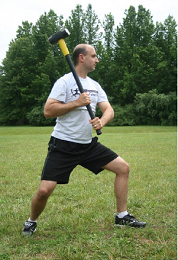
  • Sledge Hammer for force production, rotational strength, grip strength, and old school conditioning!
  • Medicine Ball for explosive strength and rotational strength!
  • Resistance Bands for force production, rotational strength, increased stabilization!
  • Bodyweight Exercise and Isometrics for structure and stabilization!
  • Discover how to use Intelligent Tension rather than general tension to power strikes!
  • Learn Breathing and vibration exercises for recovery and restoration!
  • Over 50 pages of pure, 100% actionable content – no fluff, no BS, no filler!
  • Sample Workouts!

Buy Now for only $15 USD!!

Buy Now

Warrior Fitness Guide to Striking Power is a downloadable e-book. No physical products will be shipped. After you order, you will get INSTANT ACCESS to download the e-book and all the bonus reports onto your computer. The e-book format is adobe acrobat PDF, which can be viewed on Mac or PC.

Special Offer – Warrior Fitness Book + T-Shirt!

Special Combination Offer

(good while supplies last!)


Pick up a copy of the book,


Warrior Fitness: Conditioning for Martial Arts, and


a Warrior Fitness T-Shirt for only $29.95!!


Warrior Fitness Book + T-Shirt (size)

Warrior Fitness 4th of July Workout Challenge

Looking for a way to justify all the upcoming holiday weekend festive food and alcohol consumption?  Try spicing up your  4th of July weekend with an intense workout or 2 to (maybe) balance it out.  Here are 2 different hardcore challenge workouts that you can do pretty much anywhere with just your bodyweight and a pull-up bar.  No pull-up bar, no problem – go outside and use a tree branch!


Strength Endurance Workout

100 Bodyweight Squats

100 Push-ups (break up into as many variations as you like: fist, finger tip, wrist, hindu, etc.)

100 Mountain Climbers

OR

Conditioning Workout

10 Pull-ups (any variation you like)

10 Burpees

10 Ichimonji Jump Squats (switch sides each round)

10 V-ups

Complete as many rounds as fast as possible in 15 minutes.

Good luck and have a happy, healthy, and safe 4th of July weekend!

Hone Your Mind, Invigorate Your Spirit, and Make Fierce the Body with Warrior Fitness!


Ninja Endurance – Part II

In part one of Ninja Endurance called,  How to Train for the Endurance of a Ninja, we discussed strength endurance and I provided a sample workout to help you build yours.  Here in part 2, I ‘d like to delve a little deeper into the whys of endurance training and how specifically high intensity interval training is an excellent choice for it.

What is Endurance?

Endurance is defined as being able to keep going without fatigue setting in, or being able to push oneself through fatigue.  Essentially, it is the ability to resist or bear fatigue.  What is fatigue?  Fatigue is weariness or exhaustion from exertion, or the temporary loss of power to respond.  An equally critical corollary to the definition of endurance, especially for the warrior,  is that your level of endurance also determines how quickly you are able to recover between bouts of activity.  Combat, like life, does not happen at one constant rate of speed.  It is multi-faceted in nature.  There will be periods of brutally intense activity followed by lulls in the action, again followed by another flurry of activity.  Being able to use those lulls in action to recover is a critical ability for the warrior.

Steady state cardio, Long Slow Distance (LSD) training simply will not cut it.  Running on a treadmill may be appropriate for a hamster in a cage, but human beings require more.  Long distance running can be beneficial for mental toughness and/or active recovery, but it should not be the primary focus of a warrior’s endurance training.  So then how should we train to maximize our ability to endure?

Warriors Need to HIIT!

High Intensity Interval Training (HIIT) is one of the best ways to train for endurance.  It will enhance all 3 energy systems in the body (2 anaerobic and 1 aerobic – see here for an overview), as well as prime the nervous system to recover automatically during lulls in activity.  Simply put, HIIT alternates periods of high intensity exercise with periods of rest and recovery.  It can be performed with almost any exercise and can be utilized both with and without equipment.  The variety and adaptability of this style of training is second to none in results.

How else does improving your endurance through this type of conditioning aid your martial arts training?  I’m glad you asked!  If the benefits discussed above weren’t enough, consider that having a high level of conditioning also aids in learning new skills.  How’s that possible?  To put it simply, when the central nervous system (CNS) is fatigued, the body cannot effectively process new skills, especially technically advanced skills.  So, in essence your lack of a general level of fitness and conditioning will actually impede your learning process as you will tire more readily and not have the ability to recover quickly enough during training.  Want to train more, at a higher level, for a longer period of time?  Want to get more out of your training time both at home and in the dojo?  Want to build new skills and enhance your technical arsenal?  Get yourself in shape!

There are several sample conditioning workouts here on the Warrior Fitness site.  Here are a few examples:

Workout of the Week #1


Workout of the Week #5


Stay tuned for more Warrior Fitness style conditioing workouts to help you get and stay in fighting shape!

Ukemi Flow Conditioning Workout

This one is for all the martial artists out there –  I created the following ukemi conditioning workout for myself a few years ago to specifically target the transitions between my rolls and begin to unlock flow.  Additionally, it has the effect of really getting your heart pumping and makes a great workout!  Start out slowly and smoothly by practicing for the first few rounds.  Groove the movement and then begin to increase the speed.  Remember, you do yourself and your training a disservice if you rush through the movements simply to say you accomplished the workout.  Flow is not something you do, it’s something you allow – you have to be able to get out of your own way!  That being said, give this a try and let me know how it works for you.

Ukemi Flow

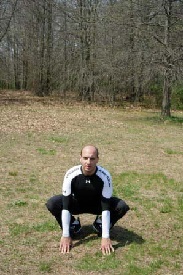
  1. Begin in Shizen No Kamae (natural stance), squat down to ball of foot squat
  2. Zenpo Kaiten (front roll) over the right shoulder
  3. Ushiro Kaiten (back roll)
  4. Stand up into Shizen No Kamae (natural stance), squat down to ball of foot squat
  5. Zenpo Kaiten (front roll) over the left shoulder
  6. Ushiro Kaiten (back roll)
  7. Stand up into Shizen No Kamae (natural stance)
  8. Yoko Nagare (side roll) with the leg crossing in front to the right
  9. Yoko Nagare (side roll) with the leg crossing in front to the left
  10. Stand up into Shizen No Kamae (natural stance)
  11. Zempo Ukemi (forward break fall)
  12. Stand up into Shizen No Kamae (natural stance)
  13. Yoko Nagare (side roll) with the leg crossing behind to the right
  14. Yoko Nagare (side roll) with the leg crossing behind to the left
  15. Stand up into Shizen No Kamae (natural stance) – repeat!

Start out with 4 rounds of 3 minutes each with a 1 minute break between rounds.  Use the minute break to get your breathing back under control and shake out the tension.  When this becomes easier, decrease the rest period to 30 seconds between rounds. Finally, try to perform the Ukemi Flow continuously for 12 minutes.  You can also adjust the difficulty level of the flow by adding directional leaps at the end of each roll.  Or, it can be made easier by performing it from kneeling in Seiza no Kamae instead of standing.

Notes: Make sure you warm-up with brief joint mobility session prior to the workout.

Got your own version of an ukemi-specific workout?  Please share with us in the comments section below!

Warrior Fitness Workout of the Week #5

8 is Enough!

This week’s Warrior Fitness Workout of the Week:

  • 8 Pull-ups
  • 8 Burpees
  • 8 Mt. Climbers (left + right = 1 rep)
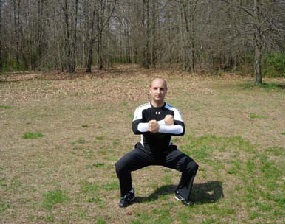
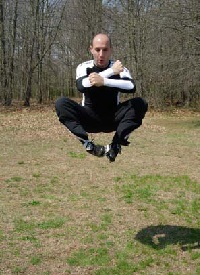
  • 8 Jumonji Squat Jumps
  • 8 Dumbbell Swings (4 each arm)

Complete 8 rounds as fast as possible.  Rest as needed.

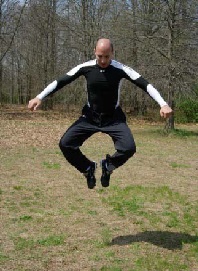
Jumonji Squat


Jump!


Modifying Your Workout

Conditioning workouts are supposed to suck.  No doubt about it!  They push your body to its limits and increase mental toughness.  However, they should be approached incrementally, especially if you are not used to them.  In this particular workout, I’d recommend that beginners cut the volume of repetitions in half.  If you still find you are struggling, increase the rest period between rounds; try not to rest in between exercises, if you can help it.   Additionally, you may perform 4 rounds to start and work your way up to 8.  As you gain confidence and begin getting stronger, you can increase the number of repetitions and rounds, and decrease the rest periods.  Change one variable at a time so you are not forcing your body to adjust too rapidly.  Remember, injury is not the goal!

Notes: Make sure you warm-up with brief joint mobility session prior to the workout.  Remember that when you sign up for our mailing list you receive a free sample chapter on Joint Mobility from my Warrior Fitness book!

For further information on the Workouts of the Week, please see our User Guide here.


Breathing 101

I was planning to title this post, “Breathing for Dummies” after the famous how-to guides, but I realized most dummies aren’t interested in bettering their health, fitness, and extending longevity in their sports, martial arts, or activities.  Plus, I dislike the subtle insult of refering to my readers as “dummies”.  Nor would I want dummies for readers anyway.  So instead today we will go over Breathing 101.  These are what I consider to be the most effective ways to integrate breathing exercises into your daily training, and use them to increase lung capacity and efficiency of how your body processes oxygen.  We will look at several different exercises that will enable you to lower your heart rate, blood pressure, and stress levels, as well as to increase energy.

Breathing as a Bridge

You may not be aware that breathing is a bridge between our voluntary and autonomic nervous systems.  Meaning breath is plugged into both.  The autonomic system will keep you breathing continuously without your conscious control, or sometimes, without even your awareness of it going on.  But, you also have the power to override that control and decide at any moment to take a deep breath or hold your breath.  What does this mean to you though, right?  Well, here’s what it means, you have the power, at any time, to consciously choose to influence things like your heart rate and blood pressure which are not under your conscious control.  Now that’s fascinating to me!  Because breath is tied into both systems it can be used like a bridge to gain access to aspects of your body that you cannot directly control.  How do we do this?

Try This Experiment

Take your pulse.  Count beats for 10 seconds then multiply by 6.  If you’re sitting and relaxed, that number should be your resting heart rate.  Now, inhale as deeply as possible and hold your breath and tense your whole body for a few seconds.  Are you red in the face?  Take your pulse again.  What happened?  Your hear rate jumped up and your blood pressure spiked right along with it, right?  Now try exhaling for a count of 6, but don’t inhale yet.  Extend the pause before the inhale a little bit.  Feel more relaxed?  Check your pulse.  It should have dropped.  Pretty cool, eh?  And this is just the beginning.

The Exercises


Relaxing Breath (Square Breathing)

This is very similar to the experiment we did above.  The basic premise of our ability to influence the autonomic nervous system is that inhalation increases heart rate, which subsequently increase blood pressure, to a slight degree, while exhalation lowers heart rate and blood pressure to a slight degree.  During our normal cycle of breathing, these changes are too minute to register, or even notice.  But, by gradually lengthening our breath and extending the pause before inhaling and exhaling, we compound the effect.

  1. Begin by exhaling through the mouth for 5 seconds.
  2. Do not inhale.  Try to extend the breath pause for 5 seconds.
  3. Before tension begins to creep in, inhale for 5 seconds.
  4. Hold the breath on the inhale for 5 seconds.
  5. Repeat the cycle 10 times.
  6. As this becomes easier, and your capacity expands, try increasing the duration to 6, 7, 8 seconds.


Energizing Breath

In this breathing exercise we will utilize a protocol founded by yoga and improved upon by Russian sport science and martial art.  Here we will divide the breath into 3 levels: clavicular (upper level), intercostal (mid level), Diaphragmatic (lower level).  This exercise will focus only on the clavicular, or upper level.  I first learned this exercise, and several others including the next one below, about 10 years ago from my good friends Dave Rusin and Oleg Yakimovich who are ROSS Russian Martial Art instructors.  More information about ROSS can be found at their website here.  Check it out!

  1. Exhale through the mouth in a short, quick burst by compressing the upper chest.
  2. Do not actively inhale.  Allow the inhale to happen by relaxing the muscles in the chest.
  3. Repeat rapidly 20 to 40 times.
  4. Build up to where you can perform continuously for 60 seconds.
  5. If you become dizzy, stop and sit down!

Restoring Breath

Here again we will depend on Russian sport science and martial art for our technique.  This one is literally a life saver when doing high intensity anaerobic workouts!  It can be used in between exercises as well as in between sets, during the rest period, and at the end of the workout to normalize breathing and dramatically lower heart rate.

  1. Forcefully exhale as deeply as possible by rolling your shoulders forward, tilting the pelvis up, and contracting the core strongly.
  2. Pause before the inhale for a few seconds.
  3. As stated above, do not actively inhale.  Allow the breath to be sucked back in through the nose as your body returns to a natural standing posture.
  4. Repeat for about 60 seconds, or as long as needed.

Try these out and let me know how they work for you.  Any questions, please feel free to contact me here.

Warrior Fitness Workout of the Week #2

Commando Pull-Ups

This week’s conditioning workout will push your anaerobic threshold to the max.  Endurance is defined as the ability to resist fatigue – how resistant are you?

  • 10 Commando Pull-ups (switch grip every 5)
  • 10 Burpees
  • 10 Lateral Jumps (jump over medicine ball or other small obstacle)
  • 10 Fudo-ken (fist) Push-ups
 Complete 5 rounds as fast as possible with good form. Rest 1 minute between rounds.

 How Do I Do a Burpee?


Burpees are a great, whole-body conditioning exercise that will really challenge your cardiovascular fitness.

Begin in a standing position.     Drop down to a squat on the balls of your feet.  Place your hands down in front of you and jump your legs back to the lowered portion of a push-up.  Jump your legs back to the ball of foot squat, then leap into the air as high as possible.  Repeat rapidly!

Burpees -Squat down from standing

Burpees - Jump back to push-up

Burpees - Leap as high as possible!

Modifying Your Workout


Conditioning workouts are supposed to suck.  No doubt about it!  They push your body to its limits and increase mental toughness.  However, they should be approached incrementally, especially if you are not used to them.  In this particular workout, I’d recommend that beginners cut the volume of repetitions in half.  If you still find you are struggling, increase the rest period between rounds up to 2-3 minutes rather than the prescribed 60 seconds.  Additionally, you may perform 3 rounds to start instead of 5.  As you gain confidence and begin getting stronger, you can increase the number of repetitions and rounds, and decrease the rest periods.  Change one variable at a time so you are not forcing your body to adjust too rapidly.  Remember, injury is not the goal!

For more information on the Warrior Fitness Workouts of the Week, please see our User Guide here.

Want to know more?  Check out Warrior Fitness: Conditioning for Martial Arts!

Conditioning for Striking

Looking for a great way to spice up your conditioning work and make it more martial arts specific at the same time? Give this workout a try! What you will need – wave bag, double-end bag, heavy bag lying on the ground (you can make substitutions as needed). 

There is no real set/rep scheme for this workout. Just perform three 5-minute rounds, or five 3-minute rounds, depending on your level of conditioning, with 60 seconds of active recovery in between.

You are free to move from one piece of equipment to the next and back, as you like. Spend as much or as little time with each. The goal is continuous movement. Use any strike or kick you like on any and all of the stations. The heavy bag lying on the ground provides not only a way to practice choking, striking and kicking on the ground, but an obstacle to leap over, roll over, and maneuver around while working the other bags. If you get stuck and don’t know what to do next, do body-weight squats or jumping jacks until you figure it out. Don’t try to think so much! If you get stuck again, do push-ups. Be creative. Have fun!

Notes: Make sure you warm-up with brief joint mobility session prior to the workout.