HeavyBody Foundations Course – My Review

The HeavyBody Foundations course is the first section in Coach Chris Davis’ new Martial Body System. The Martial Body system is an attribute-based approach to training. This non-denominational systematic method of training the body is not only revolutionary, but much needed by today’s martial artist!

Coach Chris has spent many years training with high level martial masters from several different arts, researching their approach, understanding and highlighting the commonalities between BJJ world champions, UFC fighters, Chinese martial artists, Koryu adepts and cleverly reverse engineering them into a cohesive, attribute based approach to building the ultimate body for martial arts.

The approach has been “specifically and painstakingly developed with the sole goal of creating real and lasting changes to how martial artists from any style feel to their partners or opponents, and how their body remains strong, healthy and able to perform as they age.”

The 6 qualities are presented in the MartialBody system are:

HeavyBody | StableBody | ConnectedBody | ElasticBody | SpiralBody | FluidBody

HeavyBody Foundations

The aim of the HeavyBody section is to develop the quality of heaviness through relaxation in martial exchanges. This allows the practitioner to fully utilize their connection to gravity and turn off unwanted tension in the body.

The course is broken down into 5 chapters, each complete with a series of introductory explanation videos, demonstrations and instructions for each exercise, as well as warm-up and cool down routines, and follow along routines covering all aspects of the training. Coach Chris also covers several examples of push testing designed to act as real time feedback for the process. All in all, an excellent resource for any martial artists!

As you will see inside the course, the exercises act on multiple levels and are designed to increase the level of relaxation, open up the joints, and condition and massage the tissues.

Coach Chris takes great care in explaining and demonstrating each exercise in detail as well as providing commentary as to how each one will develop the HeavyBody attribute and be useful in striking or grappling. I found myself getting up from my computer and turning the monitor around so I could work through the exercises with him as he was demonstrating on video – as they say, FEELING is believing!

HeavyBody may be the first foundations course, but foundation does not mean basic. It is, in my opinion, essential training for all martial artists, regardless of style. The exercises in this module are meant to be trained over a lifetime always coming back and plumbing greater depth.

My recommendation? HeavyBody foundations is a MUST for ANY martial artist’s library. Pick up this course NOW and get started training today!

Get your copy here.


UPDATE – The new courses: StableBody FoundationsConnectedBody Foundations, and ElasticBody Foundations are Available Now!

The Aiki Push-Up

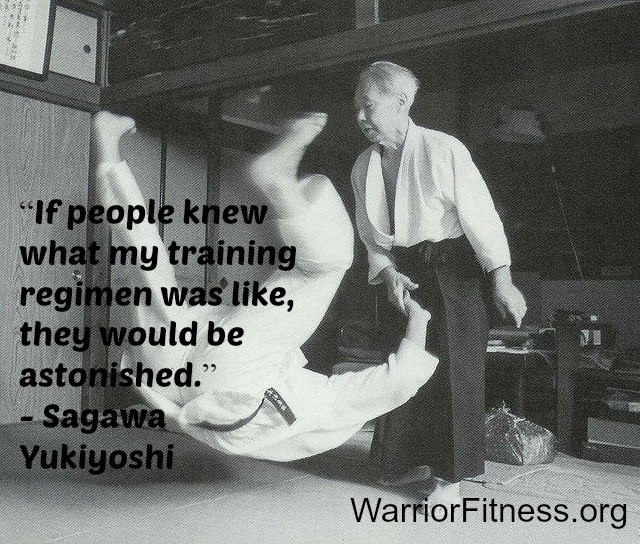
The Aiki Push-up is a literally a one-stop-shop in the study of internal power building. It was rumored to be part of Daito Ryu master, Yukiyoshi Sagawa’s secret training regimen.

Sagawa Training
Here’s a video where I explain the purpose and it and how to do it.

Watch carefully as the Aiki Push-up may look similar to what you already know, but the entire engine driving it is different!

Don’t fall prey to the common idea of thinking you know something just because you know about something! Be diligent in your study and your training – go deep!

“A little knowledge is a dangerous thing…”

Learn all the fundamental building blocks to the Aiki Push-up, as well as creating Internal Power (plus much more!) HERE!

Kata (Alone) Will Never Build Internal Power

Trying to develop Internal Power by training kata (alone) in martial art is problematic.  On one hand, you may inadvertently have minor success in creating some internal connection over the course of 20-30 years of training, but you will most likely have no idea how you did it, no idea why it worked (minimally at best), and most importantly, no idea how to correctly transmit it to the next generation.

The only advice you will be able to offer your students and fellow seekers is to keep doing this (kata training) and somehow you *might* get the correct result.  This is insufficient and irresponsible, at best, on the part of the teacher.

Assuming that you want to stand out from the crowd as a powerful martial artist, and Internal Power/Aiki is your goal, then the scatter approach to trying (and for the most part, failing) to build IP through kata alone is a waste of a career.  I say this because there exist clearly defined, step-by-step processes that rewire the body for Internal Power specifically for martial arts.

Solo Training Precedes Kata Training

Power building models as solo training exercises have existed for hundreds (if not thousands) of years  throughout the martial arts from India to China to Japan.  Why anyone would try to reinvent the wheel by attempting to create their own hodgepodge of exercises or think that merely training kata would develop real Internal Power is a mystery to me.  The reality is that solo training exercises burn in specific ways of moving that are not normal which create a very stable, powerful structure capable of absorbing, re-translating, and projecting incoming force.

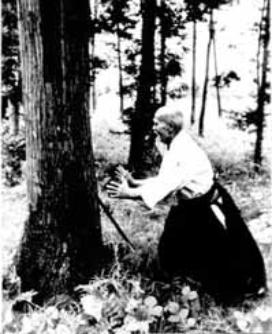
osensei_tree_kokyu1-272x334

Internal Power training is a type of General Physical Preparedness (GPP) for budo.  The goal of regular GPP for fitness, athletics, or martial arts is enhanced work capacity. This is the ability to run faster, jump higher, and hit harder. When work capacity increases, it allows the budding warrior to adapt more easily to increases in both mental and physical demands. In other words, it increases your capacity and level of readiness to absorb higher levels of specificity.

The solo training exercises for internal power training change the way outside forces act on the body.  The structure becomes dynamically stable so that applied force can either be distributed throughout the chain and dissipated or, at a higher level, simply reflected right back onto the opponent.  When force is reflected back this is what is known in Japanese as Yamabiko, or Mountain Echo.

Just to help further differentiate the two practices, solo training exercises for building internal power (there are other types of solo training exercises, obviously) are always made up of the following: standing, open/close, winding, spiraling, and breathing – all supported by Yin/Yang Theory (the union of opposites) and 6 directions (Heaven Earth Man).

Kata are for the purposes of patterning correct martial movement.

These solo training exercises are trained BEFORE kata to condition the body for powerful martial movement. They are not martial movement drills in and of themselves like sanshin no kata, kihon happo, and kata.

Kata – The Slow Boat to China

The reason it is so difficult to train IP via kata is that the vast majority of students get caught up in learning the movements of the kata correctly.  They get caught up in the application of technique and the idea of trying to make it work correctly.  What they don’t realize is that having a correctly trained body built by solo Internal Power exercises makes all the kata work much better and easier.

If you have a choice – why not learn a proven step-by-step method of developing unusual strength and Internal Power?


Join My New 21 Lessons on Internal Power Coaching Program <<==

Following a clearly defined path up the mountain is much faster and more effective than wandering around the base working on kata for 30 years and thinking you will somehow magically arrive at the summit.

Caution – While I did just say “more effective and faster” I by no means meant easier!!  Internal Power takes a lot of dedicated work.  Do not think it is a shortcut!

A Glimpse Into Internal Power Training – The Push Test

The push test is a very practical way of testing the quality of one’s solo training for internal power.  As explained in Weakest Direction Theory is BS, the body, when properly trained, acts as an omni-directional structure.  This allows the practitioner of internal power to neutralize any incoming force by diffusing it throughout the structure rather than having to surrender to it or resist against it.  Either you can do it or you can’t.  There’s no way to fake it. Continue reading

Martial Software or Martial Hardware?

Remember in The Matrix when Morpheus downloaded those dozens of different martial arts programs (software) into Neo’s brain and he instantly could perform all the techniques from those arts?

That is a perfect example of a software upgrade.  Techniques instantly available at your fingertips – literally! Continue reading

Weakest Direction Theory is BS – Part 2

Make sure you read the highly controversial Part 1,Weakest Direction Theory is BS, before moving on to part 2 below…

Preface

I love martial arts.  I love everything about it.  I love training martial arts, practicing martial arts, teaching martial arts.  I love reading martial arts history, philosophy, even martial arts fiction.  I love talking about martial arts.  I love writing about martial arts.  Are you getting the picture yet?  Have I pre-framed this well enough for you?   Continue reading

My Morning Routine

For the past several weeks there has been a running theme interwoven throughout my blog posts.  That theme has been practice, Daily Personal Practice (DPP), to be precise.

I’ve gotten several questions about the details of my own DPP since I refer to it several times in my writing.  So I figured I would pull back the curtains and give you a more detailed glimpse into my Morning Routine of DPP in this post. Continue reading

Principles, Techniques, and Internal Power

For some reason people seem to use the terms principles,techniques, and internal power interchangeably within the context of martial arts practice.  Because of this mistake, they then tend to get confused between them.  While they are all obviously related, each term is separate and distinct and should not be interchangeable with one another. Continue reading

Places of Power

Training outside in the elements has always been one of my favorite ways to practice martial arts and the art of strength, or Warrior Fitness.  There’s something special about the fresh air, sunshine, and changing terrain that gives life to the training and makes it hugely satisfying for me.  In fact, my weekly Bujinkan Martial Arts class trains outside all year round in all sorts of weather from the bitterly cold and snowy winters to the blisteringly hot and humid summers.  This type training not only helps increase our physical resilience, but our mental fortitude as well by helping us to become comfortable being uncomfortable. Continue reading

The Difference Between External Strength & Internal Power

For as long as I can remember, I have always believed that the body is meant to be used as a fully actualized, integrated unit – nothing can (or should!) exist in isolation.  By this I mean that muscle, tendon, ligament, and bone are all equally important and must all be unified in producing amazing degrees of strength and skill for fitness, martial arts, sports, or life. And, in most cases this is completely true. Continue reading