Balance Training Drills

Balance is an essential quality for the warrior to develop.  It directly affects our ability to move with grace, coordination, agility, and power.  Yet direct balance training exercises seem to be a neglected area in many people’s training programs unless they are recovering from an injury or trying to fix a specific weakness.  Personally, I think they should be an integral part of training.

The following is an introduction to the balance drills I use to train myself as well as my martial arts students and fitness clients.  I hope you find them as useful as we do.

There are 3 Systems the Body Uses to Orient Itself in Space

1. Visual – Relying on sight is the second fastest and most efficient mechanism in our balance (unless we are in a dark room!).  Most people tend to rely on visual cues for balance, to the detriment of the other 2 systems.  The visual system relies on a physiological reflex called the Ocular Gyro Cephalic reflex which creates tension chains that reflexively cause the body to orient toward whatever the eyes see.
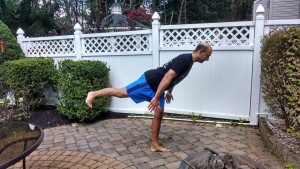
Balance Drill Leg back

2. Vestibular – This system relies on the fluid within the ears to sense balance.  As we move, the fluid sloshes around.  If we are not used to a particular pattern of movement, we may begin to feel dizzy. The brain works to process this information and integrate it with the information coming in from both the visual and proprioception systems.
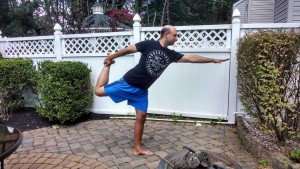
Balance Drill Leg back hold

3. Proprioception – This our sense of position and movement of the limbs and the sense of muscular tension.  Proprioception utilizes information derived from sensory receptors in our muscles, tendons, and joints to inform us of changes in movement, position, and tension.  Proprioception is plugged directly into our nervous systems making it possibly the fastest and most efficient mechanism for balance, as long as we train it.
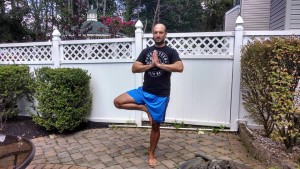
Balance Drill Tree

The balance drills shown in the video below will allow you to train all 3 systems concurrently.


For more information on balance and proprioception training, check out my new program:

Balance: The Fall Prevention System <<==
How to Train for Chaos without Making Training Chaotic

The current rage in conditioning training, especially when talking about combat conditioning, is to completely change up the workout for each and every session. This has the advantage of keeping the training fresh and throwing the body into chaos each time so it never knows what hit it.

The hardcore advocates of this type of conditioning stress that this environment will create a very broad and general fitness that prepares the trainee for almost every physical contingency, both known and unknowable.

This enables one to prepare for the chaos and uncertainty of combat by training in an uncertain and chaotic environment.

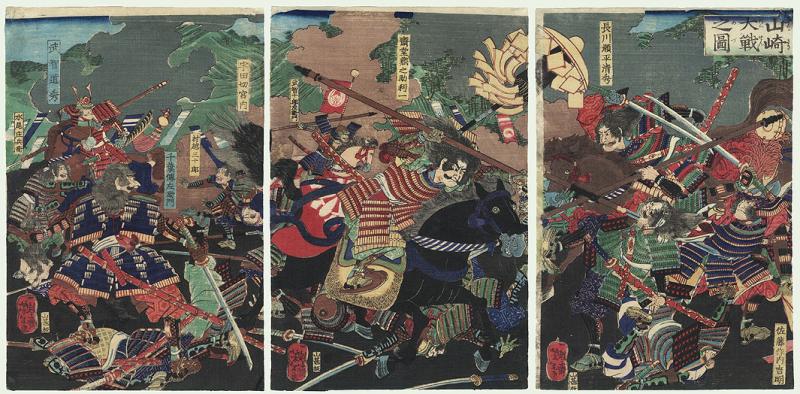
samurai

Seems to make a lot of sense on the surface, right?

However, one of the glaring problems with this type of training is that random training yields random results. It’s difficult to measure progress when the parameters are constantly shifting.

In order for the body to produce an adaptation for improved performance in life, sport, or martial art, we must apply specific stimulus as per the SAID Principle (Specific Adaptation to Imposed Demand). This basically means that the body adapts with a specific type of fitness to any demand which is imposed on it. When the same exercise is performed for too long, the body adapts to the stresses of each set and the adaptations or returns get smaller and smaller. Once it has adapted to the stress, then it’s time to change or increase the stress or else we fall into that trap of diminishing returns.

Usually though it takes the body a period of 4-to-6 weeks to adapt and then it is advisable to begin changing exercises. This does not mean that we need to completely throw away everything we have been doing; far from it. An exercise or drill can be changed by increasing intensity, increasing volume, decreasing rest periods, or increasing complexity or sophistication.

What this suggests is that a properly organized training program with incremental progression of increasing complexity and sophistication may actually prepare the body better than a set of random skills strewn together with a nebulous outcome in mind.

Yet we still crave the chaos, right?

So why not have it both ways?

Let’s program chaos into our training to instill the element of surprise and shock to the body. But, and this is key, we will ONLY do it once a week. This is enough to add the benefits of chaos training without suffering the negative aspects. The rest of the time you must follow a properly programmed training regimen to ensure all the multifaceted fitness qualities required to keep you strong, agile, mobile, and hostile are being met.

How do we program the chaos?

One of my favorite ways to do this is by picking 5-6 different exercises and setting an interval timer for 5 rounds of 3 minutes or 5 rounds of 5 minutes (depending on your fitness level). Instead of setting a rep scheme, move from one exercise to the next in any order you like performing as many or as little reps of each exercise.

If you need active recovery during the round or simply can’t figure out what to do for a few seconds – do Jumping Jacks. The only caveat is that you must not stop for the duration of the round. Take a 1 minute break between rounds to recover your breathing, then go again.

Here’s an example Chaos Training Workout:

1. Kettlebell Swings or Snatches
2. Jab/Cross Combo on Wave Bag
3. Sit Thrus
4. Med Ball Slams
5. Sandbag Burpees

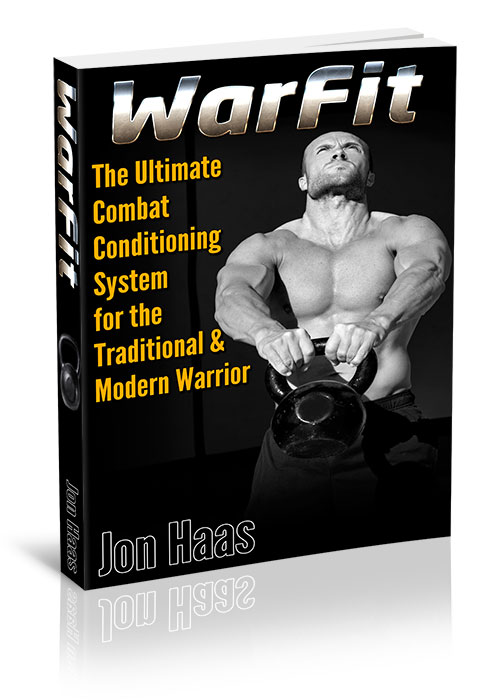
My brand new WarFit Combat Conditioning Program is perfect for the warrior athlete who wants to build superhuman strength, endurance, and conditioning…

warfit3d1


Strength in the Deviation

Usually being deviant is not looked upon as a positive character trait.  However, as we shall see, what makes for a poor character trait is in fact a desirable outcome for increasing performance and injury prevention!

In this article we will explore how building strength into a deviation of “correct” form can create a built in safety valve that will increase your resilience and resistance to injury.

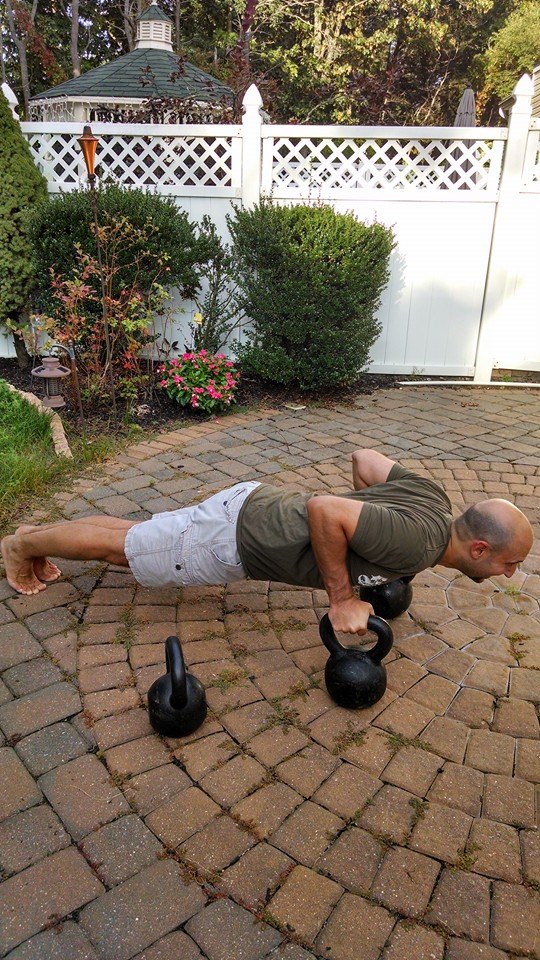
KB Pushup


The problem with always working on “correct” form in any endeavor (for our purposes here: fitness, martial arts, and athletics) is that no matter how well you perform a movement skill, there is always a possibility of moving outside the parameters of the perfect range of motion.  You do not live in a bubble! Whether through fatigue, unfamiliar or uneven terrain, accidental misstep, mental distraction, or being acted upon by an outside force – collision in sport or an opponent in a combative engagement – your movement WILL go awry.

Strength in the Deviation

So now that we established that you will never always have perfect form, how do we insure that any deviation from proper mechanics does not cause injury?  Check out the videos below for examples on how to increase strength throughout a range of motion by building a safety valve into your movement.  Strength in the deviation will not only increase resilience and injury prevention, but performance as well knowing that you have complete confidence in your movement!

Strength in the Deviation – Accident Proof Ankles

Strength in the Deviation – Wrists of Steel

Strength in the Deviation – Sledgehammer Training

Ready to increase your deviant behavior??? 🙂