
Top 10 Things to Look for in a Kid’s Martial Arts Class

One of the first things fellow parents tend to ask me after they find out I’ve been involved in the martial arts for over 25 years is, how do I find a good martial arts class for my kids?  Well, after years of answering this question, I realized my answers tend to follow a certain pattern.  They may be expressed in slightly different terms and the order of the points may change each time I’m asked, but the answers remain the same.  So, for all those parents out there who are looking to involve their child(ren) in the martial arts (a highly recommended pursuit, by the way),  I’ve formulated my own “top 10” list:

1.  Is the school a franchise? 

 These typically have cookie-cutter, one size fits all programs and tend to be belt factories.  Steer clear!  There may be franchises out there that do not fall into this category, but I haven’t run into them.

2.  Do the kids in class fear the teacher or respect him? 

This is very telling.  As a kid, I was afraid of my first karate teacher and even though I loved the art and practiced like crazy at home, I’d try to get out of going to class almost every week. 

3.  Are the parents sitting in the waiting room comfortable with the teacher and happy with the class? 

When you visit a school, talk to the parents who have been there awhile.  Do they constantly complain about the teacher, the atmosphere, or even the cost?  Do their kids love the program or simply tolerate it?  Also, what is the vibe you pick up when walking into the school – listen to your gut!

4.  Variety! 

Kids get bored very easily.  And, when they are bored, they don’t learn very well.  Classes should have a wide variety of drills to show children principles and techniques from many different perspectives.  Remember, martial arts are not academic subjects!

5.  Tons of physical exercise. 

Kids have a lot of energy.  Exercises that teach physical skills, as well as give them an outlet for their energy are the best.  Also, in case no one has told you, we have a growing childhood obesity problem in this country.  Exercise, along with a focus on a healthy diet, is key to resolving this issue and giving our kids the tools to ensure a lifetime of health.

6.  Do they teach self-defense applications of kata, or just the forms?

This is essential, not only for the correct transmission of the art, but also for the students to understand how to actually apply the techniques.  Obviously, this must be tempered to make some aspects of practice age appropriate, but it must be taught.

7.  Do they teach rolling and falling techniques?

 Not only are these fun for the kids to practice, but they can, and do, prevent injuries.  Very important both in the dojo and out in real life.  Additionally, they help to develop coordination, agility, and kinesthetic awareness!

8.  Is situational awareness stressed?

This is, without a doubt, the most important aspect of self-defense and must be continuously stressed and communicated.  Bad things do not “just happen” to kids.  There are always pre-incident cues that are present, if one is paying attention.

9.  Do the kids in class appear to be motivated or just going through the motions?

Watch carefully when you visit the class.  Are they lackadaisical in their practice?  Do they look like they don’t want to be there?  Or, are the kids energized and focused throughout the class? 

10.  Leadership. 

A school does not need to have a specific, defined class program on “Leadership” (these are usually a colossal waste of money for parents… hint, hint!).  It should, however, endow the students with leader qualities through the example of the teacher and by getting the kids involved in the class room (dojo) instruction.  This can be done by rotating who leads various drills and allowing children to teach their peers by explaining and demonstrating certain kata, techniques, or exercises.  This is not only good for the child’s self confidence, but also for their overall and long term development.


Training as You Grow Older

 One of the greatest challenges a long term fitness enthusiast faces is the debilitating impact of age.  Certainly everyone understands the concept but what does it actually mean?  The average person has a higher metabolism when they are younger, a faster recovery rate, greater use of energy stores and suppleness around the joints.  So why exactly do we age? Well did you know that for the average person the maximum heart rate is 220 – age?  That means when you are 20 your heart can go up to 200 bpm, whereas at 60 your max is 160bpm.  That’s a big difference.  Essentially like all human tissue the heart is constantly in a state or recreation, cells die and new ones are created.  However as the body gets older this ability to replace old cells with new ones becomes less efficient.  In a sense it is not the body that ages, but the ability to rejuvenate decreases over time.

That is the bad news.  The good news is that a lot can be done to counter-act the effects of ageing via exercise.  This can be divided into circulatory, respiratory, structural and the nerves.

How Does Exercise Help?

As mentioned the heart output decreases with age, generally a very fit endurance athlete has developed a large heart capacity.  That is the volume of blood per pump has increased as a result of training.  If age means that the heart will pump less frequently and become less powerful then what can be done?  Quite simply the best thing to do is make better use of the blood that is being sent around the body.  Exercises that improve blood circulation to the extremities are extremely beneficial at all ages and very useful for combating age.  Joint rotations, light resistance frequent repetition exercises are excellent for this.  Walking is perhaps the best of all.

As many biology students know, a major purpose of blood is to transfer oxygen around the body so focus should also be paid to the respiratory system.  It should also be mentioned that the oxygen in the body is very useful for cell reproduction too.  Breathing exercises not only help with good quality respiration but also assist with the structural stability of primarily the upper body but also the body as a whole.

Structurally speaking the body may be divided into bones, connective tissue and muscles for simplification.  As stated good blood flow and breathing will already provide a boost to these systems.  Perhaps we must accept that due to age repetitive actions will not be maintained to the same count as was possible in youth.  But what about strength?  Scientists have been studying muscle strength and age for at least the last 15 years and concluded that muscles can grow and remain strong at any age.  This means resistance exercises such as moderate and heavy weights will be very useful for maintaining structural strength.  Also bone mass is related to muscle mass directly, so strengthening muscles reduces the risk of damage to bones and increases calcium absorption.  Studies have shown that laboring women in areas with limited calcium in the diet have less cases of Osteoporosis than sedentary women with high calcium diets. In other words resistance exercise not only maintains more youthful strong muscles but also increase the utilization of chemicals like calcium in bone tissue.  Joining the muscles and the bones are connective tissues which get stiffer and less elastic if under utilized.  Lack of flexibility results in lack of mobility, this in turn impacts the benefits of exercise and increases the risk of injury.  Flexibility training such as Yoga or Makko-ho is very useful for combating decreased flexibility and also rejuvenating connective tissue.

Stretching and structural organization is beneficial not only for maintaining mobility but also because it opens up an often forgotten part of the body called the nervous system.  It is not possible to strengthen nerves directly and again age will deteriorate nerve function.  But, by using muscles and working on flexibility the nerves can be stimulated to be more effective in function.  This is important for not just general co-ordination but also the non-voluntary nervous system which is responsible for among many things, yes, the heart.

Taking the Holistic Approach

We have come full circle and this is an important point.  When we are younger we can focus on weights, or marathons and any kind of activity we like.  This is because our general health is fine and we simply pursue excellence in whatever activity we choose.  As we get older however the general health starts to decline if not maintained.  That is why aging persons should take a holistic approach to training to ensure all the important body systems are being stimulated.  The circulation, the breath, the structure and the nerves must all be improved upon.  It is very tempting to wait until the effects of age are experienced before reacting to change.  Of course it is fine to start exercising and focusing on health at any time.  However the best solution to aging is to prepare early on for the kind of body you will need as you do age.  Combine light exercises and breathing with heavy exercises and stretching now and save making major adjustments tomorrow.

About the Author

Tony Notarianni has been training in martial arts since the age of 12.  Up to this point, although quite active, he had very little interest in sports and fitness but that all changed over the coming years.  He started studying Sport as a subject at school and finally graduated with a Bachelors Degree in Sport and Exercise Science in 1998.  Although not a typical sportsman and not a great fan of any one sport, Tony was always keen to try new activities and considers the world to be literally full of physical experiences to explore.  Before graduation he was working at a sports complex where he was a lifeguard and could join and observe many different forms of exercise.  He also taught circuit classes and was a qualified personal fitness instructor.  After graduation he chased the dollar and ended up working in Software Development.  Although becoming more sedentary he still has a deep rooted interest in improving himself physically and developing his knowledge.

Do You Know the Enemy?

Do you know the enemy?

I do.  It inhibits peak performance.  It makes you lazy and keeps you unmotivated.  It cajoles you into seeking comfort.

It distracts you from your goals and dulls your mind. The enemy sells you on an “easy” lifestyle and lulls you into a false sense of security.

It conspires to sabotage every move toward a healthier diet or consistent workout program.  It will aim to destroy any action or activity that moves you towards bettering yourself, be it education, a new job venture, a move towards a more spiritual life, or writing the great American novel.

Ultimately, it weakens your spirit.

What is The Enemy?

The enemy comes in many forms and assumes many guises.  It may tell you that it’s alright to sit down on the sofa and watch Lifetime Television with your wife after dinner; you can get to that workout later.  It may convince you that just one brownie bite is okay, after all, they’re just “bites”.  You may feel tired from a busy day at the office, and rightly so – the enemy will whisper in your ear that you can begin your fitness regimen tomorrow and that will be good enough.  What exactly is this enemy who kills our motivation and procrastinates our calling (sometimes indefinitely)?  Steven Pressfield identifies the enemy as “Resistance” in his excellent book, The War of Art.

“Resistance will tell you anything to keep you from doing your work.  It will perjure, fabricate, falsify; seduce, bully, cajole… If you take Resistance at its word, you deserve everything you get.  Resistance is always lying and always full of shit.”

Sometimes the most insidious form the enemy can take is the form of knowledge.  We fall into the trap of, I know what I need to do, I just need to do it.  Knowledge comforts us.  It allows us to rationalize that since we are in possession of it, we can carry out the action at any time.  We don’t need to do it now.  Tomorrow is fine.  Next week is OK to start.  So, why worry?  One of my favorite quotes (just ask my daughter, she’s heard it often enough!) on this subject is:

“Knowing is not enough; we must apply. Willing is not enough; we must do.”
-Johann Wolfgang von Goethe

How Do I Defeat The Enemy?

In his book, Awakening Spirits, famed wilderness survival guru, Tom Brown Jr., gives the enemy a different name, calling it the “Demon of Distraction”.  No matter what you call it, if you call it anything at all, it’s the very same impersonal, unrelenting force pushing us away from our calling, deferring our goals to a “better time”, or for when “conditions are just right”.
Here’s a hint – conditions are never perfect.

There is no better time than right now.

How do you defeat this omnipresent enemy?  By doing your work.  By starting right now.  Don’t delay.  Don’t defer.  Begin.  Do the work(out).  Trade  the 3 o’clock junk food snack for an apple.  Skip McDonald’s on the way home from work and prepare a healthy meal.  Don’t allow yourself the luxury of excuses.  Be firm.  Be strong.  Get it done.  Be resolute and committed to your health and fitness goals.


Get the First 2 Weeks of Training from My NEW WarFit Program for FREE!

This Program is Designed To Build Whole Body Strength, Power, & Insane Endurance!!

Applying Six Sigma Principles to Your Fitness Plan

Six Sigma is a process improvement methodology that has its origins in the manufacturing business.  It has been adapted and expanded to cover a wide variety of business products, services, and help foster solutions in terms of reducing costs, removing defects, and continuously increasing efficiency.

Today, we are moving from the boardroom to the gym and looking at ways to apply a scaled-down version of Six Sigma methodology to improving your health and fitness.  Right now, you are the product and we are looking for ways to foster continuous improvement in you!

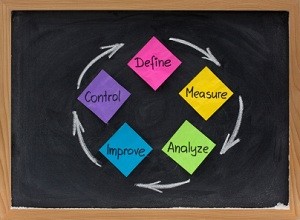
What is DMAIC?

Let’s look at one of the basic methodologies for Six Sigma projects called DMAIC and see how it can be applied to improve your fitness program.

DEFINE the problem and project goals specifically.

  • What are your fitness goals, right now, today?  Whether it’s to lose a certain number of pounds in an allotted time-frame, or be able to do a one-arm push-up at 40, it doesn’t matter.  Here is where we define our objective.

MEASURE key aspects and collect data.

  • What is your current weight or dress size or waist size?
  • How many push-ups can you do in one session?
  • How many calories, carbohydrates, and grams of protein do you eat daily?
  • How many servings of fruits and vegetables do you eat daily?
  • What is your resting heart rate?  Blood pressure?  Cholesterol numbers?
  • How fast can you run a mile?
  • Or, any other measurements that pertain specifically to the goal you outlined in the Define section above.

ANALYZE the data to investigate and verify cause and effect relationships.  Determine the root cause of the problem.

  • Do you have 3 sausage, egg and cheese breakfast sandwiches from Dunkin Donuts daily and notice that your cholesterol has sky-rocketed, your blood pressure is too high, and your waist line has expanded?
  • Do you run out of breath climbing a flight of stairs?
  • Or, not have enough energy to play with you kids in the park?
  • Do you aspire to run a marathon this year, but can’t get motivated?
  • Look closely at the data you gathered above and figure out what is holding you back from achieving your goal.

IMPROVE or optimize the process based on the analysis.

Here is where all the real work gets done, but also where you may encounter a stumbling block.  You’ve defined your goal, measured key aspects as they relate to your goal, analyzed all the data and determined the root cause of the problem, but what do you do now?

This is where having a knowledgeable and highly experienced Coach comes into play

(Book a Strategy Session Call with me HERE).

You need someone who can review the findings above and determine the best possible solution for you.  This includes:

  1. Knowledge and understanding of exercise methodologies and how to apply them on a case-by-case basis.
  2. Ability to design an individualized fitness plan for you.
  3. Ability to effectively and efficiently get you the maximum results in the minimum amount of time.
  4. Ability to communicate, break things down, and respond accordingly to questions and concerns.
  5. Ability to motivate and keep you on the path.

CONTROL future state process to ensure any deviations from the target are corrected before they result in defects.

  • Here is where your progress is charted and tracked to make sure slippage does not occur.  If slippage does occur, it can be noticed and corrected for immediately to assure the project – a fit and healthy you – remains on track!

Many companies and organizations have applied these principles to better their businesses, increase production, reduce costs, and improve their overall business processes.  Why shouldn’t you be able to take the same ideas and apply them to your health and fitness?

Warrior Fitness Executive Coaching Program

Book a Free Strategy Session call with me HERE to see if you are a good fit.

The Morality of Fitness

FatherJohn Corapi is a well known Catholic preacher, scholar, and theologian.  He also happens to be a black belt in karate, a former competitive boxer, and football player.  In this video he addresses concerns over his health and his startling weight loss.  He begins by assuring the people who care about him that he is not sick at all; in fact he is healthier than ever!  Father then goes on to remind us that fitness is a moral obligation we all have.  As Fr. Corapi states in his video address, “we are all precious, unique, and unrepeatable.”   Take care of yourselves!

You do not have to be Catholic to benefit from Father Corapi’s thoughts on fitness.  In fact, his words transcend religion and get to the heart of being human.  As he says, if you know there’s action you can take to improve your health, such as diet and exercise, you must do it. 

Stay healthy and strong!

Want to know more?  Check out Warrior Fitness: Conditioning for Martial Arts!

Warrior Fitness for Kids!

This will be the first in a continuing series of posts chronicling my thoughts and discoveries on Warrior Fitness for Kids.  As the father of 2 young girls, ages 9 and 1, I have a very vested interest in assuring my daughters are among the healthiest, fittest, and most well-informed kids out there.  Follow along and yours will be too!

It doesn’t take a genius to see that America has become a nation of over weight, physically lazy, comfort-seekers.  The saddest part is the effect this perverse attitude has had on our children.  How can we call ourselves responsible parents when our kids consume more McDonald’s than broccoli, and watch more TV than play outside?  What happened to running, jumping, playing tag, climbing trees and fences, or riding bikes as fast as you can just for the sheer thrill of it?  Has watching Sponge Bob and playing video games replaced playing outside from the time school lets out until dinner is ready?  I remember my mother having to shout for my brothers and me almost on a daily basis to call us home for supper.  And, in the summertime, we were playing outside until well after dark!

What Can We Do to Reverse This Trend?

To me, the answer is simple: Lead from the front!  What impetus do your children have to eat healthy and exercise if you do not?  You, as a parent, must set the example for your kids.  My daughters constantly see me exercising, whether it’s stretching, working on the technical details of an exercise, practicing martial arts, or a full-blown conditioning routine, I’m setting an example for them on a daily basis.  Coming home from work and sitting on our butts in front of the television while we “relax” and “unwind” is more than just detrimental to your health.  It sets up a poor pattern of conditioning that you’re children will follow for a lifetime.

Train With Your Kids

Want to spend some quality time with your kids and help them become fitter in the process?  Workout with them.  Make it fun, not drudgery.  That means stay out of the commercial gym and away from the damn treadmills!  You’re people, not hamsters.  One of the ways my oldest daughter and I spend time together during the warmer weather is to go on walks after dinner, while the sun is still up.  But just walking around the block is boring, so we found a couple ways to spice it up:

  • Pick a landmark – mailbox, telephone pole, tree – and race to it.  Recover by walking a little bit, then race again.
  • Leap like a frog until you get tired – see who gets tired first!
  • Crawl on hands and feet (be careful of the terrain), then get up and run.
  • Let your child ride their bike and you try to keep up, or you ride a bike and let them keep up!

These are just a few examples of how you can change a simple walk around the block to a fun workout for you and the kids.  Shhh… don’t tell them they’re doing High Intensity Interval Training (HIIT)!

As this series continues, I’ll be sharing more ideas about how to workout with you kids in ways that are fun and effective for both of you.  Additionally, I have workouts that I’ve designed for my 9 year old daughter that I’ll be sharing here as well – stay tuned!

How about you?  Do you workout with your kids?  What are some of the things you do to help keep them inspired and keep going?

Warrior Fitness Workout of the Week #2

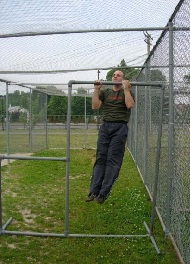
Commando Pull-Ups

This week’s conditioning workout will push your anaerobic threshold to the max.  Endurance is defined as the ability to resist fatigue – how resistant are you?

  • 10 Commando Pull-ups (switch grip every 5)
  • 10 Burpees
  • 10 Lateral Jumps (jump over medicine ball or other small obstacle)
  • 10 Fudo-ken (fist) Push-ups
 Complete 5 rounds as fast as possible with good form. Rest 1 minute between rounds.

 How Do I Do a Burpee?


Burpees are a great, whole-body conditioning exercise that will really challenge your cardiovascular fitness.

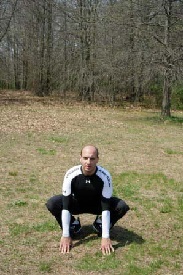
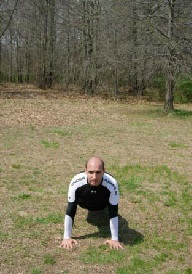
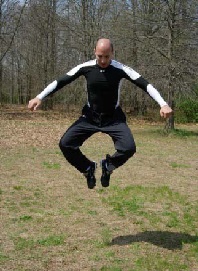
Begin in a standing position.     Drop down to a squat on the balls of your feet.  Place your hands down in front of you and jump your legs back to the lowered portion of a push-up.  Jump your legs back to the ball of foot squat, then leap into the air as high as possible.  Repeat rapidly!

Burpees -Squat down from standing

Burpees - Jump back to push-up

Burpees - Leap as high as possible!

Modifying Your Workout


Conditioning workouts are supposed to suck.  No doubt about it!  They push your body to its limits and increase mental toughness.  However, they should be approached incrementally, especially if you are not used to them.  In this particular workout, I’d recommend that beginners cut the volume of repetitions in half.  If you still find you are struggling, increase the rest period between rounds up to 2-3 minutes rather than the prescribed 60 seconds.  Additionally, you may perform 3 rounds to start instead of 5.  As you gain confidence and begin getting stronger, you can increase the number of repetitions and rounds, and decrease the rest periods.  Change one variable at a time so you are not forcing your body to adjust too rapidly.  Remember, injury is not the goal!

For more information on the Warrior Fitness Workouts of the Week, please see our User Guide here.

Want to know more?  Check out Warrior Fitness: Conditioning for Martial Arts!

Jack Hoban on Fitness

The interviews conducted here at Warrior Fitness will highlight people who have significantly influenced my thinking and training on fitness, who are leaders in their particular fields of expertise, and whom I admire.  Jack Hoban happens to fit all three.  Through his unwavering commitment to martial arts and fitness, Jack has inspired me to keep going over the past 20 years down the dual path of martial arts and fitness.

 Jack Hoban is a former active duty U.S. Marine Corps Captain and long time practitioner of martial arts.  He is Shidoshi Senior Instructor in the Bujinkan Budo Taijutsu and Togakure Ryu Ninjutsu systems under Grand Master Masaaki Hatsumi in Japan and has authored three books on warriorship.  Mr. Hoban also holds an MBA and is an executive in the healthcare industry.    Jack’s full biography, and further information, can be found on his website here


1.  Can you please describe your current philosophy on physical fitness?

I have been serious about physical fitness for most of my life, first as an athlete in grammar school, high school and college, and then as a Marine, and martial artist.  That hasn’t changed, just become more refined and age-appropriate as the years have gone by.  Humans are physical beings and have been so for millions of years; I think we should acknowledge and honor that fact by maintaining a high level of physicality in our lives.  That’s my philosophy.  Until fairly recently, being physically fit, for most of us, was just a part of being human—and staying alive through hunting and gathering, farming, work, or other physical endeavors.  That has changed, and there is a greater risk of falling into a sedentary lifestyle today.  But our basic nature as physical animals has not changed.  We have to be careful not to stray too far from our nature, or certainly unhappiness and ill health may result.

2.  How has your outlook changed over the years?

It really hasn’t changed.  It has just become more refined.  I have tried some of the new fitness technologies—for example I run barefoot now using the new Vibram footwear.  I also think I use cross-training more effectively than in the past.  But I pretty much do the kinds of things I have always done.  I do have to worry more about “overdoing it,” because injuries take longer to heal.

3.  Do you have a daily fitness regimen that you follow?

Yes and no.  I have a range of things that I do, but it changes according to my schedule, the season, the weather and how I am feeling.

4.  Can you briefly tell us what it consists of?

Again, it is not a daily thing in that I don’t do the same thing every day.   But over the course of a week I typically fit in a few runs (45 minutes to an hour), I lift weights, I do a lot of core training, and I do various calisthenics.  In the winter I use the gym for the rowing machine, treadmill and elliptical.  In the summer I swim in the ocean almost every day.  I practice martial arts daily by myself, and have a class between 2 and 5 times a week.

5.  How do you think fitness and budo (martial arts) are related?

Inseparably, although martial artists might take care to explore a regimen that is complimentary to martial arts—one that increases strength and endurance, but also promotes flexibility and relaxation.

6.  How has your being in excellent physical condition enhanced your martial arts training?

Simple, it helps me to “keep going” longer and more consistently without being tired or sick.  And by the way, real fights are very physical—tiring and punishing. 

7.  How does your being in excellent physical condition help your work with the Marine Corps Martial Arts Program (MCMAP)?

When I first meet a new class of students, the unspoken question is “Is he one of us?  Can he do what we do?  If he can’t, why should we do what he does?”  That’s just the nature of young, competitive men.  Because I can pretty much keep up with them “for an old guy,” I gain a certain measure of respect.  That way, they are open to the other physical and ethical lessons I am there to share.

8.  Has the Marines Combat Conditioning program influenced your personal exercise program, and if so, how?

Yes, in at least two ways.  It has made me more aware of the value of cross training, and two, it has made me more creative in using training aides of opportunity.  By that I mean, you can design your own training regimens and make your own training apparatuses just by using your brain and common items and structures.  You don’t need fancy equipment; an old tire works just fine as an exercise apparatus.

9.  The last, but most important question, how do you keep going?

I enjoy it!  Find a method of physical exercise that you enjoy and pursue that.  Find other people who like it as well, and do it together.  That will help too.

Thanks Jack!

User Guide to the Workouts of the Week

I received several emails this morning after yesterday’s post on Warrior Fitness Workout of the Week #1 from people who wanted more information on how to implement and program the workouts of the week.  So here it is!

The Workout of the Week section is designed to give you insight into the Warrior Fitness training method.  We will cover topics such as joint mobility, high intensity interval training (HIIT) and the Tabata Protocol for conditioning, strength endurance, explosive strength, core work, yoga, and martial arts. 

1.  How often should I do the Workout of the Week (WOW)? 

This depends on the intensity level of the prescribed workout.  For example, if the WOW is an illustration of a yoga compensatory routine, you can do it daily, but if it’s a high intensity conditioning workout, you may only be able to perform it 2-3 times a week, depending on your recovery levels.   These workouts are short; usually, under 30 minutes.   You should have plenty of time to squeeze them into a busy schedule!

2.  Should I change my workout every week to correspond to the WOW? 

Not necessarily, no.  The workouts change weekly in order to showcase various aspects of our training methodology, but that doesn’t mean you need to change it up on a weekly basis.  Workout programs should be designed with specific goals in mind and crafted to meet individual needs.  Your body needs time to adapt to your exercise selection for it to elicit the planned response, usually about 4 to 6 weeks.  If you find a something that you like, stick with it.  If you have a more detailed question about how to program a specific workout, or even a series of workouts, let me know.  I can help you.  That’s why I’m here.

3.  What if I already have a workout program?  How can incorporate the WOWs? 

 If you currently have a training regimen that you are happy with, but want to give one of our workouts a try, you can definitely do that.  Simply replace one of your conditioning days with one of our conditioning workouts.  Or, add in our joint mobility exercises as a warm-up.  Remember, you receive a sample chapter on joint mobility  from the book, Warrior Fitness, when you sign up for our mailing list.

4.  I am just starting to exercise, can I still use the WOWs? 

Absolutely!  Start slowly.  Begin by doing our joint mobility exercises on a daily basis to prime your body and help you regain lost range of motion.  Each of our workouts contains instructions on modifying the workout to scale it for any level of conditioning.  Also, if you have further questions about modifying workouts, or programming workouts, contact me.  I’ll be glad to help you.

5.  Will I lose weight with these workouts? 

 Yes!  Our conditioning workouts are designed to turn on your body’s metabolic furnace and torch unwanted fat, while building lean muscle. 

6.  How can I find out more?

My ebook, Warrior Fitness: Conditioning for Martial Arts, is available for direct download.  It contains the background, philosophy, and methodology behind Warrior Fitness, as well as an ample exercise selection and a chapter on program design.

Want to know more?  Just ask!

 I hope this has been a helpful introduction to the Warrior Fitness Workouts of the Week.  What other questions do you have?

Conditioning for Striking

Looking for a great way to spice up your conditioning work and make it more martial arts specific at the same time? Give this workout a try! What you will need – wave bag, double-end bag, heavy bag lying on the ground (you can make substitutions as needed). 

There is no real set/rep scheme for this workout. Just perform three 5-minute rounds, or five 3-minute rounds, depending on your level of conditioning, with 60 seconds of active recovery in between.

You are free to move from one piece of equipment to the next and back, as you like. Spend as much or as little time with each. The goal is continuous movement. Use any strike or kick you like on any and all of the stations. The heavy bag lying on the ground provides not only a way to practice choking, striking and kicking on the ground, but an obstacle to leap over, roll over, and maneuver around while working the other bags. If you get stuck and don’t know what to do next, do body-weight squats or jumping jacks until you figure it out. Don’t try to think so much! If you get stuck again, do push-ups. Be creative. Have fun!

Notes: Make sure you warm-up with brief joint mobility session prior to the workout.