Mobility, Mobility, Mobility

What is, hands-down, the most effective, efficient, and time saving daily practice you can adopt for greater health and longevity?

In one word – Mobility, Mobility, Mobility!

I’m sure you are familiar with the phrase, “move it or lose it”, right?  But how seriously do you take it?

A complete mobility practice moves each joint in the body through its complete range of motion bathing it in synovial fluid.  Movement is the only way your joints get nutrition!  Each session can range from a quick 5 minute recharge to a 30 minute in-depth deep practice.  It’s up to you and how your body feels on a particular day.  For example, did you do a ton of heavy lifting or a super intense metabolic conditioning session the day before?  Maybe a longer, deeper mobility session is required to aid in restoration and recovery.  Or, did you just get out of bed and maybe only have 5 minutes before you have to get ready for work?  A 5 minute quick-n-dirty mobility session will charge you up and get your body moving (literally!).

Daily Practice

I have been performing my mobility practice almost every day for over 10 years now.  However, there have been a few times when I decided to forego it for several days in a row just to see if I could notice a difference.  After 3-4 days without it I began to notice.  Muscles were tighter.  Movements were less fluid.  Joints were crunchy.  When I finally stopped my no mobility experiment on day 5, the contrast was amazing!

In my experience, mobility training and breathing exercises are the biggest bang for your buck daily practices that will only reward you more and more with each passing year.

Benefits of Mobility Training

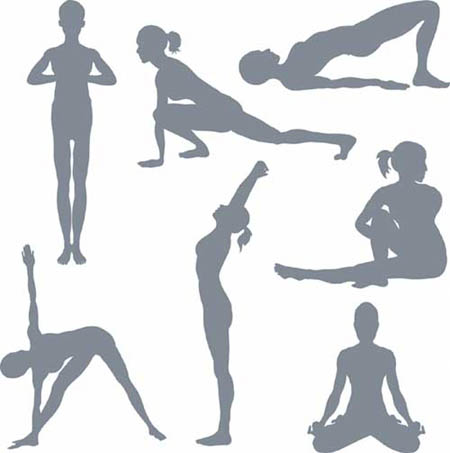
Spine mobilityIn no particular order, here are some of the benefits of mobility training:

  • Lubricates joints and allows them to receive nutrition through synovial fluid
  • Aids in removal of toxins
  • Reduces joint pain and inflammation
  • Increases range of motion (flexibility in motion)
  • Increases energy by reducing unconsciously held tension
  • Prehab for injury prevention
  • Mobility is foundation of all sport, athletic, and martial movement
  • Decreased mobility leads to increased pain and stiffness

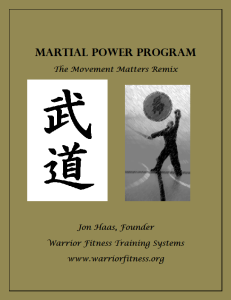
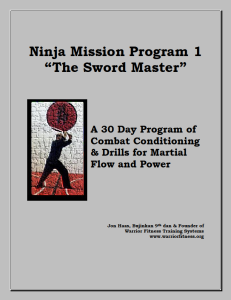
Looking for a fantastic resource on mobility?  I would suggest checking out my Martial Power Program or Ninja Missions Program 1.  Both of these courses contain a different, yet highly effective mobility routines that will keep you healthy, active, and pain free for life!

Martial Power Cover1

Ninja Mission Cover


No matter which program you choose, mobility training is the gift that keeps on giving – it literally pays health dividends that increase over time.  Establish a daily practice and keep going!!

Maintaining Preparedness

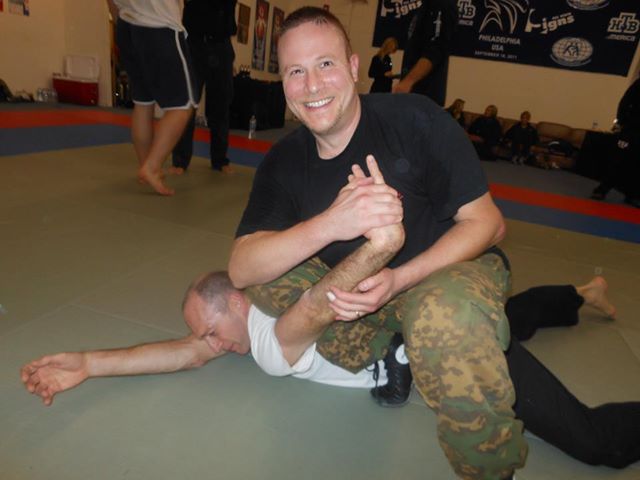
Guest blog post by Combat Systema Instructor, David Rusin.

If you are like most people, you don’t have the luxury of spending hours each day in the training hall to prepare yourself for violent confrontation. So for the time we are able to spend in training, it is in our best interest to get the most out of the opportunities we have.

Fortunately, most people will not have to experience a violent encounter. But daily life imposes demands upon our bodies, too. So the question becomes, are there things that we can do in our training that will help keep us prepared for violent threats while also translating into a positive experience in our everyday lives?

Joint Health and Mobility

An aspect of physical life which has a direct and immediate impact on the quality of our experience, regardless of the activity, is the health of our joints. Because of this, joint mobility exercises should be an integral part of a training regimen.

As we age the only way we are able to properly nourish and lubricate our joints is to move them through their full range of motion. You’ve probably heard the phrase, “use it or lose it.” With regard to joint mobility, this statement is literally true. Neglect of any particular range of motion (ROM) in a joint can result in a loss of mobility in that joint over time.

Having access to the full range of motion within our joints provides for more options when dealing with a threat of any type. Limited mobility yields limited options. Therefore, it is paramount that training includes means to recover any lost mobility, and to maintain access to the full range of motion in our joints.

Dave Rusin Systema


Movement in Combat Systema

Here is a practical example of this concept. In Combat Systema we consider two ways of responding to externally applied force – movement by part and movement by whole. Movement by part simply means that only the part of the body upon which force is applied will move in response to that force. Movement by whole means the entire body will move in response to applied force.

When moving by part, our structural stability begins to become compromised at the point at which maximum range of motion of the affected body part is reached. Thus, the greater mobility and joint function we have available to us, the more we are able to accommodate external force, moving by part, without having our structure compromised.

An effective means of recovering and maintaining full mobility in the joints is through the use of joint circles. This simply means moving each joint through a circular pattern at the maximum ROM to which you currently have access. Slow, smooth and controlled motion is best in order to remain relaxed and to be sensitive to any problem areas. Breathing should be coordinated with the movements, which also facilitates moving through areas of tension.

Movement through multiple planes simultaneously is more efficient than movement through a single plane. Therefore, a progression from joint circles to figure eight or helical movement patterns develops greater efficiency of motion while also contributing to healthy joints. These movements also have direct martial value, such as with evasions and strikes, so incorporating them into regular practice has multiple benefits.

Injuries can often occur when sudden, unexpected motion outside our normal ROM occurs. If you have ever stepped off a curb or stair, and had your ankle twisted, you’ll understand this concept. A sprain or other injury can occur if the joint is not accustomed to movement through the maximum range of motion. In a violent encounter, sudden movement outside normal range of motion is a distinct possibility. Thus, recovering and maintaining full ROM in all of our joints, and developing a level of comfort moving through extreme ranges of motion can help to keep our joints safe in any situation.

The benefits of healthy joints affect not only our daily life where most demands are imposed upon us on a regular basis, but also help to keep the body better prepared for dealing with threats. Simple movement patterns such as joint circles and figure eights can be incorporated at the beginning of a training session to warm the joints up for the session. Done regularly, these exercises can also help to maintain bodily preparedness when not in the training hall.

About the Author

David Rusin has studied various forms of martial arts for over two decades. For the last 13 years his primary training focus has been the study of Russian Martial Arts. During this time he has achieved instructor certifications in the ROSS Training System of Russian Martial Art under the tutelage of the American national ROSS Instructor Cadre, and more recently in Combat Systema under that system’s founder, Kevin Secours. He currently offers private and group instruction in Russian Martial Art near his home in Ocean Township, NJ. He can be reached via email at RMAinNJ@gmail.com

The Importance Of Isometrics

Thanks to Benjamin Bergman for this great guest post!

In most training methods, you learn to train the big muscles in the major muscle groups or for most in the gym, they isolate the muscle to a certain degree. Many neglect those little muscles that keep you intact and help avoid injuries. When you do your training, keep to your goals as much as possible but don’t forget to add in a little supplemental training. Isometrics work those little muscles like there’s no tomorrow and the amount of angles you can hit are limitless.


A key ingredient to having successful training is to be able to hit your Range Of Motion as best as you can. Some people have terrible ROM because of either an injury, just learning the basics or because of the way their body functions at that particular ROM. We all have different body types and we don’t always have the same leverage as everyone else but Isometrics can help your ROM from a specific position and increase the speed and strength of that position to your best capacity. I had trouble at one time with pull-ups and since I’m a big guy (245+ lbs.) It’s difficult sometimes to do a good amount of them but what helped me was holding specific positions in the pull-up or chin-up and after a while I began to hit reps like crazy being my best at 21 chin-ups and 17 at Pull-ups.


Working muscles especially the big ones can be good but only to a certain degree. When you don’t work the tendons and ligaments as often as possible, you’ll find that your body doesn’t function the way you want it to. Take a bodybuilder for example, he works big muscles but forgets building the tendons and so has a greater risk for injury and it only takes one minor mishap and he’s out for the count. The old-time Physical Culturists used Isometrics to enhance their strength gains in ways very rarely seen since that time. Some of them were Gymnasts, Wrestlers, Bodybuilders, Acrobats and others but one way or another they all used Isometrics to give them that edge because of that positional strength and how it keeps the joints healthy.


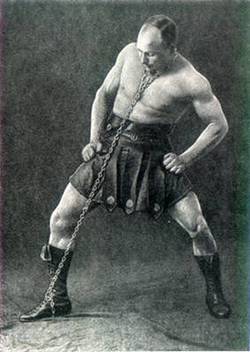
One thing you’ll learn about Isometrics not too many these days tell you is the dense and hardened muscle you develop from working different types of Isometrics. You see no matter how you work specific muscles or specific positions whether you hold for a few seconds or a few minutes, the blood rushing through the body and stressing that particular muscle or position puts density into that muscle. This can help build bone density and keep you from having long-term pain in the joints. One of the perfect examples of hard and sense muscle is the late strongman Alexander Zass, his style of Isometrics came from being in a POW camp during the 1st World War. He was chained up and instead of sulking and feeling sorry for him he pushed and pulled on those chains from as many angles as he can muster. He eventually broke the chains and escaped the camp. The muscle he developed was extraordinary and looked like a man that was carved by Michelangelo himself and this type of training made him one of the strongest men who ever lived by bending bars, twisting steel and bending spikes like they were a clothes hanger.

isometric-exercises-Alexander-Zass


Remember when I told you that you can hit an Isometric exercise from just about any angle? It’s true. One of the greatest wrestlers of his generation Karl Gotch once said “you always work your muscles from as many angles as possible.” This implies to not only dynamic movements but holding positions as well. When you hold a certain position say for instance a curl, you can work that particular exercise in the main three positions (down, middle and upper) but when you turn it in a different angle say if your arm is turned towards away or within the torso you’re still working a curl but your now working different muscles within that curl. You can do this with any exercise doesn’t matter.


Now I must warn you, doing Isometric Training in and of itself isn’t the only way to get super strong but when you add them in your current training, you can go beyond plateaus and this can help your ROM in a particular exercise like I’ve said before. A key thing is to use your imagination, think of what you want to improve and see in your mind’s eye how strong you want to be. One of the things I like to think of when I do Isometrics is when I work on my Arm Wrestling and I put a belt around a tree, I picture as if that tree was going to come down, I see it as a giant redwood and by the power of my own hands that tree will fall and I pull at times with everything I have and just want to toss that sucker right over the fence.


PT Barnum once said “Imagination is the elixir of life.” When you use your imagination no matter what it is, your results can come quicker, your body will move in a different way and your strength will skyrocket in ways you never thought of before. Make it a habit to live your training as if it was an adventure. Sure Isometrics are just holds but pictures how you use those holds, where you are and what is happening. You’d be surprised what you might find.

Check out Benjamin’s blog over at Ben’s Power and Might Writings!

To Stretch or Not to Stretch

When it comes to the question of stretching, there are opinions all across the spectrum.  Some experts contend that you should never stretch at all since it deforms the tissues, destabilizes the joints, and makes the body more prone to injury.  Then, on the completely opposite side of the scale, is the other camp which swears that stretching is an absolute must prior to any activity (up to and possibly including sex) as it is a way to warm-up the muscles to prevent injury.

So, who is right? Continue reading

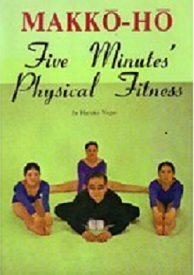
Makko-ho: Five Minutes Physical Fitness Book Review

Special thanks to guest author, Tony Notarianni for another excellent contribution!

Recently I read a book called, Makko-ho: Five Minutes Physical Fitness, by Mr. Haruka Nagai.

Summary:

Makkō-Hō is a system which through regular practice can produce a huge range of benefits for just about anybody at any age.  This book gives a good clear breakdown of the four main exercises and also some detail on the science behind the purpose and results of the exercises.  Although not a complete guide to the system (which would be an impossible feat anyway) the material provides a great opportunity to begin study and try for yourself. 

So first of all what is it?  Makkō-Hō is a complete system of exercises for wellbeing created in Japan during the mid 1900’s by the father of the book’s author.  The main benefits of this system are: increased flexibility, symmetrical skeletal alignment, nerve stimulation, improved circulation, overall good health, and even increased libido.  The founder invented this system after having been paralyzed across half of his body and seriously ill after a stroke.  He was told that he would probably never work again and would need constant care for the rest of his life even though he was only 42.  Being a very independent character he was not ready to accept this future of boredom or to be a burden upon his family.  He obtained the idea of certain postures from Buddhist prayer positions which he maintained regularly.  Over time these prayer poses developed into four main exercises which are the core of Makkō-Hō today and at the same time he managed to heal himself dramatically.  In other words the system is on first glance extremely simple and capable of remarkable regeneration.  The exercises themselves are probably familiar to students of Yoga or Japanese martial arts.  In fact I have personally seen and practiced these exercises several times in the past in different settings.  However this book clearly demonstrates that in order to really get the full benefits the student needs to study very hard and if possible find a qualified teacher to help them have the correct form.  This book is in fact not just a list of exercises.

What is in the book? Chapter Breakdown

Two Kinds of Love: Overprotection and Discipline

The introductory chapter highlights all that is wrong with many aspects of society, such as our lack of willingness to experience hardship for the sake of long term benefit.  Essentially this early truth sets up the reader for the arduous nature of what will be required later.

Lack of Use Leads to Aging and Functional Failure

In this section Mr. Nagai describes much that most of us should now know. Perhaps the most remarkable thing is that this was written in 1972 describing trends of modern living and predictions that have since born out.

God Planned the Human Body as a Delicately Balanced Machine

For me this was quite an important section of the book.  Looking at the body as a whole system with constantly regenerating living cells creates a perspective that helps the reader to get an understanding of how Makkō-Hō actually works.
Maintaining Good Circulation

At this point the book introduces some basic concepts about the major role of healthy circulation and nerve tissue in the body.  Using common analogies these concepts are clearly presented to generate recognition of the importance of these systems.

The joints: Inspecting and correcting
In reading this area I had an epiphany of study.  Quite bluntly Mr. Nagai points out that if you can’t demonstrate full hip flexibility then you are, in a sense, out of shape.  I had to re-read this several times while I internally argued that only a small percentage of the population can do these stretches however I soon had to concede that going by averages in fitness is not going to get us all very far.

Structure of the pelvic zone and the hips
This section through diagrams gives some rudimentary understanding of the lower body.  It seems that a key component of Makkō-Hō is the importance of maintaining a healthy, aligned and supple structure in this area.

Makkō-Hō Exercises

 
This section includes the 4 main exercises of Makkō-Hō.  There are photographs and diagrams demonstrating both correct and incorrect form.  The information is extremely clear and well written.  It left me with little doubt as to the intended objective however I did find the exercises very hard to perform even with the constant encouragement that repetition would work eventually.

Some Rules for Practicing Makkō-Hō Exercises

Here the author again covers the strict nature of doing the Makkō-Hō correctly, but also provides some guidelines on how and when to practice.  The basic rule of course being “Keep doing it right, and keep doing it daily”.

Effects of Makkō-Hō Exercises

The effects range from physical to psychological benefits.  Obviously when dealing with exercises that improve stability, flexibility and circulation the noticeable changes will be small but accumulative.  They will also benefit in a wide range of situations.

What is Missing?

For some of us even the beginning postures may be very difficult to get into.  You may have bad form before you even begin to perform the movement in which case the exercise may seem impossible.  Mr Nagai does give us some clues about using cushions in some of the exercises but unless you have some confidence and imagination you may get stuck.  There are other books I have seen in Japanese that show progressions for all of the exercises and it is a shame that these are not included in this English book.  Also, although essential, I think these exercises need to be supplemented with other activities.  Five minutes a day may not make you ‘fit’ but they certainly can give you a solid base of fitness.

Real Makkō-Hō?

As with all systems it is easy to get fooled by those who do not have the required qualification to teach.  This book is from the son of the founder of the system and quite legit.  If you do pursue a study of Makkō-Hō then be sure of where you get your knowledge from.  The Makkō-Hō headquarters website is here (Japanese only so use Google translator at your peril).

In the US there are two qualified instructors listed there.

Overseas
New York 多田 千恵子 Tada Tieko   212-980-0088  
Chicago 堀川 智子 Horikawa Tomoko  312-545-8221  


I have personally met and had a lot of great advice (plus encouragement) from Tomoko Horikawa.  She has a website that canbe found here, and is extremely knowledgeable.

Hopefully this relatively unknown art will spread more globally in the coming years.

About the Author

Tony Notarianni has been training in martial arts since the age of 12.  Up to this point, although quite active, he had very little interest in sports and fitness but that all changed over the coming years.  He started studying Sport as a subject at school and finally graduated with a Bachelors Degree in Sport and Exercise Science in 1998.  Although not a typical sportsman and not a great fan of any one sport, Tony was always keen to try new activities and considers the world to be literally full of physical experiences to explore.  Before graduation he was working at a sports complex where he was a lifeguard and could join and observe many different forms of exercise.  He also taught circuit classes and was a qualified personal fitness instructor.  After graduation he chased the dollar and ended up working in Software Development.  Although becoming more sedentary he still has a deep rooted interest in improving himself physically and developing his knowledge.