Form Begets Function

A new guest blog post by my friend, Jarell Lindsey owner of  Lean Functional Muscle.

Form Begets Function

I was scanning the posts of a fitness forum the other day, and I came across something that confused me a bit.

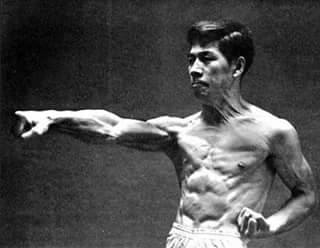
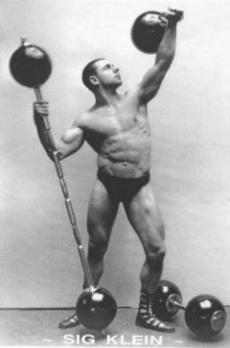
The post was regarding the physique of one Sig Klein, you may have heard of him, and how a modern bodyweight trainer could achieve a physique comparable to such a strength legend.

sig-klein

What could have been a great platform to discuss the merits of old school training methods became a complete misunderstanding of their use. For instance, the poster spoke on how lever work and static training lacked appropriate intensity for muscular growth, despite the incredible physiques that gymnasts possess above most other disciplines of fitness.

He furthermore went to say how he had trained with gymnasts before, and noted that they rarely trained to exhaustion, and more for technique than for musculature; therefore, he wanted a method that would help him develop the musculature, regardless of technique.

Funny that.

For, you see, one of my first lessons in biology was that, even on a molecular level, function begets form. The function of an organelle determines the way that it is structured.

Why wouldn’t it be the same on a macroscopic level? Gymnasts, traceurs, rock climbers, and martial artists all train for function over form, and they offer some of the best physiques the training world has to offer.

If you truly want a physique like Sig Klein with the strength to boot, training for function is key.

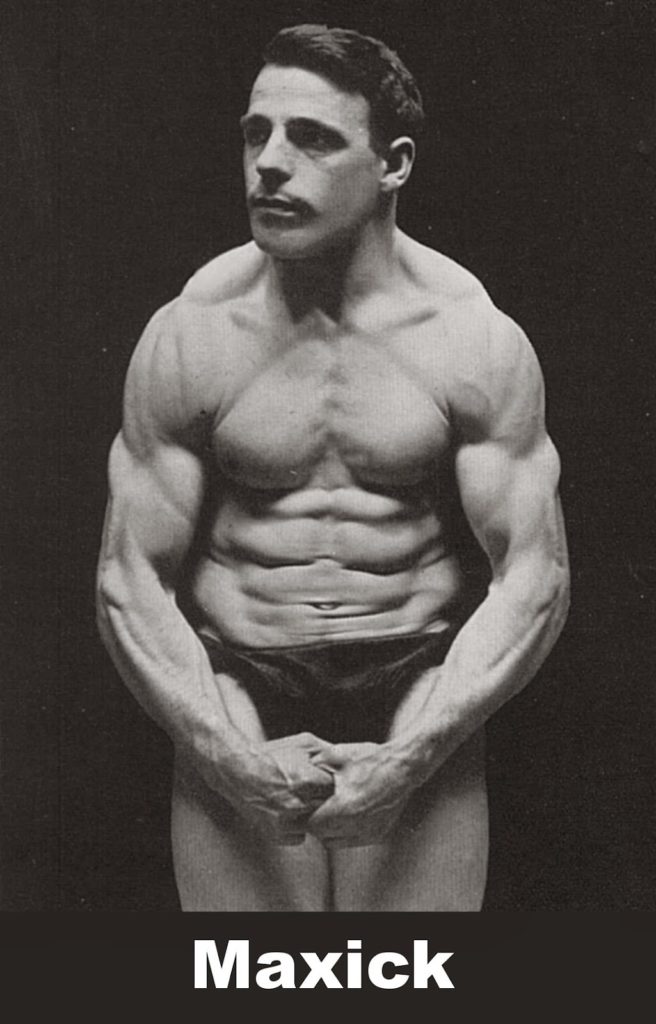
Furthermaxick2more, the poster said that the gymnasts never trained to exhaustion. From the training journals of Maxick, one of the strongest oldtime strongmen there ever were, you train daily so as not to train to exhaustion.


Your body doesn’t get stronger from training; it gets stronger from nourishment from your breath, your food, your blood and organs, etc. Many oldtime strongmen, including Sig Klein, rarely ever trained to failure. Nevertheless, they’d train their whole bodies everyday in a way that nourished their strength without fatiguing it.

Function begets form, my dear Watson.

Observe how well you function, not as a crane, tiger, or bear style, but as the functional patterns of a human, and watch your strength and physique truly begin to soar.

Martial Arts Training for Stability

Part 2 – Guest blog post by my friend, Jarell Lindsey from Lean Functional Muscle.  Part 1 is HERE.

Martial Arts Training for Stability

A mountain, snowcapped, reaching for the heavens but rooted down to Earth all the same. That is the image I visualize as the pinnacle of martial arts stability. This level of stability is something that marks mastery of the power in your craft. To be a martial artist, stability training is critical; to be a warrior, stability training is indispensable. Stability means being in a position of firmness; being able to combine that stability with mobility requires as much recovery as it does intensity.

Jarell Pic2

Intensity will be the most important factor in overall stability. Stability means “the strength to stand or endure”. You must have strength and endurance to have true stability, and the best way to obtain both is through intensity, like an ore refined under extreme heat. When it comes to endurance, mental and physical endurance are key. The greatest benefits of long distance running are in the mental benefits in endurance you’ll get from driving your body to the brink of its functionality. Nevertheless, I feel like interval cardio training is more advantageous for consistent cardio training as a martial artist.

Interval Training for Martial Arts

Interval cardio training allows you to train your spurts of intensity while increasing your recovery times overall. In a fight, there are often periods of ferocious exchanges followed by lulls to observe the opponent or recover; by training those intervals, you can get your heartbeat back near resting in a much quicker time than were you to solely train long distance. For instance, set your week up so that you perform 20-30 second sprints (it’ll be better to practice sprinting for time instead of sprinting for distance) throughout the week in sets, then perform a longer distance run toward the end of the week to test overall physical and mental endurance.

Remember that training your breathing is just as, if not more important for training your physical and mental endurance as cardio, so adopt a powerful breathing component into your training to help your stability and health.

You Must Train for Strength

Alas, strength seems to be a given to have when it comes to martial arts. People can say that a martial artist does not need strength, just technique, and they’d be enabling the weakness of people in the pursuit of a war art by doing so. Strength training is critical to being a martial artist; karatekas and the Shaolin have had their own weight training implements for centuries, so whoever promoted the idea that martial artists should not weight train was jaded. However, traditional martial arts have just as many methods to build strength using your bodyweight, so a lack of weight shouldn’t be an excuse.

Jarell Pic1


There are hordes of thoughts about the best method of strength training; what I will say is that your regimen should include something that builds your body from the inside out. For me, isometric exercises build strength from the tendons, ligaments, and nerves out to the muscles. I do training that isolates individual muscles for maximal muscle fatigue, and training that involves large muscle groups for fatigue of the central nervous system. As long as your training does not neglect internal principles of strength (like bodybuilding training that focuses solely on muscle without long-term development of the tendons), it can be a part of what gives you stability. Overall, intensity is key, so finding ways to progressively increase your intensity will progressively increase your stability. Coupled with mobility training that can prevent your powerful tendons from being overly rigid, your martial arts can reach an advanced level comparable to the legends of old.

Jarell Pic3

Martial Arts Training for Mobility

A guest blog post by my friend, Jarell Lindsey from Lean Functional Muscle.

Martial Arts Training for Mobility

The martial arts are diluted today. There are maxims and philosophies of how to dictate one’s life, and emphasis on the aspect of skill over strength, and not needing to be stronger than your opponent to claim victory. After all, there’s always someone stronger than you, right?

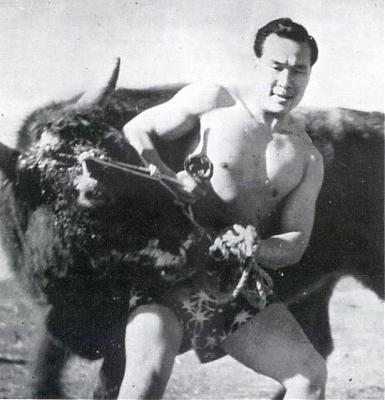
This is the most enabling psychology in the martial arts world today. The simple fact that someone out in the world is stronger than you is enough to fully discourage you from pursuing strength? Martial arts training is about more than that; traditional martial artists of yore weren’t only the most skillful at their arts; they were some of the most physically fit people you could ever encounter. If you look at the physiques of Sosai Oyama, Kanazawa Sensei, so on and so forth, these men had bodies made to fight. After all, TMA’s were designed to prepare fighters for war, not philosophy class.Jarell Post

How, then, does one begin such a pursuit for the physical fitness of the traditional martial arts warrior? Well there are two aspects that are fundamental to the physiology of every human: mobility and stability. Simple enough, let’s look at mobility here.

How Well Can You Move?

How well around can you move? No really, how efficiently can your body move as a unit? Perhaps you have a heavy squat, but can your butt reach the ground without the weight? In fact, most people have two vertebrae in their thoracic spines that all but fuse together, simply because we never make use of that full spinal mobility. If you want full physical preparation for any situation, ability to move your body in any given position should be a priority.

And the way to train mobility is not through intensity. I almost repeated that sentence for its importance; plyometric style programs may develop your explosive power, but is not the key to true mobility. In fact, I was taught that if you want to truly develop speed and control in a movement, practice it slowly. The difference is made with the tendons.

Intensity will be important for muscle training and stability, which I will cover in the next article, but variation and repetition has a precedence in mobility training. Tendons need high reps and consistency for proper development; the explosive movements, while helping the nerves in your muscle fire quicker, threaten the structural integrity of your tendons and ligaments. When practicing mobility slowly, the movements become ingrained into your body, and your connective tissues can develop alongside your nerves and muscles. Practicing those movements consistently over years is how gungfu is developed.

mas_oyama_bull


But for full mobility, variation is needed. Practice the basic, necessary movements daily over time, but when you can, add a variation to the movement you perform. Perhaps practice your squat with a posterior pelvic tilt to open the hips more. Maybe practice bringing your scapula further forward when you punch. Add different variations to your movements, but the variations must have a goal and build upon the basics, not deviate from them.

4 Tips for Bruce Lee Strength

Thanks to my friend, Jarell Lindsey, owner of Muscular Strength System, for this awesome guest blog post!

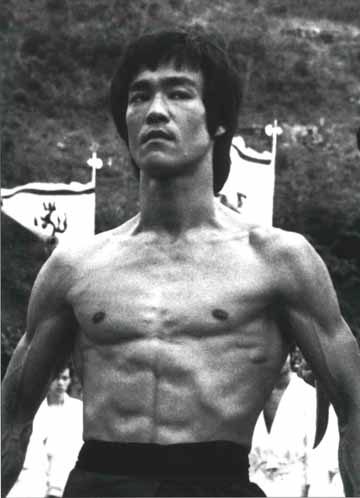
Bruce Lee is the face of fitness in America. Even 40 years after his death, he is an icon for one of the best physiques that the movie industry has ever seen, and every ounce of his flesh produced terrible strength.  At his bodyweight of around 140, Bruce Lee was known to completely demolish 300 lb heavy bags with his kicks, and punch with a force strong enough to completely splinter pieces of wood. More than power, he had dexterity, able to catch pieces of rice thrown into the air with a pair of chopsticks. He trained for function first and foremost, and the rest seemed to follow.
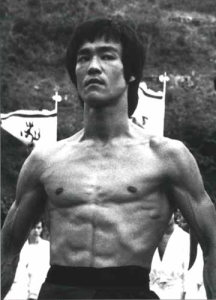
Bruce Lee

So how can one hope to even get near Bruce Lee’s strength? Just as it wasn’t for him, it will not be easy for you. In all honesty, Bruce Lee was one of those one-of-a-kind people, but that shouldn’t discourage you from training your utmost for Bruce Lee strength.  Here are four tips on how to get there:


Dedication. First, if you don’t have dedication, you can forget about the rest of these tips, because you’ll never get anywhere near the Dragon’s level of strength without using his greatest strength, which was his almost manic level of dedication to training. You better believe that if there was a single moment in the day that Bruce Lee wasn’t training, he was thinking about it. Moments like watching TV or standing in line were opportunities for extra training. A walk along the beach turned into sprints or multiple-mile jogs. Are you this dedicated to your strength? If not, that’s okay for now, because you can get there. But you’ve gotta start by doing at least one fitness related thing a day. If you can’t go to the gym everyday, walk a mile or two in the morning. If you feel up to it, make it a jog. Always think about how to improve your strength in the little things you do everyday, and it’ll become second nature.


Pyramids. Bruce Lee did a lot of pyramid training with his workouts; for a man who exercised only for function, pyramids were key. The biggest argument that martial artists had against lifting weights was that it’d make them slow and bulky. Bruce Lee proved that, by starting heavy and working your way down, you can improve strength and power without sacrificing speed. Say, for punch power, Bruce would start punching with 50 lbs for 10 reps, 40 lbs for 15 reps, 30 lbs for 20 reps and so on. So, are you ready for some intense functional strength? Incorporate these into your workouts.


Cardio. I know a lot of big, strong guys who don’t think cardio is necessary as long as they just “lift weights faster”. If Bruce Lee, who had one of the best physiques of the modern era, wasn’t too good for cardio, I’m not either. Truth of the matter is, cardio will give you the endurance to go much longer and harder in your workouts, and leaving out cardio keeps you from reaching your best fitness potential. If you’re a fighter, you know how important cardio is to keep you sane and stable for those last few rounds or that final period of the fight. It takes more that just heavy lifting to have athletic function. Bruce Lee really pushed the limit with his cardio, running 5 and 10 miles like an Energizer bunny, but the most important thing I’ve taken from his running is his interval training. Bruce wouldn’t just run aimlessly for years or sprint himself to heaven; he’d sprint, jog, shadowbox, jog and shadowbox, sprint, and repeat or switch up the pattern. This interval training is the king of cardio; it teaches the heart to be able to spike it’s activity rate from a resting heart rate more comfortably. Basically, interval cardio teaches your heart to go from 0 to 60 faster than other forms of cardio, or a lack of cardio altogether.


Isometrics. This was Bruce Lee’s secret weapon in his training, and it should be yours too. Think of isometrics as taking your body and filling it up with titanium. Isometric exercises train you from the inside out, strengthening your bones and tendons/ligaments in addition to your muscles. This is what helped Bruce Lee get that “sinewy strength” people often talk about. Isometrics are interesting because you don’t move at all during your exercise, but it gives you some incredible strength benefits. You can push or pull against an immovable object like a wall, or you can load the machine up with supra-maximal weight in your strongest range and contract against it like there’s no tomorrow. Trust me, your limbs will feel like they just got treated with adamantium, and your resulting strength will be proof of that. Happy training 🙂


About the Author  
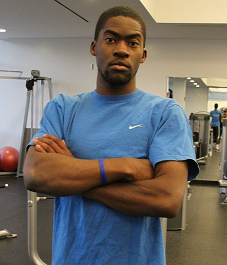
JarellJarell Lindsey is an avid physical culturist, and owner of MuscularStrengthSystem.com. He is an advocate of isometric training, and enjoys catch wrestling, sparring, or exercising in his free time. His training advice can be found on fitness, martial arts, and health sites across the web. Coming from a family plagued with various health conditions, he has been in pursuit of the best methods of health management and strength training around since youth. He is currently studying for a Bachelors in Exercise Science, and he hopes to motivate more youth to pursue physical fitness as a lifestyle. He offers training and diet advice, interviews from leading fitness experts, and self improvement advice. Ultimately, he encourages a physical culture revolution to overcome the modern health crisis.
Internally Rotate My What???

This post was inspired by a Facebook conversation started by my friend Jarell Lindsey talking about a mobility-based squatting motion with the feet parallel as opposed to splayed out (BTW, have you check out the Physical Culture Club page yet???)

There are many different ways to squat whether it is bodyweight only or with an implement such as a barbell, kettlebell, sandbag, or even another person.

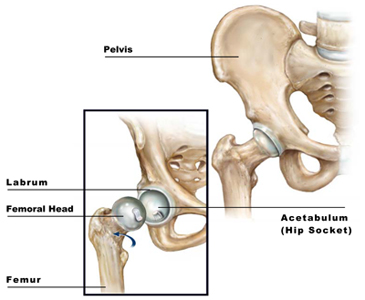
The particular squat I am talking about here is what I refer to as an Internal Rotation Squat.  The Internal Rotation Squat differs from the traditional bodyweight squat in that the feet are parallel, as opposed to opened outward, and the squatting motion is accomplished by internally rotating the femoral heads within the hip sockets rather than relying on quad muscle power alone.

hip-anatomy-new

The Internal Rotation Squat requires MUCH more mobility, control, and mind power to accomplish since you must actually teach your body how to rotate the bones of the femurs within the hip sockets.  This will take some practice!

 Why Do This?

In order to begin generating what known as Internal Power (IP), you must have mobility in the inguinal area that the Chinese Internal Martial Arts refer to as the kwa.  There is much, much more to IP than this, but having mobility in the kwa is an essential requirement.  Additionally, even if you have no interest in IP or Chinese Martial Arts, having this type of mobility and control is an asset in any athletic endeavor or martial art, regardless of style.

Internal Rotation Squat – Bodyweight Version

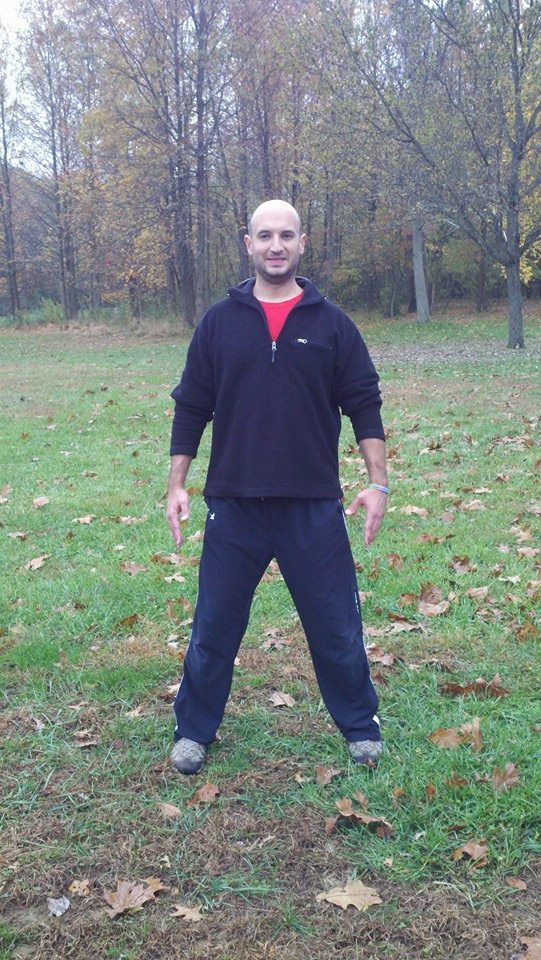
Begin with feet slightly more than shoulder-width apart.  Keep the feet facing forwards, as if on railroad tracks.

Squat1

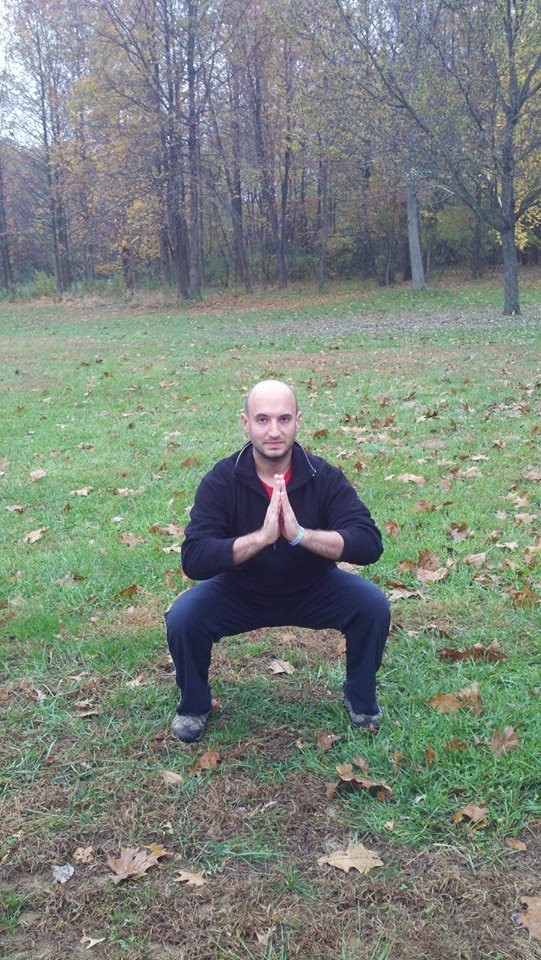
This will be important later when working on winding the tissues, but for now, just do it.  Place your fists on either side of the kwa (inguinal area) where the femur bones connect in to the hip sockets.  Use the imagery of turning your fists to aid in turning the bones.  Internally rotate the femoral heads and sit down into the kwa.

Squat2

Squat as low as possible while keeping your back straight and the weight mid-foot balance.  Pause at the bottom then externally rotate the femoral heads to stand back up.

Internal Rotation Squat – Goblet Squat Version

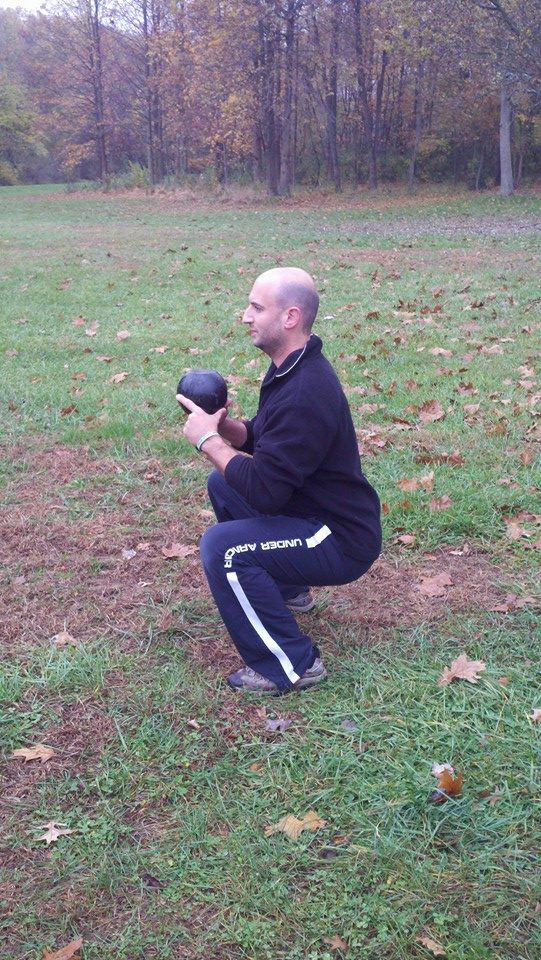
All requirements are the same as above with the addition of holding the kettlebell in front of your chest in the Goblet Squat position.  Use the weight of the kettlebell to allow you to sink further into the kwa.

Goblet Squat2

Thanks to Dan Harden for teaching me this exercise in the context of working on Aiki/IP.  Any errors or omissions are my own and not the responsibility of my teachers.  Also, thanks to Jaime for helping me to refine the squat and for taking the pictures!

Also, Dan Harden will be back in NJ in March 2014.  Details on the seminar can be found HERE <<====