Kata (Alone) Will Never Build Internal Power

Trying to develop Internal Power by training kata (alone) in martial art is problematic.  On one hand, you may inadvertently have minor success in creating some internal connection over the course of 20-30 years of training, but you will most likely have no idea how you did it, no idea why it worked (minimally at best), and most importantly, no idea how to correctly transmit it to the next generation.

The only advice you will be able to offer your students and fellow seekers is to keep doing this (kata training) and somehow you *might* get the correct result.  This is insufficient and irresponsible, at best, on the part of the teacher.

Assuming that you want to stand out from the crowd as a powerful martial artist, and Internal Power/Aiki is your goal, then the scatter approach to trying (and for the most part, failing) to build IP through kata alone is a waste of a career.  I say this because there exist clearly defined, step-by-step processes that rewire the body for Internal Power specifically for martial arts.

Solo Training Precedes Kata Training

Power building models as solo training exercises have existed for hundreds (if not thousands) of years  throughout the martial arts from India to China to Japan.  Why anyone would try to reinvent the wheel by attempting to create their own hodgepodge of exercises or think that merely training kata would develop real Internal Power is a mystery to me.  The reality is that solo training exercises burn in specific ways of moving that are not normal which create a very stable, powerful structure capable of absorbing, re-translating, and projecting incoming force.
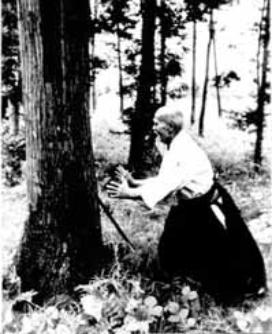
osensei_tree_kokyu1-272x334

Internal Power training is a type of General Physical Preparedness (GPP) for budo.  The goal of regular GPP for fitness, athletics, or martial arts is enhanced work capacity. This is the ability to run faster, jump higher, and hit harder. When work capacity increases, it allows the budding warrior to adapt more easily to increases in both mental and physical demands. In other words, it increases your capacity and level of readiness to absorb higher levels of specificity.

The solo training exercises for internal power training change the way outside forces act on the body.  The structure becomes dynamically stable so that applied force can either be distributed throughout the chain and dissipated or, at a higher level, simply reflected right back onto the opponent.  When force is reflected back this is what is known in Japanese as Yamabiko, or Mountain Echo.

Just to help further differentiate the two practices, solo training exercises for building internal power (there are other types of solo training exercises, obviously) are always made up of the following: standing, open/close, winding, spiraling, and breathing – all supported by Yin/Yang Theory (the union of opposites) and 6 directions (Heaven Earth Man).

Kata are for the purposes of patterning correct martial movement.

These solo training exercises are trained BEFORE kata to condition the body for powerful martial movement. They are not martial movement drills in and of themselves like sanshin no kata, kihon happo, and kata.

Kata – The Slow Boat to China

The reason it is so difficult to train IP via kata is that the vast majority of students get caught up in learning the movements of the kata correctly.  They get caught up in the application of technique and the idea of trying to make it work correctly.  What they don’t realize is that having a correctly trained body built by solo Internal Power exercises makes all the kata work much better and easier.
If you have a choice – why not learn a proven step-by-step method of developing unusual strength and Internal Power?


Join My New 21 Lessons on Internal Power Coaching Program <<==

Following a clearly defined path up the mountain is much faster and more effective than wandering around the base working on kata for 30 years and thinking you will somehow magically arrive at the summit.

Caution – While I did just say “more effective and faster” I by no means meant easier!!  Internal Power takes a lot of dedicated work.  Do not think it is a shortcut!
Weakest Direction Theory is BS – Part 2

Make sure you read the highly controversial Part 1,Weakest Direction Theory is BS, before moving on to part 2 below…

Preface

I love martial arts.  I love everything about it.  I love training martial arts, practicing martial arts, teaching martial arts.  I love reading martial arts history, philosophy, even martial arts fiction.  I love talking about martial arts.  I love writing about martial arts.  Are you getting the picture yet?  Have I pre-framed this well enough for you?   Continue reading

Never Take Ukemi Again

What if you never had to take ukemi again?

Not because you stopped training or avoided it or anything negative like that, but simply because no one who came in contact with you was able to throw you.

Interesting idea, eh?

Although for the sake of paired training and being a good training partner, perhaps a better model would be this – what if you only took ukemi from someone when you wanted to, and not when you had to?

What if you had the skill to naturally reflect incoming force so that an attacker was not able to throw you, joint lock you, take you down, or even off balance you? Continue reading

Internal Power and Bujinkan Training

When I first began talking about internal power in the context of Bujinkan training, I realized that many people might be skeptical of this type of training at the very least, or have many preconceived misconceptions that would not allow them to even consider the method as a viable form of training for budo.

Therefore I decided to write this blog post to gauge the interest of my readership and how accepting you might be of internal power training and my interpretation of its role within Bujinkan training. I hope you find it helpful!

What is Internal Power?

I think it’s best to start with the basics.  What is internal power and how can it useful to the practitioner of Bujinkan Budo Taijutsu?  Let me state this at the outset to hopefully clear up a rather unfortunate misinterpretation of IP.

Internal Power is physical.

It’s not some mystical mumbo jumbo or a throwing chi balls type of nonsense.

It is actually a way of conditioning the body through specific solo training exercises and paired partner training. The training method spans thousands of years and has been handed down through the ages within the warrior traditions of India, China, and Japan.  It is a body technology with a set method and detailed process of instruction that simply cannot be learned by osmosis.  It must be explicitly taught.

takamatsuSensei

The basis for the method is what is known as the union of opposites or In Yo Ho, in Japanese.

By creating opposing forces within the body (up/down, left/right, front/back) through the use of intent – your own mental direction using imagery, feeling, and visualization – we begin to increase the mind-body connection to a remarkable degree.

Through the solo training exercises we condition and strengthen the entire fascia network, as well as tendons and ligaments, throughout the body.  This process serves to create a connected body through the center so that when ‘one thing move, everything moves’.

The Ultimate Ukemi

Internal Power training changes the way outside forces act on the body.  The structure becomes dynamically stable so that applied force can either be distributed throughout the chain and dissipated or, at a higher level, simply reflected right back onto the opponent.  When force is reflected back this is what is known in Japanese as Yamabiko, or Mountain Echo.

At first blush it may sound like a party trick, but the budo applications are quite staggering.  Think about it.

How does every martial art technique work?

What is the first thing you are taught to do prior to applying a technique?

Break the opponent’s balance, right?  Get kuzushi.

What if no one can compromise your structure?

What does that do to every throw, lock, and take down applied to you?  Yeh.  You’re getting it now, aren’t’ you?

And that’s just the beginning.

Every time you move, you are completely and dynamically stable, balanced.  You gain the ability to hit like a truck using the full mass of a connected body without dedicating your weight.  (Remember – when one thing moves, everything moves.)

This becomes very profound, especially when you start to incorporate weapons.

And, since you are connected through the middle of your body due to the specific solo training exercises, you will finally and probably for the first time, actually be moving from center, hara, or dantien.

Sound interesting?

You can learn my full method of integrating and training the mind-body system HERE.


I am also more than happy to share what I know about internal power training, especially in the context of how it can be fully integrated into our Bujinkan Budo Taijutsu practice.  I teach it in my weekly classes and seminars upon request. Contact me HERE.