The origins of standing practices are lost in the mists of time, but one can easily imagine that they began with ancient hunters as a way of attuning to their surroundings and gathering deep reserves of energy and strength while becoming invisible to the prey they hunted.
As they were used by hunters, warriors, and healers they began to be further refined, developed, and codified into the powerful practices we have today under the broad heading of zhan zhuang or standing meditation.
The Paleolithic Posture
“In the Paleolithic Posture, the knees are slightly bent, the spine is straight and long, the breath is deep and quiet, the eyes are open and alert. The body feels like a tree standing with deep roots for balance and tall branches for grace… The Paleolithic Posture is an attitude of mind and body that was a matter of instinct and survival among ancient hunters, warriors, mothers, and healers.”
– Honoring the Medicine by Kenneth “Bear Hawk” Cohen, M.A., M.S.Th.
I researched, studied, and practiced these postures for well over a decade plumbing their mysteries and making them accessible for anyone who wants to understand and experience the tremendous benefits for themselves.
You can apply all that I teach to your own health, strength, and energy here or here.
“In ancient times great masters stood on earth, supporting heaven, controlling yin and yang, breathing with essence of qi, standing alone, guarding spirit, with body being as one.”
The health preserving and sustaining effects of zhan zhuang have been documented in hospitals and medical clinics across China. The reason this practice has such a profound impact on health and recovery from exercise is that standing meditation acts like a system-wide reboot for the whole body. It stimulates the nervous system, increases circulation, and raises energy levels, while providing deep relaxation for both mind and body.
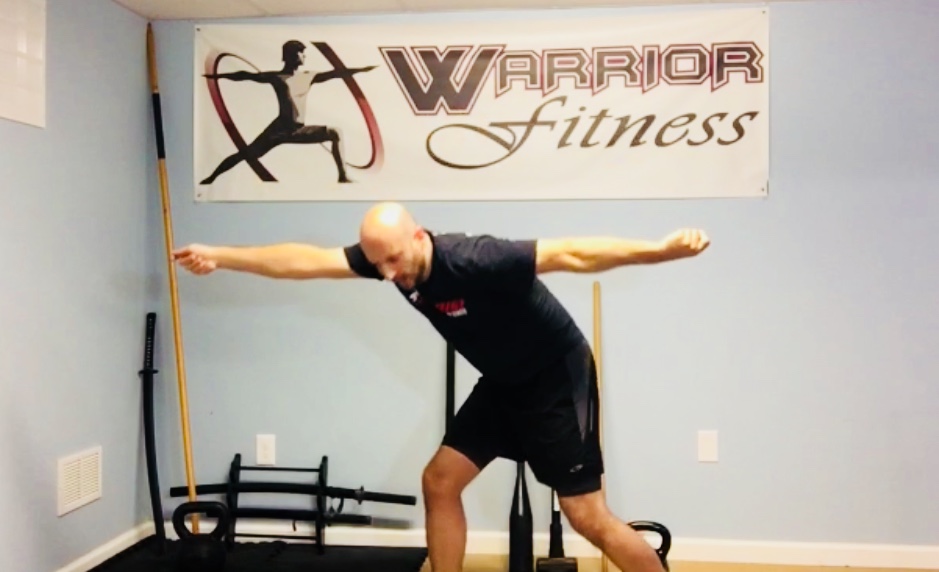
All movement skills, especially martial movement skills, must be built on a foundation of both stability and mobility. Today we will cover mobility.
A complete mobility practice moves each joint in the body through its complete range of motion bathing it in synovial fluid.
Movement is the only way your joints get nutrition!
Many trainers and coaches tend to look at the current rage of joint mobility protocols as recent innovations in sports science and training. Everyone is talking about mobility for health, mobility for prehab or injury prevention, mobility for warm-ups, mobility for fending off the ravages of aging. Everyone is talking about the benefits of increased range of motion for sport performance and martial art training enhancement. And, just to be perfectly clear, this is a good thing. They are all correct. Mobility training is the rage for a reason.
However, as with many “new” types of training methods, mobility work is an ancient idea come full circle.
This is not a new idea. In fact, Hua Tuo (2nd century AD), one of the patriarchs of Chinese Medicine and creator of the famous qigong set, The Five Animal Frolics, once said:
“Just as a door hinge will not rust if it is used, so the body will attain health by gently moving and exercising all of the limbs.”
Hua Tuo’s The Five Animal Frolics model movements from the crane, bear, monkey, tiger, and deer. Each animal emphasizes different health benefits and you can choose a specific animal for specific results. The movements form arcs, spirals, waves and spins, in order to accommodate all ranges of motion for the body.
Now what does that sound like?
Health by moving and exercising all the limbs… hmm… reminds me of a certain new exercise protocol called joint mobility. And this quote from Hua Tuo is just one example. There are many more within Chinese Medicine as well as Indian Yoga that all point to the same idea – mobility is essential for health. Or, more crudely but succinctly put, move it or lose it.
Each session can range from a quick 5-minute recharge to a 30-minute in-depth deep practice. It’s up to you and how your body feels on a particular day.
For example, did you do a ton of heavy lifting or a super intense metabolic conditioning session the day before?
Maybe a longer, deeper mobility session is required to aid in restoration and recovery.
Or, did you just get out of bed and maybe only have 5 minutes before you have to get ready for work? A 5-minute quick-n-dirty mobility session will charge you up and get your body moving (literally!).
Daily Practice
I have been performing my mobility practice almost every day for over 15 years now. However, there have been a few times when I decided to forego it for several days in a row just to see if I could notice a difference. After 3-4 days without it I began to notice. Muscles were tighter. Movements were less fluid. Joints were crunchy. When I finally stopped my no mobility experiment on day 5, the contrast was amazing!
In my experience, mobility training and breathing exercises are the biggest bang for your buck daily practices that will only reward you more and more with each passing year.
Benefits of Mobility Training
In no particular order, here are some of the benefits of mobility training:
Lubricates joints and allows them to receive nutrition through synovial fluid
Aids in removal of toxins
Reduces joint pain and inflammation
Increases range of motion (flexibility in motion)
Increases energy by reducing unconsciously held tension
Prehab for injury prevention
Mobility is foundation of all sport, athletic, and martial movement
Decreased mobility leads to increased pain and stiffness
For your daily training, here is my own personal full-body joint mobility routine. Implement this first thing tomorrow morning and feel amazing all day long!
I had a very interesting conversation the other day with an elderly Chinese gentleman. At 74 years young he still works part-time as a medical doctor and is in excellent health. He told me that back in 1982 in China he was diagnosed with a very severe lung problem, which was slowly reducing his breathing capacity. The doctor at the time gave him only 3 months to live!! I looked at him in amazement and said- “Well, obviously you are still alive and in good health, so what happened?” Continue reading →
Many trainers and coaches tend to look at the current rage of joint mobility protocols as recent innovations in sports science and training. Everyone is talking about mobility for health, mobility for prehab or injury prevention, mobility for warm-ups, mobility for fending off the ravages of aging. Everyone is talking about the benefits of increased range of motion for sport performance and martial art training enhancement. And, just to be perfectly clear, this is a good thing. They are all correct. Mobility training is the rage for a reason. Continue reading →