Balance Training Drills

Balance is an essential quality for the warrior to develop.  It directly affects our ability to move with grace, coordination, agility, and power.  Yet direct balance training exercises seem to be a neglected area in many people’s training programs unless they are recovering from an injury or trying to fix a specific weakness.  Personally, I think they should be an integral part of training.

The following is an introduction to the balance drills I use to train myself as well as my martial arts students and fitness clients.  I hope you find them as useful as we do.

There are 3 Systems the Body Uses to Orient Itself in Space

1. Visual – Relying on sight is the second fastest and most efficient mechanism in our balance (unless we are in a dark room!).  Most people tend to rely on visual cues for balance, to the detriment of the other 2 systems.  The visual system relies on a physiological reflex called the Ocular Gyro Cephalic reflex which creates tension chains that reflexively cause the body to orient toward whatever the eyes see.

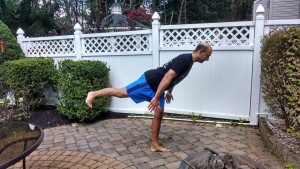
Balance Drill Leg back

2. Vestibular – This system relies on the fluid within the ears to sense balance.  As we move, the fluid sloshes around.  If we are not used to a particular pattern of movement, we may begin to feel dizzy. The brain works to process this information and integrate it with the information coming in from both the visual and proprioception systems.

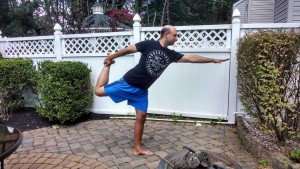
Balance Drill Leg back hold

3. Proprioception – This our sense of position and movement of the limbs and the sense of muscular tension.  Proprioception utilizes information derived from sensory receptors in our muscles, tendons, and joints to inform us of changes in movement, position, and tension.  Proprioception is plugged directly into our nervous systems making it possibly the fastest and most efficient mechanism for balance, as long as we train it.

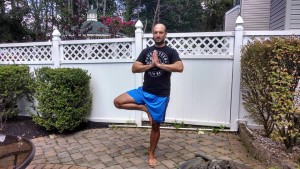
Balance Drill Tree

The balance drills shown in the video below will allow you to train all 3 systems concurrently.


For more information on balance and proprioception training, check out my new program:

Balance: The Fall Prevention System <<==

The Failure of Yogic Breathing

There are many different systems of breath work out there that focus on relaxed breathing and stress reduction that also talk about how to increase breath control and expand the practitioner’s lung capacity.  Unfortunately the majority of these systems fall short due to the fact that they tend to focus the bulk (or all) of their work on static posture breathing and breath retention exercises.  Usually the practitioner is either seated on the floor, on a chair, or lying down in a comfortable, meditative posture while the breath is regulated through a series of counts and breath is retained in gradually expanding holds.

Breathing2

Before any of my Yogi friends get upset with me, let me clearly state that yes, this process works and I am a huge fan of Yoga’s Pranayama along with other systems of breath work.  There is nothing wrong with it!  Doing this type of exercise on a regular basis will increase lung capacity and control, to a degree.

So What is the Problem?

The problem with this type of exercise, as I see it, is that very rarely do we require all that enhanced lung power and capacity while sitting on our butts in a comfortable and relaxed position.  Unless you are only interested in showing off how long you can hold your breath at parties and stuff, this way of exercising has limited usefulness.

A much more practical way of exercising lung capacity and breath control is by working the body through a series of simple calisthenics.  By placing the body under stress via exercise while incrementally increasing the retention of the breath on both the inhale (easier) and the exhale (more advanced), we magnify the results.  In my experience, this has a much broader and far reaching effect on the body’s systems.  It is also vastly more practical in terms of real world usage for martial art, athletics, and overall strength & conditioning training.

So, how do we do it?

I’m glad you asked!  Let’s begin with one of the most natural movements in the world, a basic bodyweight squat.

If you are not familiar with a basic bodyweight squat, here is a super quick tutorial:

  1. Stand in a natural position with feet slightly wider than shoulder width apart
  2. Keep the alignment of your spine as straight as possible from crown to tail bone.
  3. Squat down as low as possible while maintaining the alignment of your straight spine.
  4. Keep the weight mid-foot balance.
  5. Pause for a second at rock bottom.
  6. Lift from the crown of the head to “pull” the body back to standing.

Breathing Squats

We will do our breathing squats in the same fashion but with a couple modifications.  First remember that the purpose of these exercises is to train your breathing and expand your breath control and capacity.  They are not meant to “kill” your legs.  Although, depending on your level of conditioning, they might.

  1. Perform a basic bodyweight squat as detailed above.
  2. Just prior to beginning the squat, inhale deeply into the belly and comfortably hold the breath.  Your goal is to do the squats as relaxed as possible while maintaining the breath hold.
  3. Do 3 squats all while holding the breath on the inhale.
  4. After the 3rd squat, exhale and inhale.  Slowly inhale into the belly and exhale sharply to recover your breath.  When you are recovered, do 3 more.  Repeat.
  5. When you can comfortably do 3 squats while holding your breath (meaning you are not out of breath when you stop), then proceed to 5 squats on the breath hold.

Slowly increase the number of squats you can do on the breath hold.  When you can comfortably do 10 squats with the breath held on the inhale, start over again with 3 squats and hold the breath on the exhale.  You will find that holding the breath on the exhale is much more difficult.  The body is already out of breath and now you are adding stress in the form of exercise.  It is here that you will make the greatest gains in teaching the body how to use a limited supply of oxygen in the most efficient manner.  Make sure you proceed slowly and only add more repetitions when you can comfortably hold the breath on the exhale.

Remember – B.I.F (Breathing Is Fundamental)!

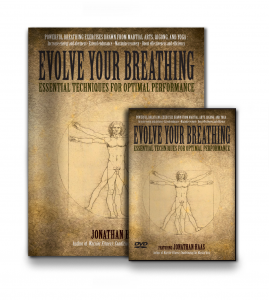
Evolve Your Breathing is a master class in learning how to breathe and respond under stress.  Don’t just breathe to survive – Thrive!!

Learn more here…

EVOLVE_SPOT-1 (2)


The 4 Top Strength Training Myths for Women

When talking about strength training for women there are several pervasive myths that seem to never go away.  Here are the four  most common ones.

  1. I’ll Bulk Up.  This is probably one of the most pervasive, albeit incorrect myths out there.  Women simply do not have the correct hormone profile to build huge, bodybuilder type muscle. Continue reading

To Stretch or Not to Stretch

When it comes to the question of stretching, there are opinions all across the spectrum.  Some experts contend that you should never stretch at all since it deforms the tissues, destabilizes the joints, and makes the body more prone to injury.  Then, on the completely opposite side of the scale, is the other camp which swears that stretching is an absolute must prior to any activity (up to and possibly including sex) as it is a way to warm-up the muscles to prevent injury.

So, who is right? Continue reading

Warrior Workout in the Park

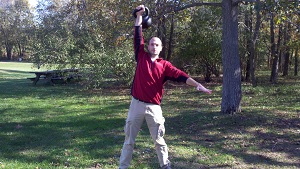
This past Saturday was a beautiful fall day here in Jersey.  A perfect day for a Warrior’s Workout in the Park!  This workout was directly inspired by Zach Even-Esh’s Ultimate Underground Strength System.

Warrior Workout

15 minute warm-up – mobility, movement, animal crawls, band work, breathing exercises followed by…
1) KB Clean & Press –  5×5
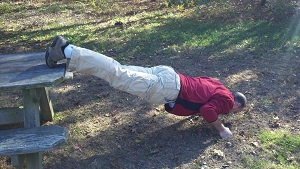
2A) Picnic Table Push-ups on fists – 4 x submax
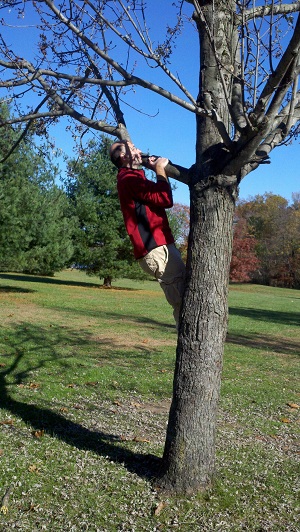
2B) Thick Tree Branch Pull-ups – 4 x submax


3A) KB Goblet Squats 4×10 (forgot to take pics of these – sorry guys!)
3B) KB Swings 4×10

4) Abs / Grip work 3 sets each

The cool-down consisted of various yoga asana and breathing exercises as both normalizing work and compensatory movement.

Hope you enjoyed this!  How did you workout this weekend?  Let me know!

Yoga for Guitar Players

This is an article I wrote last year for my friend, Josh Sager’s kick-ass guitar blog, Fretterverse.  I hope my Warrior Fitness readers enjoy it as well!

 Every guitar player knows that consistent practice is the key to becoming great.  But what happens when your daily practice is causing you daily aches and pains?  Give up?  No way.  Scale back your practice?  Not a chance.  Live with it?  Some do.  You shouldn’t have to.

Every activity that we repeat consistently causes an adaptation in the body.  The critical thing to note here is that it does not matter at all how we value this adaptation.  It can be something that we want like how healthy exercise increases lean muscle mass and burns excess fat, or it can be something we do not want like how eating junk food to an extreme causes our body to adapt by putting on weight.  Both of these are examples of activities that cause adaptations in the body.  Sitting and playing guitar for extended periods of time also causes specific adaptations in the body.  Some we value highly, like the enhanced neural connections in our nervous system that adapt to increase our skill level.  Others, like hunching over a classical guitar for example, may cause our body to adopt this rounded back, slumped shoulders posture while standing and performing activities other than practicing guitar.  In order to bring our bodies back to balance, while retaining the adaptations we value, ie the skill in playing that our practice is supposed to generate, we must compensate specifically for the typical posture used while shredding.

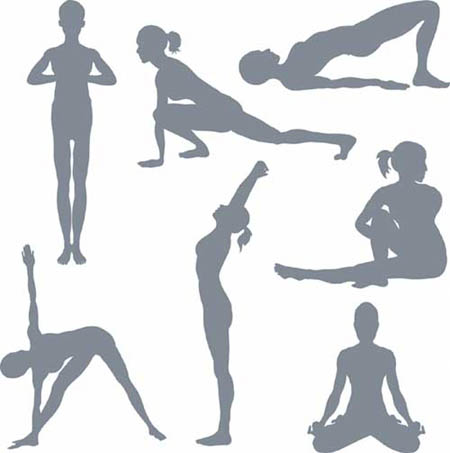
Yoga is designed to bring your body back to balance.   Don’t worry, I’m not about to ask you to jump into a Power Yoga class.  Not unless you want to, anyway.  What I am going to have you do is take about 10 minutes after your practice and use just a few simple yoga postures (illustrated below) to help bring your body back to balance and prevent, or relieve, the back and neck pain that tend to be associated with long term sitting, whether due to working on a computer, sitting in an office, or sitting while practicing guitar.  An added benefit is that we will also open up your chest and lungs to improve your breathing pattern and help reduce stress.
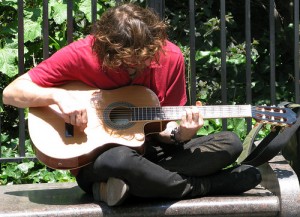
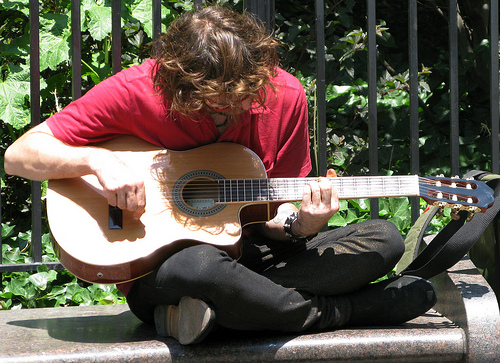
Note in the picture above how his back is rounded and his head looking down.  Over time, this will contribute to low back pain, neck pain, and hunched, rounded shoulders.  His posture is not optimal for breathing either.  The effect of rounding the back concaves the chest and compresses the lungs making it difficult to achieve a full, deep breath.

Postures

1.  Shoulder bridge
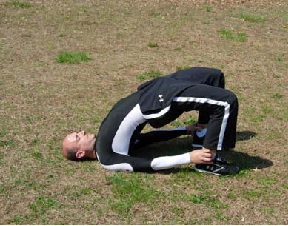
  • Lay on your back and bend your knees
  • Pull your heels in as close to your butt as possible
  • Exhale and lift your hips up, driving with the middle part of your feet
  • Squeeze your glutes and lift a little higher
  • Exhale and pull your belly to your spine
  • Hold for 20 to 30 seconds
  • Relax for a few breaths and then do it again
  • Bring your knees into your chest and squeeze them tight to release any excess tension
  • Straighten out your legs and then move onto the next posture

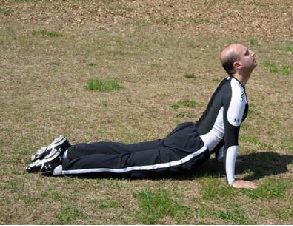
2.  Upward Facing Dog
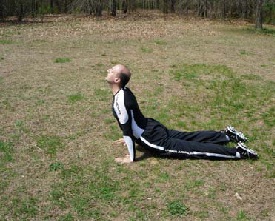
  • From the end position of the last posture, laying on your back, roll over onto your stomach
  • Lift from the crown of your head and drive with the palm heels
  • Make sure your elbow pits are facing forward
  • Drop your shoulder down, so they are not up by your ears
  • Lift your hips and legs off the ground
  • Inhale, expanding the chest, lifting it up at a 45 degree angle
  • Hold for 20 to 30 seconds
  • Lay down flat on your stomach and rest for a few breaths
  • Repeat and then finish by moving into Sleeping Warrior

3.  Sleeping Warrior
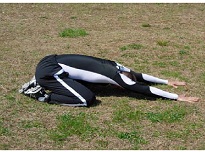
  • From a kneeling position, exhale and pull your belly to your spine.
  • Fold your torso forward over your knees and place your forehead on the ground.
  • Extend your arms straight out in front of you.
  • As you extend and reach with the hands, draw the shoulder blades down so they are not coming out of joint.
  • Continue to extend and pull back to stretch and release the tension stored in your shoulders.
  • As you inhale, you will find it difficult to expand the abdomen and the chest due to the compression.  Try to find the free spaces on the sides and back where you can inhale into and expand slightly.
  • As you exhale, again pull belly to spine and contract your core moving deeper into the posture.

What About My Hands?

Although the following are not particularly yoga exercises, they can be of benefit to guitar player’s hands.  The repetitive motion of strumming and chord changing can cause problems similar to the repetitive keyboard typing of the desk jockey and thus special attention needs to be paid to the hands, wrists, and fingers.

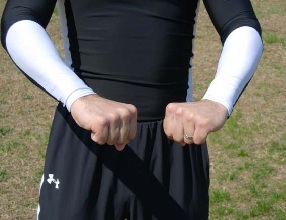
Releasing the Wrists

  • Hold both hands in loose fists, make circles clockwise for 5 to 10 reps and counter-clockwise for 5 to 10 reps
  • Next, starting with left wrist, hold in fist as above, lift wrist up, to the outside, down, to the inside, reverse direction and repeat with right wrist for 5 to 10 reps each direction
Releasing the Fingers

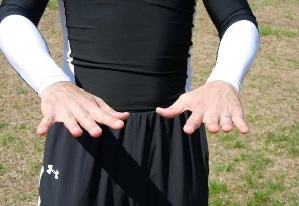
  • Begin circling fingers with thumbs (5 times each) then continue with each additional finger
  • Circle fingers from pinkies back to the thumbs in the opposite direction
Shaking the Hands

  • Shake the hands vigorously keeping them very loose for about 10 to 20 seconds.  This has the effect of releasing residual tonus and relaxing the muscles.

The above exercises, if performed consistently, will act as compensation for long periods of sitting and help you to abate any type of chronic muscle tension and pain that comes as a result of your practice.  There are, of course, many other yoga postures that can be utilized with the same type of success to help compensate for any type of activity, including inactivity!  Hopefully this brief introduction on yoga for guitar players will enable you to practice longer and pain free – shred on!

About the Author:  Jon Haas is a NJ based fitness trainer, writer, and martial artist.  He can be reached at www.warriorfitness.org
Yoga – A System

Special thanks to guest author, Tony Notarianni  for another excellent contribution!

In my latest Yoga class I was about to leave and I felt like I had left something, twice I went back from the reception area and twice I found that all my possessions were with me.  I left and returned home, and it was a little later that I realized something was missing.  Not physical but something else, a part of me that was perhaps unduly troubled or distressed.  It was gone, at least for a while.
I am not saying Yoga is the cure for all life’s ills, but there is some magical moments that can occur if you just dedicate yourself a little to its teachings.  On the physical level it lengthens and strengthens muscles.  It provides tone and improves posture.  Joints open up and movements become more efficient.  Internal organs are massaged by your movements and the lungs are developed through breathing.  Throughout the whole process you work the mind, overcoming the physical by focusing the concentration which culminates in a calmness deep inside your being.  This leads to an open mindedness that allows you to see things differently, to think and act in new ways.
Have I sold it to you yet? Are all the things I told you true? I know them to be true through personal experience and observation.  You see when I first started doing Yoga which was about 8 months ago things were different.  Not only were things different but I saw them differently.  I had a more negative outlook on life.  My body was deteriorating for one thing, I couldn’t run much because of hip pain, I couldn’t do much weights because of back pain.  I could still do my martial arts but at the back of my mind I was wondering how long and at what level can I maintain that kind of training.  There was also a swathe of things in my personal life that I will not go into with detail but I assure you were weighing me down immensely.  To sum it up, I had a lot of things to deal with and sort out, starting with the body itself.

Why Yoga?

Having had Yoga suggested to me I went along to my first class with a very weak hope that maybe it would help a little bit. It did help, I felt like I had a good workout and it really got my circulation going.  So I went back.  Next time I found I was a bit more flexible and that in the relaxing stage of the class I was deeper under.  So I went back.  Next time I found a posture that was really difficult but left me feeling rehabilitated afterwards.  So I went back.  And this is the amazing thing about Yoga to me, that it keeps giving you new benefits every time.  I am not a Yoga historian, so I do not know the intricacies of how it was developed, but I can see that the system is designed so that whatever your current state, you only have to enter into practice and the rest takes care of itself.  That is why it is a system and not just a recreational activity, it is somehow self regulating in all aspects.  If you develop flexibility you can hold deeper and more opening stances, in which case your muscles need to strengthen.  In order to do some balancing exercises you must be able to focus fully, this develops your self control and allows you to improve your technique.  In other words every posture you hold gives you exactly what you need and this gift allows you to get more rewards from other postures and so the cycle continues.  The important thing is to keep working on it and enjoy the benefits.  And the benefits of course are not just that you get better at your Yoga, you get better at life.  Also of note: I have started running and lifting weights again.

My Yoga Teacher

At this point I should mention my Yoga teacher Bridget Yanni.  She runs a Yoga centre called Amma Yanni Yoga in Glenside PA.  Her style is inspired by Iyengar, Anusara and Inner Fire Yoga; each a form of Hatha yoga.  The class usually starts with a warm up using variations of the Sun Salutation or Surya Namaskara.  Once warmed up the class can vary immensely.  The focus could be on twists, back bends, handstands, upper body, thighs, binds and various other aspects.  Sometimes Yin yoga is incorporated where a posture is relaxed into for several minutes.  Some classes have a spiritual focus, others are more physical.  You never know what to expect and I like this variation a great deal.  At the end of the class we finish with Savasana at which point one can let go having earned a deep relaxation.  As a teacher Bridget is very educational, she has an extensive knowledge of the body structure and ensures that we work on a strong foundation while we practice.  The class also feels quite personal in that you are not left alone and uncertain about what you are trying to achieve.  Another thing I like about her teaching style is that she encourages you to believe in your own abilities.  Most of the time she is right, and many students, including me, have surprised ourselves at what we were capable of.  The other side of this is that she always has alternate exercises for those who can’t do the basic exercise due to body problems, so everyone gets to work at their own level.  To me this is very important because Yoga is not just about restoration and healing, it is also about development.  Taking you from the negative, back to zero and then upwards into the positive in a sustainable manner.

In summary Yoga is an incredible vehicle for improving every part of your being.  The key is to find a good instructor so that you can jump aboard and stay the course.  How long is the road?  It is as long as you need.

About the Author

Tony Notarianni has been training in martial arts since the age of 12.  Up to this point, although quite active, he had very little interest in sports and fitness but that all changed over the coming years.  He started studying Sport as a subject at school and finally graduated with a Bachelors Degree in Sport and Exercise Science in 1998.  Although not a typical sportsman and not a great fan of any one sport, Tony was always keen to try new activities and considers the world to be literally full of physical experiences to explore.  Before graduation he was working at a sports complex where he was a lifeguard and could join and observe many different forms of exercise.  He also taught circuit classes and was a qualified personal fitness instructor.  After graduation he chased the dollar and ended up working in Software Development.  Although becoming more sedentary he still has a deep rooted interest in improving himself physically and developing his knowledge.