Yielding vs. Overcoming Isometrics: The Two Types of Strength for Martial Artists
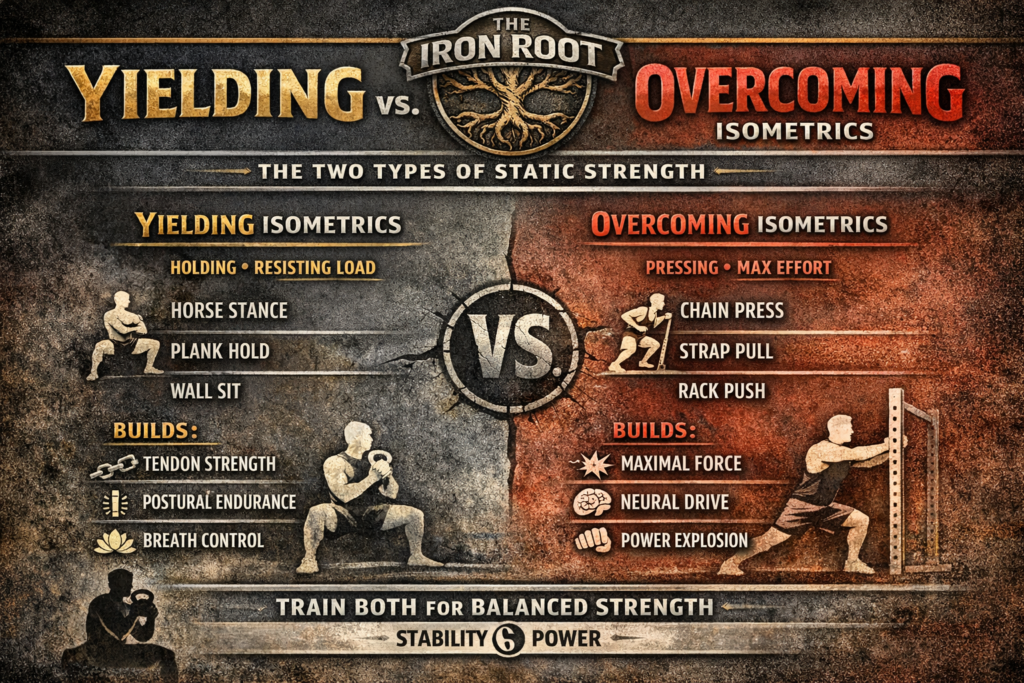
There’s a reason isometric training has quietly become one of the most powerful tools for martial artists, grapplers, and fighters who want to develop real strength without destroying their joints.
But here’s something most people don’t realize:
Not all isometrics are the same.
In fact, there are two fundamentally different types of isometric training, and each one develops a completely different layer of strength.
These are known as:
• Yielding Isometrics
• Overcoming Isometrics
Understanding the difference between these two methods can completely change how you train.
Because when they’re used correctly, they develop the exact qualities that traditional martial artists valued most:
• structural integrity
• tendon strength
• breath control
• whole-body power
Let’s break them down.
Yielding Isometrics
The Foundation of Structural Strength
A yielding isometric is when you hold a position against gravity or load without allowing your posture to collapse.
You are resisting the force and refusing to give up the position.
In other words:
You yield to the load, but you do not break.
Examples include:
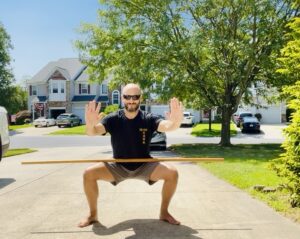
• horse stance holds
• planks
• side planks
• push-up holds
• goblet squat holds
• wall sits
• suitcase carries
In martial arts, these positions closely resemble traditional stance training or zhan zhuang standing practice.
They develop something that most modern strength programs ignore – structural endurance.
Instead of building strength through movement, you build strength by learning to maintain alignment under pressure.
And that produces several powerful adaptations.
Yielding Isometrics Build Tendon Strength
When you hold a position for time, the load transfers directly into the connective tissue.
That means you strengthen:
• tendons
• ligaments
• fascia chains
These tissues adapt slowly—but when they do, the strength becomes extremely durable.
This is why old martial artists could train for decades without breaking down.
Yielding Isometrics Train Breath Control
One of the most overlooked benefits of static holds is how they affect breathing.
When you hold tension for time, the nervous system must learn to regulate pressure and breathing simultaneously.
If your breath panics, your structure collapses.
Learning to breathe calmly under load builds the same composure needed for:
• grappling exchanges
• striking under pressure
• resisting takedowns
Yielding Isometrics Improve Posture and Alignment
Static holds teach the body how to:
• stack joints correctly
• distribute tension through the body
• root into the ground
This is the foundation of what many internal martial arts call connected power.
The Limitation of Yielding Isometrics
While yielding isometrics are incredible for building structure and endurance, they have one limitation.
They do not train maximum force production.
In other words:
They make you stable and durable—but not necessarily explosive.
That’s where the second type of isometric training comes in.
Overcoming Isometrics
The Hidden Method for Building Raw Power
An overcoming isometric occurs when you attempt to move an object that cannot move.
Instead of holding a position, you push or pull against an immovable resistance.
Examples include:
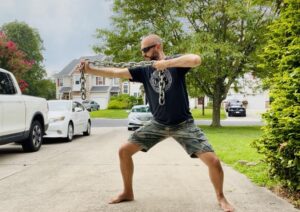
• pulling against straps or chains
• pushing against a wall
• rack pulls against safety pins
• belt squat pulls
• towel pulls in horse stance
In these exercises, the goal is to apply maximum force.
The object doesn’t move, but the nervous system behaves as if it should.
This creates an extremely powerful training effect.
Overcoming Isometrics Train Maximum Neural Recruitment
When you attempt to move an immovable object, the nervous system recruits as many muscle fibers as possible.
This dramatically increases strength.
Even though the object never moves, the body learns how to generate maximum contraction.
Overcoming Isometrics Build Explosive Power
These exercises train the ability to produce force quickly.
 That makes them incredibly valuable for martial artists who want to improve:
• striking power
• grappling pressure
• pushing strength
• pulling strength
Overcoming Isometrics Strengthen Tendon Elasticity
Short bursts of maximal tension also increase the spring-like behavior of tendons.
This creates the elastic recoil responsible for powerful striking and throwing mechanics.
The Limitation of Overcoming Isometrics
Overcoming isometrics are extremely intense.
If they’re used too frequently or without proper structure, they can:
• fatigue the nervous system
• create excessive tension
• encourage breath holding
This is why the best systems combine them with yielding isometrics.
The Real Secret: Combining Both Methods
The most effective strength systems use both types of isometrics together.
Yielding isometrics build:
• structure
• endurance
• tendon durability
• breath control
Overcoming isometrics build:
• maximum force
• explosive strength
• neural recruitment
• elastic tension
In traditional martial philosophy, this combination represents the balance of:
Yin and Yang.
Yielding training stores potential.
Overcoming training releases it.
Together they build a body that is both stable and powerful.
How I Teach These Methods
Inside my training programs, these two methods are integrated into a progressive system.
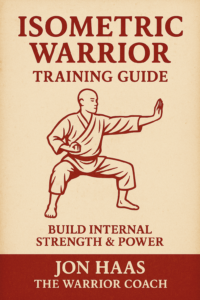 The Isometric Warrior Training Guide
This program teaches the foundations of structural strength through carefully selected yielding isometrics.
You will learn how to build:
• strong connective tissue
• stable posture
• calm breathing under load
👉 Learn more about The Isometric Warrior Training Guide here
The 21-Day Isometric Forge
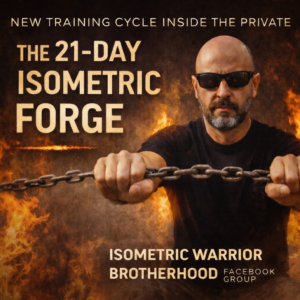 Inside the private Isometric Warrior Brotherhood, we take the next step and begin integrating overcoming isometrics.
These exercises introduce:
• diagonal force
• rotational tension
• strap-based resistance
• martial power development
Access to the Forge is available as a free bonus program when you join the Brotherhood through the Isometric Warrior Training Guide.
The Iron Silk Method
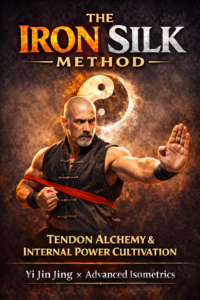
For advanced practitioners, the Iron Silk Method combines traditional tendon-changing exercises from the Yi Jin Jing with advanced isometrics to develop deep structural power.
This program integrates:
• breath training
• tendon elasticity
• structural force transmission
👉 Learn more about The Iron Silk Method here
Final Thoughts
Many martial artists spend years training technique while neglecting the body that must perform it.
The result is predictable:
Skill increases.
But power becomes inconsistent.
By combining yielding and overcoming isometric training, you develop something different:
A body that can express technique effortlessly.
Stable.
Elastic.
Calm under pressure.
The way martial artists were meant to move.
—
Jon Haas
The Warrior Coach
 The Five Pillars of the Iron Body
 Bringing It All Together