Sanshin no Kata (form of the three hearts) forms the basis for movement in the Bujinkan. These five foundational exercises cannot be overlooked, especially with regard to solo training.
When I first began training in the Bujinkan over 20 years ago there were very few training resources. There was no Internet! In a way it was much easier for a beginner since there weren’t a lot of distractions. Today we are bombarded by information and perhaps sometimes even overwhelmed by it. Back in the day, practicing alone was easy. You had kamae. You had some basic strikes. You had ukemi. You had basic hanbo movements. And, you had Sanshin No Kata. In the early days of my training, Jack Hoban used to drill us in these basics virtually every class. I remember many a hot, sweaty night in the old gym dojo back in Asbury Park, NJ where the small class would work Sanshin No Kata in front of full length mirrors for the entire class, usually followed by basic kicking and punching an ancient heavy bag in the corner. This kind of practice may seem boring or at least unsexy these days, but I assure you it built a very strong foundation.
How to Practice
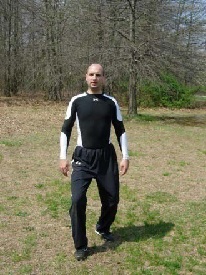
Today, one of the best ways to practice these kata is still in front of a full-length mirror. This way, you will be able to notice all the little “hitches” and inconsistencies in your movement. Use the mirror as a training device to evaluate your posture and movement. For each kamae, and especially including the transitory movements between kamae, make sure that:
- back is straight (crown lifted up),
- shoulders are down,
- head is not transposed forward over the neck,
- chest is relaxed,
- butt not sticking out,
- hips are open,
- knees are over the toes,
- weight evenly distributed (50/50)
- no leaning forward or backward
These are the very obvious, glaring errors that will be easily noticed as you start this practice. Chronic tension and tightness when in transition between kamae will be abated with continued practice – the key to eliminating the excess tension in your movement is first being aware of it! With consistency and patience, you will gradually shape your body to conform to the characteristics of good taijutsu. This is not an easy process and can be painstakingly difficult due to the constant attention to detail working to chip away at all the unnecessary, inefficient movement built up over years of chronic tension and unnatural movement. You may also notice a particular lack of flow between movements because you are concentrating so much. Build efficiency in steps. First, work on the static kamae. Next begin to add the steps and strikes. Finally, work the entire kata in a flow with no pauses or breaks in the movement. This process will gradually streamline your movement and eliminate the unwanted tension and imbalances. It takes a lot of practice, dedication, and hard work to move with ease!
Chi No Kata as an Example
Let’s take a look at the first kata, Chi no Kata, as an example.
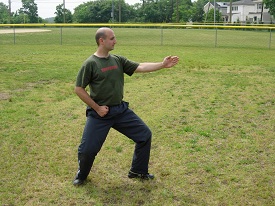 To begin, start in Boubi No Kamae, left hand straight out in front with a natural bend in the elbow, pointed at the opponent’s heart, right hand held in a fist in the crook of your right hip. Move with exaggerated slowness as if practicing a Tai Chi version of the kata.
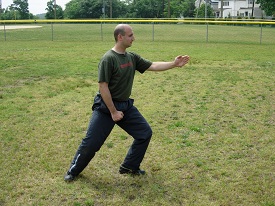 Drop the weight from your hips, shift over the front knee, and let your rear elbow straighten, dropping the hand in front of the hip to create a slight tension in the spine. This point here about creating torque or stored elastic energy (SEE) in the spine is essential in being able to move powerfully without winding up or telegraphing the movement. If you are having trouble feeling it, try to exaggerate the movement. Make it much larger than necessary to study the feeling. It should feel like a tension in the lower back near the bottom of the spine.
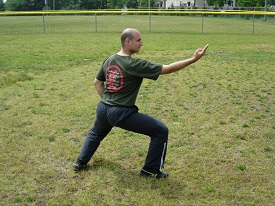 When this tension (torque) is relaxed (released), the movement happens. See if you can figure out where the energy is stored and how it’s released in the rest of the San Shin no Kata!
Be very careful when transferring your weight that you do not bob up and down; move smoothly through the same plane by shifting your weight laterally. Another point to be mindful of during the weight transfer is that you should be in balance (kamae) at all times. If you were to stop the movement at any point in the transition, you should not lose your balance.
Try it. Practice it. Create a strong foundation upon which to build, expand, and grow so that all the information and knowledge being handed down to you today takes root.
You can pick up my video tutorial on how to use Sanshin No Kata to create stability and power in your movement as a FREE Bonus with my Martial Power Program. OR, you can click HERE and get the Sanshin No Kata video separately for just $7!