If you’re like me and can’t stand to waste any amount of time no matter how short, you’ll love how isometrics can fill in some strength gaps. Nowadays, my days are jam-packed full with work, meetings, conference calls, networking, family time, training time, teaching time, writing time, and oh yeah – a little sleeping in my spare time. Since there are never enough hours in the day to accomplish all the things I want to do (not to mention those pesky things I have to do!), I try to make the most of those few free minutes of downtime in between tasks so I can be just a little more productive.
The only way to constantly improve is to consistently work on improving your self. One of my favorite quotes of all time is from Calvin Coolidge:
“Nothing in this world can take the place of persistence. Talent will not; nothing is more common than unsuccessful people with talent. Genius will not; unrewarded genius is almost a proverb. Education will not; the world is full of educated derelicts. Persistence and determination alone are omnipotent.”
And, since I don’t consider myself particularly talented, or even all that smart, it’s a good thing I am persistent!
So, let’s talk isometrics.
Isometrics are a great way to work on increasing strength, or shoring up a strength deficiency in a certain movement or exercise, with virtually no equipment and very little time. They are both effective and efficient – good news for us!
So what exactly are isometrics? Basically, isometric exercise is exerting force against an immovable object. The idea is that the length of the muscle does not change, but the tension remains constant during the exercise. There are 2 general types of isometric exercise:
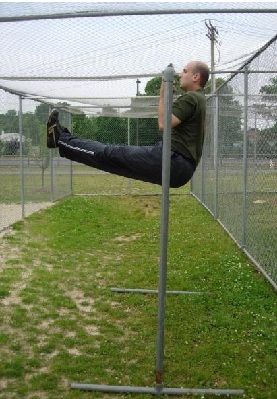
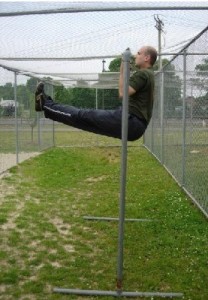
1. Holding yourself (or a weight) in a static state. For example holding the mid-point of a push-up position or the mid-point of a squat. Or, holding yourself statically on a pull-up bar.
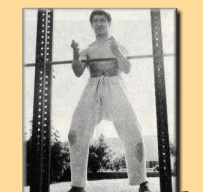
2. The other type of isometric exercise consists of pushing or pulling against an immovable object. This picture of Bruce Lee is a great example of just one of the ways he used to train isometrics.
For our purposes, when training the first type of isometric drill, try holding the mid-range or hardest point of the exercise for 30 to 60 seconds. Make sure to keep breathing! Then shake it out – see the vibration exercises here – and go again.
We will use much shorter time frames for the second type of isometric exercise. Here we will be pushing or pulling against an immovable object as hard as possible (maximal contraction) for 1 to 3 seconds each rep. Exert force as quickly as possible to improve speed strength. Studies have found that the intention to move fast was more important for speed development than the actual speed of the the movement. Interesting, eh? Train about 4 to 6 reps per set and use the vibration exercises referenced above to remove residual muscle tension between sets. Since there are innumerable variations here – pushing with the arms (one or both), pushing with the legs (one of both), pulling with the arms (one or both), pulling with the legs (one or both), not to mention the number of different joint angles one can use with either push or pull, I will leave it up to your creativity to determine how to best apply it in your training. Let me know what you find works best for you.
I hope you enjoyed this short primer on isometrics. We will be exploring them in more depth, as well as showing how isometrics can be used to not only increase strength, but increase power for your strikes in my upcoming book… Stay tuned!
 We all know people who think they can continue to grow and continue to make gains indefinitely by simply pushing harder and harder in their training day in and day out. But what always happens to them? Injury, burn out, sickness, stagnation. Then what? Well, once they get back on their feet they start the same cycle all over again. Why? Because maybe, just maybe they weren’t pushing hard enough or using enough brute force last time to succeed and this time will be different. Riiigghhht…