Top 5 Fat Loss Strategies

Today, let’s take a look at my top 5 favorite, no-brainer strategies for losing fat like a champ.

If you are not seeing the results you want with your current fat loss plan, implement some, or preferably all of the following strategies and watch the fat literally fall off you! Continue reading

Prepare Yourself Every Day

Ever have one of those days when nothing goes right?

The alarm clock is blaring yet you hit the snooze again for the 5th time dreading the prospect of getting up and facing the day.  When you finally drag yourself out of from under the covers and realize just how late it is, your heart jumps into overdrive as you rush through your morning routine desperately trying to get out of the house to make it in to work on time.  If you have small children to get ready for school, daycare, or other activities as well, that simply throws more chaos into the mix.

In your rush, you forgot to eat breakfast and left your steaming mug of coffee sitting on the kitchen counter while you ran out of the house.  Traffic sucks, of course, because you’re late, and when you finally get in to work there are 6 messages from your boss wondering why you missed the morning project meeting…  and your day goes downhill from there.

Some days it just seems like the universe is conspiring against you and this time it’s personal!

What do you do?

How do you respond to the myriad changes and vicissitudes life throws at you?

Do you find yourself tossed about like a small boat on a rough sea constantly overreacting and over-correcting with each wave?

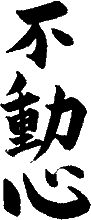
Or, do you have a quiet calm reserve of energy and strength that allows you to maintain a state of fudoshin – “immovable spirit”?

Fudoshin is a state of mind that remains undisturbed and not easily upset by either internal thoughts or external factors.  It is the even keel that keeps your craft steady and on course during rough seas of life.

How do you develop fudoshin though?  How do you cultivate that quiet reserve of strength and energy?

Prepare Yourself Daily

Daily preparation is the key.  A reserve of strength must be built up gradually and nurtured daily, even when you don’t need it, especially when you don’t need it, so it’s there when you do.  Like a savings account you invest a little bit each day so that when the unexpected happens the funds are there for you to draw upon.  So let’s get to the nuts and bolts.

How do you prepare yourself daily?  Here’s what I do…

  1. Get up earlier each morning.  Yes, earlier.  Allow 30 to 45 minutes BEFORE you actually need to be up to get ready for the day.
  2. Grab a cup of coffee.  I love my coffee; there’s nothing like that first sip in the morning.  Feel free to skip this step if you don’t drink coffee. 🙂
  3. Head outside for a breath of fresh morning air (feel free to bring your coffee).  According to Chinese Medicine, early morning is the springtime of the day and thus best for planting seeds to cultivate good health.
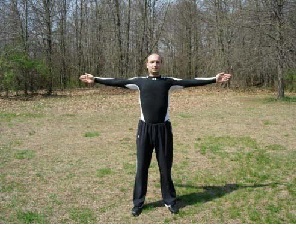
  4. Stand tall, feet shoulder width apart, knees slightly bent, spine straight.  Raise the arms laterally up over head breathing in slowly and deeply with the movement.  As you inhale imagine the oxygen and energy carried by the breath is filling up your entire body.  Hold the full breath for a moment or two, then slowly exhale completely bringing the arms back down.  On the exhale, imagine the body is expelling tiredness.  Repeat 3 to 5 times.  Feel free to add other imagery to this exercise as well.  For example, on the inhale imagine drawing in the positive qualities of strength, health, and confidence, and on the exhale imagine the breath drawing out and expelling negative qualities of weakness, sickness, and fear.
  5. Perform a full, head to toe joint mobility routine to further wake up and enliven the body.  For a complete discussion on joint mobility work and much, much more, see my book, Warrior Fitness: Conditioning for Martial Arts.
  6. Depending on how much extra time you have, relax a few more minutes enjoying the strength and energy you have cultivated – and finish that cup of coffee before heading in to start your day!


 Life is Stressful – Prepare Yourself!


What’s Hindering Your Performance?

What’s sapping your energy and, unbeknownst to you, hindering your performance in martial arts, athletics, or simply the daily art of living, working, and taking care of your family?  Residual muscle tension, or tonus, is the continuous, passive partial contraction of muscles in the body that aids in posture and support.  Unfortunately, any type of exercise, stress, fear, and trauma, all cause an unwanted and unnecessary increase in the normal residual muscle tension of the body.  Usually this extra tonus goes unnoticed, or worse is simply deemed an acceptable and natural side effect of living.  The problem with this added tension is that the continuous contraction of muscle throughout the day, ever day, is using up energy.  Energy that can, and should, be available to us is being siphoned off thereby putting the brakes on our performance.  It’s like driving a car around all day with the emergency brake on.  You can still get where you need to go, but that extra, unnecessary drag is killing the car’s performance and guzzling gas.

So how do we remove these insidious restrictive forces on our body?  Besides a daily dose of joint mobility, which has been covered extensively in Warrior Fitness: Conditioning for Martial Arts, and in various other posts, I have come across 2 methods that work wonders:

1.  Tension/Relaxation Exercises

At first glance, it may seem odd to increase tension in order to relieve tension, but remember, residual muscle tension is held unconsciously while these exercises will intentionally increase muscular tension for the purposes of identifying and releasing it.  Stand naturally and lift your shoulders as high as possible up to your ears while simultaneously squeezing them as tight as possible.  Hold for a couple seconds then drop with an exhale.  Do it again.  Feel the tension in your shoulders, neck, and upper back start to release?  You can do this locally with any area of the body, or the whole body all together.  For example, tense your left arm as tight as possible on an inhalation, hold for 3 seconds, then completely relax on an exhale.  Do this with the legs, the abdomen, chest, back, shoulders.  Tense each area while inhaling, hold for 3 seconds, then release and relax on the exhale.

2.  Vibration Exercises

These are very simple, yet highly effective exercises which have been used for centuries in yoga and qigong to shake out and release residual muscle tension in the body.  So how do you do them?  Stand naturally, feet shoulder-width apart, knees slightly bent.  Spine straight.  Lift up from the crown of your head.  Begin to bounce gently with the legs shaking the whole body up and down.  On each down bounce allow the body to exhale – don’t force it.  Don’t try to breath, just let the motion breath the body.  Slightly round the shoulders and tuck the pelvis to help the motion push air out.  Continue shaking the body up and down for about 30 seconds to a minute.  Stay loose.  Stay relaxed.  Shake out the tension.

These 2 simple exercises, done on a daily basis, will go a long way toward helping you recover the energy that’s been bound up in holding residual muscle tension.  Let me know how they work out for you!
EVOLVE_SPOT-1 (2)

5 Ways to Help Decrease the Stress

Today’s corporate warriors are often besieged with too many tasks, meetings, email, cell phone calls, pagers going off, Blackberrys buzzing, etc. Individually, these things are not significant, but when combined together in a constant barrage, all day long, they produce a cacophony of stimulation which, if not addressed through specific countermeasures, can cause a significant stress response in the brain. This stress response emanates from our primal, survival oriented center of the brain which, in times of crisis, can overload and over run the higher brain functions – i.e., those that allow us to plan, prioritize, manage time and people, and be creative.

Article in Harvard Business Review

 According to an article in Harvard Business Review, when busy executives begin to experience symptoms of this stress response in the brain, they often forget important details, lose the ability to prioritize tasks, and generally feel overwhelmed. Overall tension in the body increases, as well as other important markers such as heart rate and blood pressure.

The ability to reduce and manage stress is a key issue in the overcoming of these symptoms in busy workers. Stress can be reduced in various ways such as relaxation, meditation, vacation, diet, and exercise. It is the last two, diet and exercise, that I am focusing on in my recommendations today.

5 Ways to Help Decrease the Stress

  1. Begin to increase complex carbohydrates at every meal. (Complex carbohydrates are whole wheat, multi-grain, etc.)
  2. As you increase complex carbohydrates, begin to eliminate simple carbohydrates. (Simple carbohydrates are white flour, white sugar, and white rice)
  3. Eat protein and vegetables (or fruit) with every meal.
  4. Exercise at least 3 days a week for a 1/2 hour or more.
  5. Daily short exercise breaks – this can be done at your desk or standing up in the office. It is a quick “10 Minute Recharge” for stress reduction and to increase energy throughout the day. This consists of moving all the joints in the body in circles or waves to increase mobility, increase blood flow in muscles and prevent stagnation. These joint mobility exercises coupled with active exhalation breathing aid in the reduction of stress and help to lower blood pressure.

These exercises can be taught quickly and easily, but the benefits are enormous.

For all the aspiring Corporate Warriors out there, how do you deal with stress?