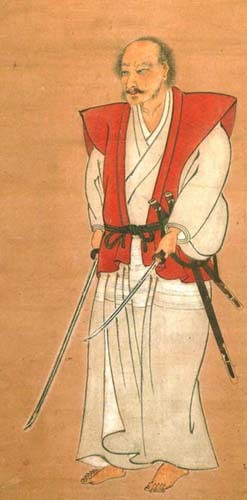
In his classic work on the art of strategy, Go Rin No Sho, Musashi gives the following instructions on Posture in his art.
“Keep your neck straight, putting some force in the hollow of the nape; lower your shoulders, with the sensation that the torso from the shoulders down forms a unity; keep the back straight, do not stick out your buttocks, push your force downward from your knees to the tips of your toes, Advance the belly slightly forward so that the pelvis does not lose its stability…
It is necessary for you to have as your posture in strategy just the ordinary one, and it is essential that the posture of strategy be the ordinary one for you. This must be examined well.”
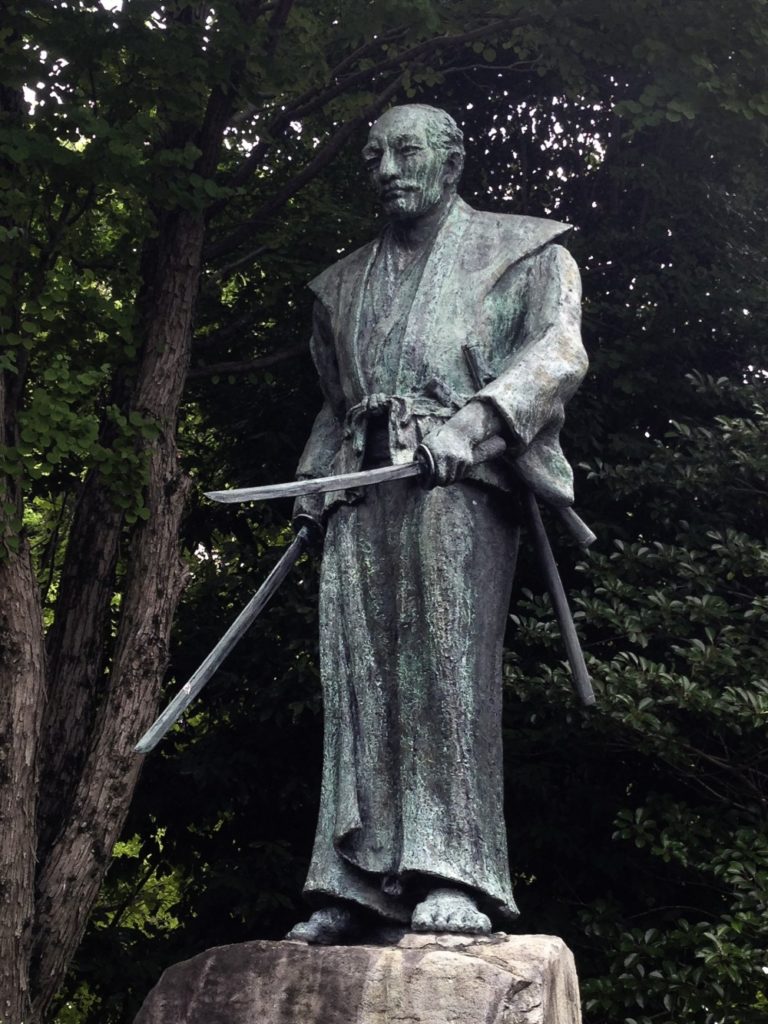
Notice how adamant he is that your stance for combat and your everyday stance be the same…
Isn’t it interesting that Musashi’s instructions for how to stand in his system of strategy sound remarkably similar to zhan zhuang (standing meditation) and shizen no kamae (natural posture).
Coincidence? I think not…
For comparison here is a video I made on how to stand in Shizen no Kamae (natural posture).
Now let’s take a deeper look into the standing practice as the world’s oldest and most effective form of Qigong.
Tachi Geiko (Standing Training) or Ritsu Zen (Standing Zen)
Zhan zhuang, or standing meditation exercise, has been used as a method of relaxation and health cultivation for thousands of years. The earliest known reference to standing appears inThe Yellow Emperor’s Classic of Chinese Medicine. Martial arts master Wang Xiangzhai wrote the following in his book on zhan zhuang:
“It is said that already 2000 years ago there existed the book Internal Canon, the gem of Chinese medicine, which even today is a guide for medical practice. The chapter Simple questions concentrates on cultivating health. For example we can read there: “In ancient times great masters stood on earth, supporting heaven, controlling yin and yang, breathing with essence of qi, standing alone, guarding spirit, with body being as one.”… Before the eastern Han dynasty many scholars and warriors knew the methods of “tranquil cultivating.” The exercises could be done walking, standing, sitting, lying. It was popular form of cultivating health. Later, during reign of Liang dynasty’s emperor Wu, Damo came to China to teach. He transmitted methods of “washing marrow” and “changing tendons.”
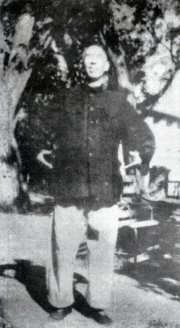
The health preserving and sustaining effects of zhan zhuang have been documented in hospitals and medical clinics across China. The reason this practice has such a profound impact on health and recovery from exercise is that the standing meditation acts like a system-wide reboot for the whole body. It stimulates the nervous system, increases circulation, and raises energy levels, while providing deep relaxation for both mind and body.
Aches, pains, old injuries, muscular tensions, and imbalances are highlighted and brought to the forefront by this method and then slowly dissolved over time and completely released. The practice provides a way of completely relaxing and letting go of the muscular tensions in the body, while the correct alignment of the bones delivers support, creating a profound neutral and relaxed, almost buoyant state. As the whole body and mind are exercised, both relax and stimulate the nervous system, increase circulation, open the joints, and raise energy level for a feeling of overall well-being.
This exercise looks easy from the outside. After all, you’re just standing there and not moving. However, inside, there is a lot going on – the breath and the qi (energy) are moving. This exercise is a challenging, sometimes frustrating, yet highly beneficial and rewarding practice. The only way to truly appreciate it is to experience it for yourself.
How Do We Stand?
In practical terms, how should we stand? Let’s start with the head and work our way down.
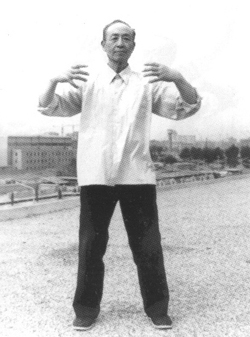
- Begin by standing in a natural stance. Feet shoulder width apart, knees slightly bent.
- Lift upward slightly with the crown of the head, as if being pulled up by a string, allowing the chin to lower. This straightens the vertebrae at the back of the neck.
- Shoulders are back and down sitting on the spine.
- The back should be flat. Do not tuck the pelvis. The spine should be suspended from above like a skeleton hanging in a science classroom.
- Hold the arms in front of the body, level with the solar plexus, as if hugging a tree. There should be a golf-ball sized space under the armpits.
- The bottom of the spine pulls straight down from the tailbone, as if there is a weight attached to the sacrum. You should feel like you are sitting on a high stool yet trying to stand up at the same time.
- Allow the knees to bend slightly. Feet should be shoulder width apart and pointed straight forward as if on railroad tracks.
- Legs should feel like they are squeezing a beach ball. Remember, though, the ball puts outward pressure on the legs as they squeeze in, so there is pressure both directions, not just one.
- The weight is carried in the hollow behind the balls of the feet. In Chinese medicine, this is known as the yongquan or bubbling well point.
All of the above points must be maintained to have a truly “natural” standing posture.
Maintaining a relaxed posture is key to beginning your standing meditation.
Supercharge Your Standing Practice
Now that you have the external mechanics down, let’s talk about how to supercharge your relaxation process.
- Mentally scan the body for areas of tension. The usual suspects will be the neck, shoulders, low back, and quads.
- Begin to actively release each area of tension one by one with your mind. For example, think of the tightness in your shoulders and relax it by telling yourself, “The tightness in my shoulders is letting go and relaxing.” Then proceed to the next area until you have systematically gone through them all.
- If one particular area is giving you trouble, then work on breathing into it. Inhale into the area, hold for a few seconds, and then exhale from the area to release it. Use this process over and over again until all the tension has let go.
- Once you have removed all the residual tension in the body, continue to stand holding that relaxed feeling. Think of your body as a drop of ink dissolving in the ocean, spreading out in all directions.
- Start with ten minutes of zhan zhuang standing. Work up to thirty minutes. In Chinese medicine, it is said that it takes approximately 28 minutes for the blood to complete one full cycle though the body, thus the recommendation to stand for thirty minutes. This can be increased to sixty minutes over time to allow for two full cycles of blood to be completed.
A New Way to Recover
In teaching this method to both my fitness clients and martial arts students I find that in addition to our usual compliment of recovery drills (consisting of mobility exercises, yoga asana, and compensatory movement), the addition of this simple practice of standing meditation has consistently accelerated our recovery process, allowed us to reach new levels of relaxation, and strengthened the mind-body connection beyond any other work we have done. Additionally, it has managed to increase energy levels while fortifying our bodies against the daily rigors of life, work, and family stresses.
While this method is elegantly simple to practice, requires little space and no special equipment, and can be done at virtually any time of day, it also is startlingly deep.
Go Deeper – Take the 100 Day Challenge!
Traditionally it is said that a minimum period of 100 days is necessary for the body to acclimatize and adapt to a practice. As our goal is to completely rewire the nervous system in order to change the body, 100 days seems like the perfect length of time.
How to Do It
- Work your way up to standing for 30 minutes a day for 100 days – think you can do it?
- Take the Integrated Strength Program challenge for 100 days and seriously upgrade your strength, health, and martial power!