
Kata (Alone) Will Never Build Internal Power

Trying to develop Internal Power by training kata (alone) in martial art is problematic.  On one hand, you may inadvertently have minor success in creating some internal connection over the course of 20-30 years of training, but you will most likely have no idea how you did it, no idea why it worked (minimally at best), and most importantly, no idea how to correctly transmit it to the next generation.

The only advice you will be able to offer your students and fellow seekers is to keep doing this (kata training) and somehow you *might* get the correct result.  This is insufficient and irresponsible, at best, on the part of the teacher.

Assuming that you want to stand out from the crowd as a powerful martial artist, and Internal Power/Aiki is your goal, then the scatter approach to trying (and for the most part, failing) to build IP through kata alone is a waste of a career.  I say this because there exist clearly defined, step-by-step processes that rewire the body for Internal Power specifically for martial arts.

Solo Training Precedes Kata Training

Power building models as solo training exercises have existed for hundreds (if not thousands) of years  throughout the martial arts from India to China to Japan.  Why anyone would try to reinvent the wheel by attempting to create their own hodgepodge of exercises or think that merely training kata would develop real Internal Power is a mystery to me.  The reality is that solo training exercises burn in specific ways of moving that are not normal which create a very stable, powerful structure capable of absorbing, re-translating, and projecting incoming force.
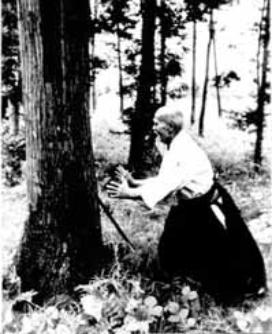
osensei_tree_kokyu1-272x334

Internal Power training is a type of General Physical Preparedness (GPP) for budo.  The goal of regular GPP for fitness, athletics, or martial arts is enhanced work capacity. This is the ability to run faster, jump higher, and hit harder. When work capacity increases, it allows the budding warrior to adapt more easily to increases in both mental and physical demands. In other words, it increases your capacity and level of readiness to absorb higher levels of specificity.

The solo training exercises for internal power training change the way outside forces act on the body.  The structure becomes dynamically stable so that applied force can either be distributed throughout the chain and dissipated or, at a higher level, simply reflected right back onto the opponent.  When force is reflected back this is what is known in Japanese as Yamabiko, or Mountain Echo.

Just to help further differentiate the two practices, solo training exercises for building internal power (there are other types of solo training exercises, obviously) are always made up of the following: standing, open/close, winding, spiraling, and breathing – all supported by Yin/Yang Theory (the union of opposites) and 6 directions (Heaven Earth Man).

Kata are for the purposes of patterning correct martial movement.

These solo training exercises are trained BEFORE kata to condition the body for powerful martial movement. They are not martial movement drills in and of themselves like sanshin no kata, kihon happo, and kata.

Kata – The Slow Boat to China

The reason it is so difficult to train IP via kata is that the vast majority of students get caught up in learning the movements of the kata correctly.  They get caught up in the application of technique and the idea of trying to make it work correctly.  What they don’t realize is that having a correctly trained body built by solo Internal Power exercises makes all the kata work much better and easier.
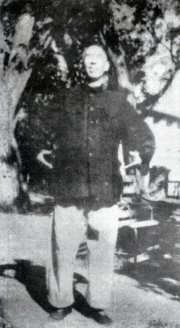
If you have a choice – why not learn a proven step-by-step method of developing unusual strength and Internal Power?


Join My New 21 Lessons on Internal Power Coaching Program <<==

Following a clearly defined path up the mountain is much faster and more effective than wandering around the base working on kata for 30 years and thinking you will somehow magically arrive at the summit.

Caution – While I did just say “more effective and faster” I by no means meant easier!!  Internal Power takes a lot of dedicated work.  Do not think it is a shortcut!
Gyokko Ryu’s Internal Power Training

There is no doubt in my mind that Hatsumi Sensei possesses unusual power in his budo.  Anyone who has trained with him can tell you that!  But what is it and where does it come from?  More importantly, how can YOU develop it as well?

Soke’s martial movement displays many of the characteristics associated with Internal Power training: ghostly movement, immovability (static and dynamic), shockingly powerful strikes with little windup, adhesion caused by movement, kuzushi on contact, and others. Continue reading

This Simple Practice RESETS Your Body

Let’s face it.  Some days we just need to hit the RESET button.  Whether due to stress, an accumulation of injuries, fatigue, or illness we need to find a way to RESET the body in order to allow its own natural healing function to take over.

Luckily, there is a very simple process whereby we can RESET ourselves and acquire a deep level of whole body relaxation.  It can be accomplished through the Yiquan training method of Wuji standing, otherwise known as Health Standing.

Wuji translates to “without poles” or “pre-heaven” meaning that yin and yang have not yet been determined.  It is a pure untapped potential and possibility.  It is from this untapped potential that we will begin to form a relaxed, connected body primed for internal power training.

Before we get into the particulars of the exercise, you need to know how to stand. Continue reading

Top 9 Posts From 2014

It’s that time of the year again.  Time for the Top 10, er… 9, best blog posts of 2014!

This year saw 2 distinct themes emerge: a critical examination of what internal power really is and its relationship to martial arts training, specifically, but not limited to, Bujinkan Martial Arts training, and the importance of daily practice in fitness and martial training.  So it’s no surprise that these 2 themes are heavily reflected in the following Top 9 posts of 2014.  ENJOY!!

top-9

Top 9 posts…


1. Internal Power and Bujinkan Training

2.  Training in the Elements

3.  Never Take Ukemi Again

4.  The Un-Natural Athlete

5.  The Warrior’s Way

6.  Best Way to Program Your Training

7.  My Morning Routine

8.  Weakest Direction Theory is BS

9.  A Glimpse Into Internal Power Training – The Push Test

Bonus Post – Reflections on 42

A Glimpse Into Internal Power Training – The Push Test

The push test is a very practical way of testing the quality of one’s solo training for internal power.  As explained in Weakest Direction Theory is BS, the body, when properly trained, acts as an omni-directional structure.  This allows the practitioner of internal power to neutralize any incoming force by diffusing it throughout the structure rather than having to surrender to it or resist against it.  Either you can do it or you can’t.  There’s no way to fake it. Continue reading

Martial Software or Martial Hardware?

Remember in The Matrix when Morpheus downloaded those dozens of different martial arts programs (software) into Neo’s brain and he instantly could perform all the techniques from those arts?

That is a perfect example of a software upgrade.  Techniques instantly available at your fingertips – literally! Continue reading

Weakest Direction Theory is BS – Part 2

Make sure you read the highly controversial Part 1,Weakest Direction Theory is BS, before moving on to part 2 below…

Preface

I love martial arts.  I love everything about it.  I love training martial arts, practicing martial arts, teaching martial arts.  I love reading martial arts history, philosophy, even martial arts fiction.  I love talking about martial arts.  I love writing about martial arts.  Are you getting the picture yet?  Have I pre-framed this well enough for you?   Continue reading

Weakest Direction Theory is BS

Warning: The following post is going to conflict with the most basic, fundamental principle you “know” to be true in martial arts.  Chances are you learned this principle on your first day of martial arts class.  Since that day you have repeated it almost every class.  You have taught it as truth to every new person you’ve ever trained with.  It’s so ingrained into your psyche that it’s practically dogma.  Most likely you will read this a instantly brand me a Budo Heretic.  Yup.  It’s that controversial…

Continue reading

My Morning Routine

For the past several weeks there has been a running theme interwoven throughout my blog posts.  That theme has been practice, Daily Personal Practice (DPP), to be precise.

I’ve gotten several questions about the details of my own DPP since I refer to it several times in my writing.  So I figured I would pull back the curtains and give you a more detailed glimpse into my Morning Routine of DPP in this post. Continue reading

Principles, Techniques, and Internal Power

For some reason people seem to use the terms principles,techniques, and internal power interchangeably within the context of martial arts practice.  Because of this mistake, they then tend to get confused between them.  While they are all obviously related, each term is separate and distinct and should not be interchangeable with one another. Continue reading