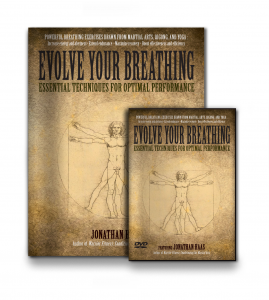
 I was planning to title this post, “Breathing for Dummies” after the famous how-to guides, but I realized most dummies aren’t interested in bettering their health, fitness, and extending longevity in their sports, martial arts, or activities. Plus, I dislike the subtle insult of refering to my readers as “dummies”. Nor would I want dummies for readers anyway. So instead today we will go over Breathing 101. These are what I consider to be the most effective ways to integrate breathing exercises into your daily training, and use them to increase lung capacity and efficiency of how your body processes oxygen. We will look at several different exercises that will enable you to lower your heart rate, blood pressure, and stress levels, as well as to increase energy.
Breathing as a Bridge
You may not be aware that breathing is a bridge between our voluntary and autonomic nervous systems. Meaning breath is plugged into both. The autonomic system will keep you breathing continuously without your conscious control, or sometimes, without even your awareness of it going on. But, you also have the power to override that control and decide at any moment to take a deep breath or hold your breath. What does this mean to you though, right? Well, here’s what it means, you have the power, at any time, to consciously choose to influence things like your heart rate and blood pressure which are not under your conscious control. Now that’s fascinating to me! Because breath is tied into both systems it can be used like a bridge to gain access to aspects of your body that you cannot directly control. How do we do this?
Try This Experiment
Take your pulse. Count beats for 10 seconds then multiply by 6. If you’re sitting and relaxed, that number should be your resting heart rate. Now, inhale as deeply as possible and hold your breath and tense your whole body for a few seconds. Are you red in the face? Take your pulse again. What happened? Your hear rate jumped up and your blood pressure spiked right along with it, right? Now try exhaling for a count of 6, but don’t inhale yet. Extend the pause before the inhale a little bit. Feel more relaxed? Check your pulse. It should have dropped. Pretty cool, eh? And this is just the beginning.
The Exercises
Relaxing Breath (Square Breathing)
This is very similar to the experiment we did above. The basic premise of our ability to influence the autonomic nervous system is that inhalation increases heart rate, which subsequently increase blood pressure, to a slight degree, while exhalation lowers heart rate and blood pressure to a slight degree. During our normal cycle of breathing, these changes are too minute to register, or even notice. But, by gradually lengthening our breath and extending the pause before inhaling and exhaling, we compound the effect.
- Begin by exhaling through the mouth for 5 seconds.
- Do not inhale. Try to extend the breath pause for 5 seconds.
- Before tension begins to creep in, inhale for 5 seconds.
- Hold the breath on the inhale for 5 seconds.
- Repeat the cycle 10 times.
- As this becomes easier, and your capacity expands, try increasing the duration to 6, 7, 8 seconds.
Energizing Breath
In this breathing exercise we will utilize a protocol founded by yoga and improved upon by Russian sport science and martial art. Here we will divide the breath into 3 levels: clavicular (upper level), intercostal (mid level), Diaphragmatic (lower level). This exercise will focus only on the clavicular, or upper level. I first learned this exercise, and several others including the next one below, about 10 years ago from my good friends Dave Rusin and Oleg Yakimovich who are ROSS Russian Martial Art instructors. More information about ROSS can be found at their website here. Check it out!
- Exhale through the mouth in a short, quick burst by compressing the upper chest.
- Do not actively inhale. Allow the inhale to happen by relaxing the muscles in the chest.
- Repeat rapidly 20 to 40 times.
- Build up to where you can perform continuously for 60 seconds.
- If you become dizzy, stop and sit down!
Restoring Breath
Here again we will depend on Russian sport science and martial art for our technique. This one is literally a life saver when doing high intensity anaerobic workouts! It can be used in between exercises as well as in between sets, during the rest period, and at the end of the workout to normalize breathing and dramatically lower heart rate.
- Forcefully exhale as deeply as possible by rolling your shoulders forward, tilting the pelvis up, and contracting the core strongly.
- Pause before the inhale for a few seconds.
- As stated above, do not actively inhale. Allow the breath to be sucked back in through the nose as your body returns to a natural standing posture.
- Repeat for about 60 seconds, or as long as needed.
Try these out and let me know how they work for you. Any questions, please feel free to contact me here.