The Morality of Fitness

FatherJohn Corapi is a well known Catholic preacher, scholar, and theologian.  He also happens to be a black belt in karate, a former competitive boxer, and football player.  In this video he addresses concerns over his health and his startling weight loss.  He begins by assuring the people who care about him that he is not sick at all; in fact he is healthier than ever!  Father then goes on to remind us that fitness is a moral obligation we all have.  As Fr. Corapi states in his video address, “we are all precious, unique, and unrepeatable.”   Take care of yourselves!

You do not have to be Catholic to benefit from Father Corapi’s thoughts on fitness.  In fact, his words transcend religion and get to the heart of being human.  As he says, if you know there’s action you can take to improve your health, such as diet and exercise, you must do it. 

Stay healthy and strong!

Want to know more?  Check out Warrior Fitness: Conditioning for Martial Arts!

Warrior Fitness for Kids!

This will be the first in a continuing series of posts chronicling my thoughts and discoveries on Warrior Fitness for Kids.  As the father of 2 young girls, ages 9 and 1, I have a very vested interest in assuring my daughters are among the healthiest, fittest, and most well-informed kids out there.  Follow along and yours will be too!

It doesn’t take a genius to see that America has become a nation of over weight, physically lazy, comfort-seekers.  The saddest part is the effect this perverse attitude has had on our children.  How can we call ourselves responsible parents when our kids consume more McDonald’s than broccoli, and watch more TV than play outside?  What happened to running, jumping, playing tag, climbing trees and fences, or riding bikes as fast as you can just for the sheer thrill of it?  Has watching Sponge Bob and playing video games replaced playing outside from the time school lets out until dinner is ready?  I remember my mother having to shout for my brothers and me almost on a daily basis to call us home for supper.  And, in the summertime, we were playing outside until well after dark!

What Can We Do to Reverse This Trend?

To me, the answer is simple: Lead from the front!  What impetus do your children have to eat healthy and exercise if you do not?  You, as a parent, must set the example for your kids.  My daughters constantly see me exercising, whether it’s stretching, working on the technical details of an exercise, practicing martial arts, or a full-blown conditioning routine, I’m setting an example for them on a daily basis.  Coming home from work and sitting on our butts in front of the television while we “relax” and “unwind” is more than just detrimental to your health.  It sets up a poor pattern of conditioning that you’re children will follow for a lifetime.

Train With Your Kids

Want to spend some quality time with your kids and help them become fitter in the process?  Workout with them.  Make it fun, not drudgery.  That means stay out of the commercial gym and away from the damn treadmills!  You’re people, not hamsters.  One of the ways my oldest daughter and I spend time together during the warmer weather is to go on walks after dinner, while the sun is still up.  But just walking around the block is boring, so we found a couple ways to spice it up:

  • Pick a landmark – mailbox, telephone pole, tree – and race to it.  Recover by walking a little bit, then race again.
  • Leap like a frog until you get tired – see who gets tired first!
  • Crawl on hands and feet (be careful of the terrain), then get up and run.
  • Let your child ride their bike and you try to keep up, or you ride a bike and let them keep up!

These are just a few examples of how you can change a simple walk around the block to a fun workout for you and the kids.  Shhh… don’t tell them they’re doing High Intensity Interval Training (HIIT)!

As this series continues, I’ll be sharing more ideas about how to workout with you kids in ways that are fun and effective for both of you.  Additionally, I have workouts that I’ve designed for my 9 year old daughter that I’ll be sharing here as well – stay tuned!

How about you?  Do you workout with your kids?  What are some of the things you do to help keep them inspired and keep going?

Warrior Fitness Workout of the Week #2

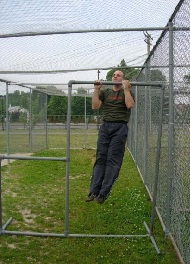
Commando Pull-Ups

This week’s conditioning workout will push your anaerobic threshold to the max.  Endurance is defined as the ability to resist fatigue – how resistant are you?

  • 10 Commando Pull-ups (switch grip every 5)
  • 10 Burpees
  • 10 Lateral Jumps (jump over medicine ball or other small obstacle)
  • 10 Fudo-ken (fist) Push-ups
 Complete 5 rounds as fast as possible with good form. Rest 1 minute between rounds.

 How Do I Do a Burpee?


Burpees are a great, whole-body conditioning exercise that will really challenge your cardiovascular fitness.

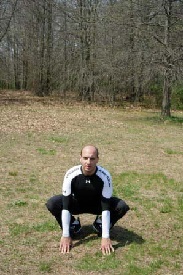
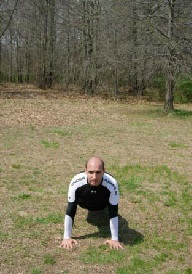
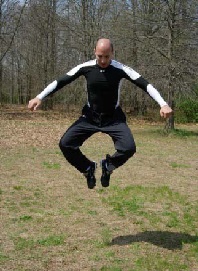
Begin in a standing position.     Drop down to a squat on the balls of your feet.  Place your hands down in front of you and jump your legs back to the lowered portion of a push-up.  Jump your legs back to the ball of foot squat, then leap into the air as high as possible.  Repeat rapidly!

Burpees -Squat down from standing

Burpees - Jump back to push-up

Burpees - Leap as high as possible!

Modifying Your Workout


Conditioning workouts are supposed to suck.  No doubt about it!  They push your body to its limits and increase mental toughness.  However, they should be approached incrementally, especially if you are not used to them.  In this particular workout, I’d recommend that beginners cut the volume of repetitions in half.  If you still find you are struggling, increase the rest period between rounds up to 2-3 minutes rather than the prescribed 60 seconds.  Additionally, you may perform 3 rounds to start instead of 5.  As you gain confidence and begin getting stronger, you can increase the number of repetitions and rounds, and decrease the rest periods.  Change one variable at a time so you are not forcing your body to adjust too rapidly.  Remember, injury is not the goal!

For more information on the Warrior Fitness Workouts of the Week, please see our User Guide here.

Want to know more?  Check out Warrior Fitness: Conditioning for Martial Arts!

Jack Hoban on Fitness

The interviews conducted here at Warrior Fitness will highlight people who have significantly influenced my thinking and training on fitness, who are leaders in their particular fields of expertise, and whom I admire.  Jack Hoban happens to fit all three.  Through his unwavering commitment to martial arts and fitness, Jack has inspired me to keep going over the past 20 years down the dual path of martial arts and fitness.

 Jack Hoban is a former active duty U.S. Marine Corps Captain and long time practitioner of martial arts.  He is Shidoshi Senior Instructor in the Bujinkan Budo Taijutsu and Togakure Ryu Ninjutsu systems under Grand Master Masaaki Hatsumi in Japan and has authored three books on warriorship.  Mr. Hoban also holds an MBA and is an executive in the healthcare industry.    Jack’s full biography, and further information, can be found on his website here


1.  Can you please describe your current philosophy on physical fitness?

I have been serious about physical fitness for most of my life, first as an athlete in grammar school, high school and college, and then as a Marine, and martial artist.  That hasn’t changed, just become more refined and age-appropriate as the years have gone by.  Humans are physical beings and have been so for millions of years; I think we should acknowledge and honor that fact by maintaining a high level of physicality in our lives.  That’s my philosophy.  Until fairly recently, being physically fit, for most of us, was just a part of being human—and staying alive through hunting and gathering, farming, work, or other physical endeavors.  That has changed, and there is a greater risk of falling into a sedentary lifestyle today.  But our basic nature as physical animals has not changed.  We have to be careful not to stray too far from our nature, or certainly unhappiness and ill health may result.

2.  How has your outlook changed over the years?

It really hasn’t changed.  It has just become more refined.  I have tried some of the new fitness technologies—for example I run barefoot now using the new Vibram footwear.  I also think I use cross-training more effectively than in the past.  But I pretty much do the kinds of things I have always done.  I do have to worry more about “overdoing it,” because injuries take longer to heal.

3.  Do you have a daily fitness regimen that you follow?

Yes and no.  I have a range of things that I do, but it changes according to my schedule, the season, the weather and how I am feeling.

4.  Can you briefly tell us what it consists of?

Again, it is not a daily thing in that I don’t do the same thing every day.   But over the course of a week I typically fit in a few runs (45 minutes to an hour), I lift weights, I do a lot of core training, and I do various calisthenics.  In the winter I use the gym for the rowing machine, treadmill and elliptical.  In the summer I swim in the ocean almost every day.  I practice martial arts daily by myself, and have a class between 2 and 5 times a week.

5.  How do you think fitness and budo (martial arts) are related?

Inseparably, although martial artists might take care to explore a regimen that is complimentary to martial arts—one that increases strength and endurance, but also promotes flexibility and relaxation.

6.  How has your being in excellent physical condition enhanced your martial arts training?

Simple, it helps me to “keep going” longer and more consistently without being tired or sick.  And by the way, real fights are very physical—tiring and punishing. 

7.  How does your being in excellent physical condition help your work with the Marine Corps Martial Arts Program (MCMAP)?

When I first meet a new class of students, the unspoken question is “Is he one of us?  Can he do what we do?  If he can’t, why should we do what he does?”  That’s just the nature of young, competitive men.  Because I can pretty much keep up with them “for an old guy,” I gain a certain measure of respect.  That way, they are open to the other physical and ethical lessons I am there to share.

8.  Has the Marines Combat Conditioning program influenced your personal exercise program, and if so, how?

Yes, in at least two ways.  It has made me more aware of the value of cross training, and two, it has made me more creative in using training aides of opportunity.  By that I mean, you can design your own training regimens and make your own training apparatuses just by using your brain and common items and structures.  You don’t need fancy equipment; an old tire works just fine as an exercise apparatus.

9.  The last, but most important question, how do you keep going?

I enjoy it!  Find a method of physical exercise that you enjoy and pursue that.  Find other people who like it as well, and do it together.  That will help too.

Thanks Jack!

Motivation

Everything sounds like a great idea when you are thinking about it and planning it out. The problem, as they say, is in the execution. Sunday afternoon you are superbly confident of your plan to get up at 5 AM Monday morning and do your prescribed workout. However, when that alarm goes off, suddenly your mind finds every excuse in the book to hit the snooze button and sleep “just 10 more minutes….” How do you remedy this? What do you do in the early hours of the morning to drive the demons of laziness out of your head and get up to get that workout done? Well, there really is just one way. Force yourself. Drag yourself. Make yourself get up and do it. I know, that’s not what you wanted to hear. You expected something magical, something logical, something practical, something that wouldn’t require you to exert any effort to make it happen. Me too. I used to think the same way. Why isn’t there some sort of crazy mental trick I can use to motivate myself? Why does it have to be so hard to force myself to get up and get the workout done? There actually is a trick, in a way. It’s called the law of accommodation. Whatever you keep doing over and over again becomes easier. If I’m lazy and unmotivated, then as I repeat that action of hitting the snooze alarm, it becomes easier for me. If I drag my lazy ass out of bed and make it to my basement gym just one day, it becomes slightly easier the next. As I keep pushing, prodding, coaxing, cajoling myself to get up at 5 AM and workout, it becomes habitual. It becomes easy. My body and brain naturally “accommodate” me. Don’t just do it. Get it Done.

How do you get and stay motivated?  Discuss!

Fitness at Work?

This proves to be quite difficult for many cube-dwelling corporate warriors. This article will provide the reader with concrete examples of ways to increase health, energy, mobility, and core strength all while seated (or standing) at your own desk. Fitness at Work will only require about 10 minutes a day which can even be broken up into shorter increments and done throughout the work day.  And, for those concerned with being stared at, most of these can be accomplished surreptitiously!

Before we get started, let’s take a look at some of the specific impediments to our health, vitality, and fitness that may be exacerbated by sitting at a desk, working on a computer 8+ hours a day, 5 days a week:

  • General fatigue
  • Short-range stiffness
  • Stiff neck, neck pain (pain in the neck?)
  • Low back trouble, ruptured/herniated/bulging discs, etc.
  • Carpal tunnel syndrome
  • Expanding waist line
  • Lack of good overall muscle tone

Try to perform the following exercises a few times a day to reduce tension from the daily grind!

Neck Mobility

  • Up/Down (Lift up from crown of head, slide down along plane of jaw)
  • Left/Right (Turn head as far left as possible without pain, turn as far right as possible)
  • Side/Side (Tilt head down to left, move from corner of jaw, repeat to right)
  • Full circle

Shoulder Mobility

  • Roll both shoulders backwards (Lift shoulders up towards ears, roll backward fully articulating the range of motion, drop them down as far as comfortable)
  • Roll both forward
  • Alternate shoulder rolls (Roll left shoulder back as described above while pushing right shoulder forward then switch)


Wrist Mobility 

  • Hold both hands in loose fists, make circles clockwise and counter clockwise with wrists
  • Begin with left wrist, hold in fist as above, lift wrist up, to the outside, down, to the inside, reverse direction and repeat with right wrist

Finger Mobility

  • Begin circling fingers with thumb (5 times) then continue with each additional finger
  • Circle fingers from pinky in the opposite direction

Core Strength

  • Tilt the pelvis up slightly while rolling the shoulders down, creating a “scooped out” concave with your torso. As you do this exhale and tighten all the core muscles and muscles around the core
  • Hold the tension for 5 – 8 seconds, then release allowing the breath to rush in as your abdomen naturally expands out again
  • Repeat 5 to 10 reps

Remember, just a short 10 minute break a few times a day will do wonders to increase your concentration, productivity, and mental health!

 Let me know how these exercises work for you.  Also, how do you relieve stress at work?

Want to know more?  Check out Warrior Fitness: Conditioning for Martial Arts!

User Guide to the Workouts of the Week

I received several emails this morning after yesterday’s post on Warrior Fitness Workout of the Week #1 from people who wanted more information on how to implement and program the workouts of the week.  So here it is!

The Workout of the Week section is designed to give you insight into the Warrior Fitness training method.  We will cover topics such as joint mobility, high intensity interval training (HIIT) and the Tabata Protocol for conditioning, strength endurance, explosive strength, core work, yoga, and martial arts. 

1.  How often should I do the Workout of the Week (WOW)? 

This depends on the intensity level of the prescribed workout.  For example, if the WOW is an illustration of a yoga compensatory routine, you can do it daily, but if it’s a high intensity conditioning workout, you may only be able to perform it 2-3 times a week, depending on your recovery levels.   These workouts are short; usually, under 30 minutes.   You should have plenty of time to squeeze them into a busy schedule!

2.  Should I change my workout every week to correspond to the WOW? 

Not necessarily, no.  The workouts change weekly in order to showcase various aspects of our training methodology, but that doesn’t mean you need to change it up on a weekly basis.  Workout programs should be designed with specific goals in mind and crafted to meet individual needs.  Your body needs time to adapt to your exercise selection for it to elicit the planned response, usually about 4 to 6 weeks.  If you find a something that you like, stick with it.  If you have a more detailed question about how to program a specific workout, or even a series of workouts, let me know.  I can help you.  That’s why I’m here.

3.  What if I already have a workout program?  How can incorporate the WOWs? 

 If you currently have a training regimen that you are happy with, but want to give one of our workouts a try, you can definitely do that.  Simply replace one of your conditioning days with one of our conditioning workouts.  Or, add in our joint mobility exercises as a warm-up.  Remember, you receive a sample chapter on joint mobility  from the book, Warrior Fitness, when you sign up for our mailing list.

4.  I am just starting to exercise, can I still use the WOWs? 

Absolutely!  Start slowly.  Begin by doing our joint mobility exercises on a daily basis to prime your body and help you regain lost range of motion.  Each of our workouts contains instructions on modifying the workout to scale it for any level of conditioning.  Also, if you have further questions about modifying workouts, or programming workouts, contact me.  I’ll be glad to help you.

5.  Will I lose weight with these workouts? 

 Yes!  Our conditioning workouts are designed to turn on your body’s metabolic furnace and torch unwanted fat, while building lean muscle. 

6.  How can I find out more?

My ebook, Warrior Fitness: Conditioning for Martial Arts, is available for direct download.  It contains the background, philosophy, and methodology behind Warrior Fitness, as well as an ample exercise selection and a chapter on program design.

Want to know more?  Just ask!

 I hope this has been a helpful introduction to the Warrior Fitness Workouts of the Week.  What other questions do you have?

Warrior Fitness Workout of the Week #1

For 15 minutes, perform the following:

Chin Up


  • Chin-ups
  • Hindu Push-ups
  • Jumping Jacks
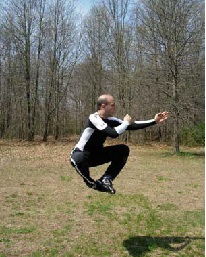
  •  Ichimonji Jump Squats (can be replaced with non-jumping squats as fatigue levels rise)


Hindu Push-up


Ichimonji Jump Squat

Do them in any order for any number of reps at a time as long as you continuously move for the full 15 minutes.    

Modifying Your Workout

Not quite ready to jump into the full 15 minutes yet?  This workout can be modified depending on your current level of conditioning.

For example, you may break up the 15 minutes into 5 rounds of 3 minutes each and include a rest period of 1 to 2 minutes between rounds.  As your conditioning levels increase, begin increasing the length of the rounds and decreasing the rest period.  Remember, the goal is to exercise for 15 minutes straight.    

Additionally, if you do not have a chin-up bar, you can try  towel pulls instead.  Wrap a towel around a pole in your basement, or around both door knobs of an open door, sit all the way back until your arms are straight and pull yourself forward.  You can make this exercise more difficult by grasping the towel with one hand which also provides a great grip workout to boot!

Enjoy!    

Notes: Make sure you warm-up with brief joint mobility session prior to the workout.  Remember that when you sign up for our mailing list you receive a free sample chapter on Joint Mobility from my Warrior Fitness book!

For further information on the Workouts of the Week, please see our User Guide here.