
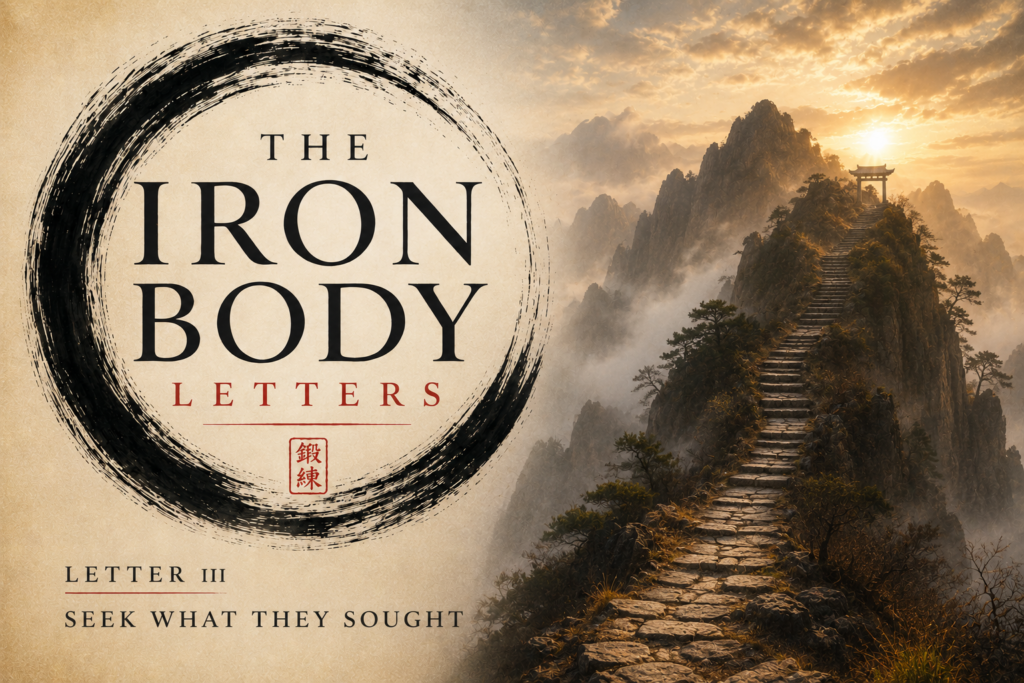
Seek What They Sought
“Do not seek to follow in the footsteps of the wise; seek what they sought.”— Matsuo Bashō
Warriors –
There are certain sentences that enter your life quietly. You read them once, appreciate their beauty, and move on.
Then, years later, after enough practice, enough mistakes, and enough honest reflection, you discover that those same words have been patiently waiting for you all along.
For me, this was one of those sentences.
For many years I believed my goal was to follow the great masters.
I studied their techniques.
I practiced their kata.
I admired their accomplishments.
I tried to understand how they moved.
But, eventually I realized that imitation was never the goal. The goal was understanding. Not understanding what they did. Understanding what they were searching for.
That realization changed the direction of my entire journey.
I stopped asking why Sagawa moved the way he moved.
I began asking what he had discovered.
I stopped asking why Wang Xiangzhai devoted so much of his practice to standing meditation.
I began asking what truth he believed standing could reveal.
I stopped asking why the old masters returned again and again to posture, breathing, structure, patience, and seemingly simple exercises.
I began asking why these same principles kept appearing across traditions that had never met one another.
Different countries.
Different languages.
Different histories.
Different methods.
Yet somehow they continued arriving at remarkably similar conclusions.
That cannot be an accident. It suggests that beneath every method lies something deeper. A principle waiting to be discovered.
The longer I trained, the less interested I became in collecting methods.
I wanted to understand the principles that gave birth to those methods.
Methods belong to styles.
Principles belong to reality.
Styles evolve.
Methods change.
Principles endure.
That realization liberated me.
I no longer felt compelled to choose between Japanese martial arts and Chinese internal arts. Between old-time strength training and modern exercise science. Between standing meditation and strength development.
If they revealed the same principle, they belonged together.
The principle was more important than the method.
Many years after this realization began taking shape, I encountered a statement from Yukiyoshi Sagawa that seemed to express in a few direct sentences what had taken me decades to understand.
When I first read those words, they sounded severe.
Today they sound compassionate.
Sagawa was not diminishing technique. He was reminding us that technique can never rise above the quality of the practitioner expressing it.
Technique is not where mastery begins. It is where mastery becomes visible.
Everything else happens long before anyone is watching.
That is why the greatest lessons are often hidden inside the simplest practices.
Standing quietly.
Breathing attentively.
Moving with awareness.
Returning every day.
These things rarely impress spectators.
Yet they transform practitioners.
Looking back over forty years of training, I no longer believe I have spent my life studying different martial arts.
I believe I have spent my life following a single question through many different traditions.
Each teacher offered a different path.
Each tradition spoke a different language.
Yet all of them pointed toward the same mountain.
Not the perfection of technique.
The cultivation of the human being. I suspect that is what the masters were really seeking. And I believe that search is still worthy of our lives today.
The longer I reflect on these things, the less interested I become in preserving methods simply because they are old, or adopting new methods simply because they are modern.
Age has very little to do with truth.
What matters is whether a method reveals an enduring principle.
The responsibility of every generation is not merely to preserve the forms it has inherited.
It is to rediscover the principles that gave those forms life in the first place.
That is why I no longer ask whether an exercise is Japanese or Chinese.
Ancient or modern.
Traditional or scientific.
I ask only one question.
What truth does it reveal about the cultivation of the practitioner? If that truth is genuine, then it deserves to be preserved. If it helps us become stronger without becoming rigid…
More resilient without becoming hardened…
More capable without becoming arrogant…
Then it belongs on the path.
Perhaps that is what Bashō was inviting us to understand all along.
The masters never asked us to become copies of themselves.
They invited us to continue the search.
Not to walk in their footsteps…
But to seek what they sought.
That search has become the work of my life.
Tomorrow, I’d like to share where that search ultimately led me—and why I believe every meaningful method I have ever studied is part of a single path that I now simply describe as building the body beneath the art.
Stronger Every Day!
Jon Haas, The Warrior Coach
Read Letter 4 here <<==
