
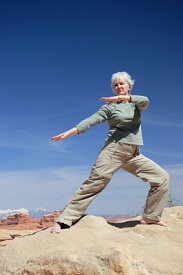
 One of the greatest challenges a long term fitness enthusiast faces is the debilitating impact of age. Certainly everyone understands the concept but what does it actually mean? The average person has a higher metabolism when they are younger, a faster recovery rate, greater use of energy stores and suppleness around the joints. So why exactly do we age? Well did you know that for the average person the maximum heart rate is 220 – age? That means when you are 20 your heart can go up to 200 bpm, whereas at 60 your max is 160bpm. That’s a big difference. Essentially like all human tissue the heart is constantly in a state or recreation, cells die and new ones are created. However as the body gets older this ability to replace old cells with new ones becomes less efficient. In a sense it is not the body that ages, but the ability to rejuvenate decreases over time.
That is the bad news. The good news is that a lot can be done to counter-act the effects of ageing via exercise. This can be divided into circulatory, respiratory, structural and the nerves.
How Does Exercise Help?
As mentioned the heart output decreases with age, generally a very fit endurance athlete has developed a large heart capacity. That is the volume of blood per pump has increased as a result of training. If age means that the heart will pump less frequently and become less powerful then what can be done? Quite simply the best thing to do is make better use of the blood that is being sent around the body. Exercises that improve blood circulation to the extremities are extremely beneficial at all ages and very useful for combating age. Joint rotations, light resistance frequent repetition exercises are excellent for this. Walking is perhaps the best of all.
As many biology students know, a major purpose of blood is to transfer oxygen around the body so focus should also be paid to the respiratory system. It should also be mentioned that the oxygen in the body is very useful for cell reproduction too. Breathing exercises not only help with good quality respiration but also assist with the structural stability of primarily the upper body but also the body as a whole.
Structurally speaking the body may be divided into bones, connective tissue and muscles for simplification. As stated good blood flow and breathing will already provide a boost to these systems. Perhaps we must accept that due to age repetitive actions will not be maintained to the same count as was possible in youth. But what about strength? Scientists have been studying muscle strength and age for at least the last 15 years and concluded that muscles can grow and remain strong at any age. This means resistance exercises such as moderate and heavy weights will be very useful for maintaining structural strength. Also bone mass is related to muscle mass directly, so strengthening muscles reduces the risk of damage to bones and increases calcium absorption. Studies have shown that laboring women in areas with limited calcium in the diet have less cases of Osteoporosis than sedentary women with high calcium diets. In other words resistance exercise not only maintains more youthful strong muscles but also increase the utilization of chemicals like calcium in bone tissue. Joining the muscles and the bones are connective tissues which get stiffer and less elastic if under utilized. Lack of flexibility results in lack of mobility, this in turn impacts the benefits of exercise and increases the risk of injury. Flexibility training such as Yoga or Makko-ho is very useful for combating decreased flexibility and also rejuvenating connective tissue.
Stretching and structural organization is beneficial not only for maintaining mobility but also because it opens up an often forgotten part of the body called the nervous system. It is not possible to strengthen nerves directly and again age will deteriorate nerve function. But, by using muscles and working on flexibility the nerves can be stimulated to be more effective in function. This is important for not just general co-ordination but also the non-voluntary nervous system which is responsible for among many things, yes, the heart.
Taking the Holistic Approach
We have come full circle and this is an important point. When we are younger we can focus on weights, or marathons and any kind of activity we like. This is because our general health is fine and we simply pursue excellence in whatever activity we choose. As we get older however the general health starts to decline if not maintained. That is why aging persons should take a holistic approach to training to ensure all the important body systems are being stimulated. The circulation, the breath, the structure and the nerves must all be improved upon. It is very tempting to wait until the effects of age are experienced before reacting to change. Of course it is fine to start exercising and focusing on health at any time. However the best solution to aging is to prepare early on for the kind of body you will need as you do age. Combine light exercises and breathing with heavy exercises and stretching now and save making major adjustments tomorrow.
About the Author
Tony Notarianni has been training in martial arts since the age of 12. Up to this point, although quite active, he had very little interest in sports and fitness but that all changed over the coming years. He started studying Sport as a subject at school and finally graduated with a Bachelors Degree in Sport and Exercise Science in 1998. Although not a typical sportsman and not a great fan of any one sport, Tony was always keen to try new activities and considers the world to be literally full of physical experiences to explore. Before graduation he was working at a sports complex where he was a lifeguard and could join and observe many different forms of exercise. He also taught circuit classes and was a qualified personal fitness instructor. After graduation he chased the dollar and ended up working in Software Development. Although becoming more sedentary he still has a deep rooted interest in improving himself physically and developing his knowledge.