
Blind Spots

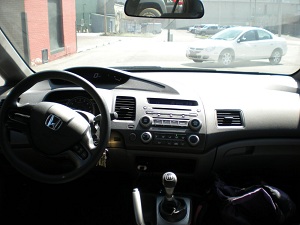
A few years ago I traded in my 2000 Honda Civic for a 2007 Civic. The minute I sat in the seat of this streamlined, yet economical car, I knew it was the one I would own. The way it shifted, its responsiveness to the road, the look of the dash, how the seat seemed to perfectly fit my body, somehow it just felt right and even though I wasn’t planning on buying another car with a manual transmission, I knew this would be the car that I would drive home that day. Training can be very much like as well, often it just “feels right” somehow.

Although the car felt good and right to me; one of the things that I immediately noticed was that it had many blind spots that my other car didn’t have… well, wait a minute, re-thinking that, it wasn’t that my other car didn’t have any blind spots, it’s that I got used to them and I eventually learned how to see around them, so much so that I almost didn’t even know that the car had any blind spots at all. Now, that I have owned this current Civic for a few years now, I don’t notice the blind spots that were so apparent when I first bought it. It is funny to think that once these blind spots were so apparent and difficult to see around, and now my mind has trained itself to see around these dangerous short comings and it is once again giving me the illusion that those spots aren’t even really there at all!

This same concept also applies to training and life. Each method, system and person has its blind spots; things that are just taken for granted and often overlooked until something happens to change that perspective. Growth and evolution sometimes can be a smooth, natural progression and other times, it can be challenging, difficult and cause great conflict.

How a system or person approaches their training be it martial arts, military tactics, verbal communication, health and fitness, strength, conditioning, world philosophy, politics, economics, science, etc., is due to a variety of reasons, including, but not limited to, the environment, context, past experiences, education, conditioning, limitations, strengths, objectives, philosophy, preference, etc.  There are many ways to do many things, all aren’t right, nor are all wrong; however, some ARE better than others for sure. Many believe they have the corner of the market on the “right” way to do whatever they are trying to accomplish. This attitude lends itself to stagnation, justification and conflict with self and others. It is good to be confident; however growth and progress means change and change sometimes can be tough and take you places that were never anticipated.

“1500 years ago, everybody knew that the Earth was the center of the universe. 500 years ago, everybody knew that the Earth was flat. And 15 minutes ago, you knew that people were alone on this planet. Imagine what you’ll know tomorrow.”

 ~Agent K (played by Tommy Lee Jones) talking to Will Smith’s character in the movie Men in Black.

Ok, so let me rein in this article a little bit to focus on the point I am trying to impart:

Always be open to the idea that no matter how good you or your training are, there are blind spots. Things that you just don’t see, obstructions that you have been looking around for so long you no longer see them.  This is why not only instructors, teachers and coaches are necessary, but also having the “beginners mind.” Like the old Zen story about the student coming to a teacher with an empty cup so to speak. We all need to be perpetual students, remain flexible, seek to improve, be curious, and keep our egos in check.

A saying I frequently use is, Learn like you know nothing, perform like you know everything.” This means keeping an open mind when learning, but when it comes time for action, whether in life, in the sports arena, or during a real conflict, where hesitation can cost you more than a trophy; (in the moment) do what you think you need to do with confidence.

No matter if today was your first day training or you’ve been at it for forty years, whether you are training the Israeli Defense Force, for the UFC, or just for fun, here’s your homework:

What are your blind spots? (In training and in life?)  Uncovering those blind spots is a process that never ends. Remember it’s a journey not a destination. Enjoy the ride!

Keep going.

~Craig Gray

www.roninempowermentgroup.com

www.rgi.co

Craig Gray is a world traveler, speaker, trainer and Subject Matter Expert (SME) for numerous law enforcement agencies as well as Nationally Syndicated Talk Radio Show Frontlines of Freedom & WZZM TV 13 Web Community. Craig is responsible for creating the MCOLES (Michigan Commission of Law Enforcement Standards) approved Krav Maga Self Defense for Law Enforcement Training Program. Craig is one of twelve hand picked instructors with Resolution Group International a conflict resolution training organization developed for the needs of military, law enforcement and business organizations. He is an adjunct instructor for hand to hand combatives and warrior ethics at the Homeland Security and Protective Services Academy within the Gerald R. Ford Job Corps. Craig also serves as education director for Her Survival Guide an organization that teaches empowerment skills, risk management and conflict resolution skills to college bound girls and their mothers.
RGI Conflict Resolution Course Review

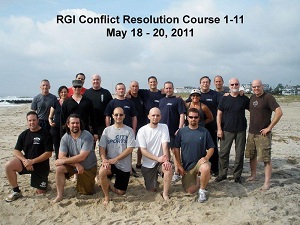
Last week I had the very special privilege of attending the RGI Conflict Resolution Certification Course.  Resolution Group International (RGI) is a conflict resolution company specializing in: Ethics presentations, Leadership training, Tactical Communication, Cross-Culture Conflict Resolution, and Defensive Tactics and Combatives.  It was hosted in Spring Lake, NJ and taught by a panel of experts in the field of conflict with decades of real world experience and credentials behind them. 

The RGI seminar format utilizes a unique teaching methodology which blends values-based lessons, conflict communication skills, and ethics with physical training and exercise to activate and clarify the principles being taught.  The interchange of movement with the classroom style lecture increases the absorption and retention of the intellectual and values-bases lessons.  This concept is backed up by latest research into combining education with physical exercise.  Check out the book, Spark: The Revolutionary New Science of Exercise and the Brain by John J. Ratey, MD for a more detailed discussion of the science behind it. 

RGI’s Conflict Resolution course starts with a premise: in order to resolve conflict one must be moral, knowing right from wrong; one must be ethical, putting that morality into action; and one must have the physical skills and confidence from which to proceed.  The Dual Life Value (DLV) theory is the linchpin holding the course together.  It permeates the philosophy, intellectual discussions, physical skills, and emotional stories.  The DLV states that we are all equal because my life and the lives of my loved ones are as important to me as your life and the lives of your loved ones are to you.  Further, the life value is a universal value by which all other values are judged.  If they support the life value, they are moral, if they don’t, then they are not.  This is a very high level summary of an extremely important concept.  To really gain a full understanding and appreciation of the DLV theory, you really need to attend the course and be immersed in the philosophy.  This review can do nothing more than offer a taste to whet your appetite.  I hope it makes you hungry!

PT with Joe Marine

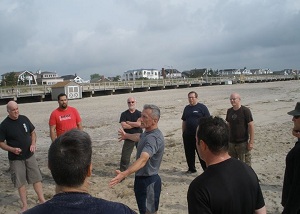
Joseph C. Shusko AKA “Joe Marine” is a decorated veteran who served the United States Marine Corps for over 30 years.  He is now serving as the Deputy Director, Marine Corps Martial Arts Center of Excellence overseeing the Corps’ Martial Arts Program.  Joe Marine is also known as the “combat conditioning guru”.  He took the class through 2 morning PT sessions Thursday and Friday.  The Thursday morning PT session began with a discussion on health and fitness in which Joe Marine shared his outlook and really brought home the importance of taking care of oneself, especially as we get older.  We then proceeded to go through a simple, yet highly effective workout Joe calls “5-10-15-20”.  It’s basically a plug –n- play type workout template which uses a variety of bodyweight exercise for the prescribed number of repetitions, 5, 10, 15, and 20, respectively.  The set is repeated as many times as possible in 10 minutes.  This allows trainees to work at their own pace and to their own fitness level.  But as Joe says, you only get out of it what you put into it!  Friday morning’s PT was a real treat as we moved the location outdoors to the beach on Spring Lake.  This time the workout was done in teams of 2.  This really pulled the participants together as they struggled to overcome the shared adversity of the physical challenges together.

In addition to being the combat conditioning guru, Joe Marine is also known for his “tie-ins”.  These are values-based stories which serve to illustrate points and drive home the intellectual or physical lessons with an emotional impact.  Never miss an opportunity to ask for a tie-in!

Maneuver Martial Arts

Maneuver Martial Arts is the term RGI President, Jack Hoban uses to describe RGI’s approach to physical conflict.  Jack is a speaker, writer and Subject Matter Expert (SME) for the U.S. Marine Corps Martial Arts Program (MCMAP).  His business and military experiences, as well as an extensive 30-year background in martial arts, give him a unique and interesting perspective.  Jack, along with co-instructors Craig Gray and Artie Mark, skillfully introduced the participants to the concept of tactical movement, striking, escapes, takedowns, submissions, and protecting others.  Tactical movement and being able to control the tactical space around the opponent(s) was emphasized as primary, over and above the concept of technique.  This allowed the participants, some of whom had no prior martial arts experience, to gain an understanding and quickly absorb the principles of martial movement as the seminar progressed.  As a martial artist of almost 30 years of experience myself, it was hugely gratifying to watch this process unfold!

The crown jewel of RGI’s martial arts training though is really the protecting others piece.  As Jack mentioned in his introduction to this section, in a typical martial arts school setting, if 100 techniques are taught, 100% of those techniques are geared towards defending yourself.  How many look at how to defend others?  Usually none.  This segment of the training served to rectify that deficiency in current martial arts training, as well as to drive home the importance of the universal life value of self and others – all others.  Protecting others activates the life value and solidifies the concepts, principles, and ethics in a very real and effective way.

Conflict Communication

RGI’s approach to conflict communication is both an art and a science.  Gary Klugiewicz is employed by PoliceOne as a police and corrections subject matter expert. He is retired from the Milwaukee County Sheriff’s Department after 25 years of service where he was promoted to the rank of captain. Gary has been a Verbal Judo Instructor for the last fifteen years.  Gary expertly distilled the essence of Dr. George Thompson’s Verbal Judo, to give the participants a highly beneficial introduction to tactical communication.  Take a look at what Verbal Judo calls the 5 Universal Truths and see if they resonate with you.  They certainly did with me.  Also, try them out on your kids.  You’ll be amazed at the level of compliance!

5 Universal Truths

  1. All people want to be treated with dignity and respect.
  2. All people want to be asked rather than told to do something.
  3. All people want to be told why they are being asked to do something.
  4. All people want to be given options rather than threats.
  5. All people want a second chance.

Real world experience in conflict communication from both the ER and out on the street from a law enforcement perspective was also shared by Joseph Lau, RN, veteran police detective Arthur “Artie” Mark, and decorated veteran detective James Shanahan.  Additional presentations were given by heavy hitters such as Brian Pensak, Marine Corps Martial Arts Program Instructor Trainer and SME, and Bruce Gourlie, Special Agent of the FBI.  There is so much experience, expertise, and information to unpack from just one of these gentlemen’s presentations that it’s impossible to delve into in a short seminar review.  My advice?  If you deal with any type of conflict in your job, in your family, in your life, get to an RGI Conflict Resolution course ASAP – you’ll never look at conflict the same way again!

The RGI Conflict Resolution Course has a synergistic effect whereby the whole is much, much greater than the sum of its individual parts.  The combined impact of the instructors’ professional presentations, the interchange of physical skills with values, morals, and ethics, and the engaging course material create an outstanding professional development course. 5 out of 5 stars – highly recommended!!

For more information on RGI upcoming events and seminars, please click here.