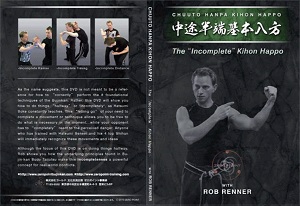
 Chuuto Hanpa Kihon Happo or, The “Incomplete” Kihon Happo, is a new DVD by Bujinkan instructor, Rob Renner. Rob has been training in the Bujinkan since 1986 and living in Japan since 2005. He trains with Hatsumi Soke and the Shihan, senior instructors, typically 5 to 6 days a week.
This DVD is, as Rob points out, not the “official” version of the foundational techniques of the Bujinkan, but rather a synthesis of each Japanese Shihans’ take on the techniques as studied and interpreted by Rob.
The DVD begins with Rob’s expanation of Hanmi, or “half-body” kamae. This incomplete Ichimoni no Kamae has the hips at a 45 degree angle forward to facilitate structure, stability, and mobility instead of the traditionally taught kamae with the hips completely sideways while the head looks forward. Not only is Rob teaching 1/2 kamae, but as each technique is analyzed, he shows how to utilize 1/2 the distance, and 1/2 the time as well to create more efficient, and effective, technique.
Each technique of the Kihon Happo is then presented, first as they are usually performed in Bujinkan Dojos worldwide, followed by a discussion of common problems and mistakes when done as shown. Make sure to pay attention here as you may recognize some of your own mistakes. This discussion alone is worth the price of the DVD!
Rob then moves on to demonstrating and explaining how to use the principles of Bujinkan Taijutsu to effectively do the techniques. Each section begins with a quick bulleted list of principles that will be taught for each technique. This is an effective way to prepare the audience for the material to be reviewed in the section and also serves as an effective reminder as the same principles are presented, and added to, each time. Throughout the principle-based discussions, Rob constantly stresses the importance of correct kamae by using hips, knees, feet, and shoulders in alignment to be able to control distance and move in any direction.
In the Torite Goho section of Kihon Happo, Rob makes a very important distinction between translating kuzushi as “breaking balance” versus “breaking structure”. When you break an opponent’s structure, he is still very much on balance, but simply can’t generate force in any meaningful way. And, since his balance is not compromised, he still believes in his mind that he is okay. Hmm… sounds like kyojitsu to me. However, when breaking an opponent’s balance, his body will automatically endeavor to correct it and suddenly you’re in a fight.
Kihon Happo Techniques Taught on the DVD
Koshi Sanpo:
- Ichimonji no Kata
- Jumonji no Kata
- Hicho no Kata
Torite Goho:
- Omote Gyaku
- Mushadori
- Onikudaki
- Ura Gyaku
- Ganseki Nage / Musodori
In the final section of the DVD, Rob uses the Torite Goho to show examples of Hatsumi Sensei’s movement as it is today. This is done by following all the principles espoused in the earlier parts of the DVD and through manipulation of the kukan and kyojitsu. It’s a great way to wrap up, pull everything together, and show a progression of the material all at the same time. This is a very well done DVD with tons of detailed instruction. Highly recommended!
For more information, and to purchase the DVD, please see Rob Renner’s website, Bujinkan Zeropoint Dojo.