10 Books Every Warrior Should Read

I am what you would call an avid reader. Some would even say my reading habit borders on a reading obsession since at any one time I can be found to have at least three, sometimes four books going simultaneously. I have several on my nightstand next to my bed, a couple on the coffee table downstairs, one or two on the kitchen counter and, of course, my bathroom book.

Usually I am reading one book on fitness or health, one book on business, and one fiction.  I also continuously have audio books playing in my car anytime I drive, creating a mobile library.

Great warriors train all the time. Reading is a form of training that must be practiced by the warrior on a daily basis. Feeding and training the mind is just as important as feeding and training the body. Remember – knowledge is power!

Here are 10 books that are a must in every warrior’s library. Expand your mind and pick up these books!

Also, if you have any recommendations, be sure to let me know in the Comments section below – I am always on the look out for new books to add to my collection.


1) The Warrior Ethos by Steven Pressfield

WARS CHANGE, WARRIORS DON’T We are all warriors. Each of us struggles every day to define and defend our sense of purpose and integrity, to justify our existence on the planet and to understand, if only within our own hearts, who we are and what we believe in. Do we fight by a code? If so, what is it? What is the Warrior Ethos? Where did it come from? What form does it take today? How do we (and how can we) use it and be true to it in our internal and external lives?

2) The Ethical Warrior: Values, Morals and Ethics – For Life, Work and Service by Jack Hoban

Jack Hoban was shaped by service in the U.S. Marine Corps, a life-changing epiphany at a Cold War bar, and mentorship under two masters: The 34th generation grandmaster of the shadowy art of the Ninja and a sage of the Natural Law who may just have deciphered the meaning of life. He now delivers a revolutionary view of moral values for our time epitomized by the Ethical Warrior – protector of self and others as equal human beings. Hoban’s methodology reaches from the Greek ancients to the counterinsurgency efforts of today’s Marines to provide ethical clarity and confidence in our moral actions.

Having been exposed to both Dr. Humphrey’s and Jack’s teaching on this since I began studying Bujinkan martial arts back in 1989, I cannot recommend this book enough!!

3) The Book of Five Rings by Miyamoto Musashi

Composed in 1643 by the famed duelist and undefeated samurai Miyamoto Musashi, The Book of Five Rings analyzes the process of struggle and mastery over conflict that underlies every level of human interaction. For Musashi, the way of the martial arts was a mastery of the mind rather than simply technical prowess—and it is this path to mastery that is the core teaching in The Book of Five Rings. This brilliant manifesto is written not only for martial artists but for anyone who wants to apply the timeless principles of this text to their life.

The classic book on strategy by Japan’s most famous swordsman. This book is one I read over again every few years and constantly find more nuance and deeper understanding as my training and years of experience grow.

4) Lone Survivor: The Eyewitness Account of Operation Redwing and the Lost Heroes of SEAL Team 10 by Marcus Lutrell

This is the story of the only survivor of Operation Redwing, SEAL fire team leader Marcus Luttrell, and the extraordinary firefight that led to the largest loss of life in American Navy SEAL history. His squadmates fought valiantly beside him until he was the only one left alive, blasted by an RPG into a place where his pursuers could not find him. Over the next four days, terribly injured and presumed dead, Luttrell crawled for miles through the mountains and was taken in by sympathetic villagers who risked their lives to keep him safe from surrounding Taliban warriors.

5) The Rise of Theodore Roosevelt (Modern Library Paperbacks) by Edmund Morris

This book tells the story of TR’s irresistible rise to power. (He himself compared his trajectory to that of a rocket.) It is, in effect, the biography of seven men—a naturalist, a writer, a lover, a hunter, a ranchman, a soldier, and a politician—who merged at age forty-two to become the youngest President in our history. Rarely has any public figure exercised such a charismatic hold on the popular imagination. Edith Wharton likened TR’s vitality to radium. H. G. Wells said that he was  “a very symbol of the creative will in man.” Walter Lippmann characterized him simply as our only “lovable” chief executive.

6) Eric Greitens: Resilience : Hard-Won Wisdom for Living a Better Life (Hardcover); 2015 Edition by Eric Greitens

Eric’s letters—drawing on both his own experience and wisdom from ancient and modern thinkers—are now gathered and edited into this timeless guidebook. Greitens shows how we can build purpose, confront pain, practice compassion, develop a vocation, find a mentor, create happiness, and much more. Resilience is an inspiring meditation for the warrior in each of us.

7) Meditations (Penguin Classics) by Marcus Aurelius (1995) Mass Market Paperback by Marcus Aurelius

One of the world’s most celebrated and persuasive books, Meditations, by the Roman ruler Marcus Aurelius (A.D. 121– 180), fuses the stoic statutes he used to adapt to his life as a warrior and manager of a domain. Rising to the royal position of authority in A.D. 161, Aurelius discovered his rule assailed by catastrophic events and war. In the wake of these difficulties, he set down a progression of private reflections, plotting a logic of sense of duty regarding prudence above joy and peacefulness above joy. Mirroring the sovereign’s own particular honorable and generous set of accepted rules, this persuasive and moving work draws and advances the convention of Stoicism, which focused on the look for internal peace and moral sureness in a clearly confused world.

8) Unbeatable Mind: Forge Resiliency and Mental Toughness to Succeed at an Elite Level (Third Edition) by Mark Divine

You are capable of twenty times more than what you believe. Are you living in your 20X factor?  Or have you settled for a lesser productivity taught by society, your upbringing, or the things you believe about yourself?  I want to wake up the authentic, connected warrior within you.

But waking up to a bigger reality is only the first step.  The next step is learning to win in your mind before you ever enter the battlefield of life.  Unbeatable Mind will teach you to starve your fear, overcome negativity and connect with a deeper and heightened sensitivity to what’s going on around you.  You’ll clear emotional blocks, step into the shoes of self-mastery, and become the leader of others you know you were made to be.

9) Spiritual Journey of Joseph L. Greenstein: The Mighty Atom by Ed Spielman (1-Mar-1998) Paperback by Ed Spielman

The Spiritual Journey of Joseph L. Greenstein, World’s Strongest Man is a fully-documented and illustrated biography that also details the methods Greenstein used to train himself for the “impossible”. As a vaudeville star, he bit through iron bars, crushed steel spikes in his hands, and held back airplanes tied to his hair. These feats were all the more amazing because he stood only five feet four inches and weighed in at just 145 pounds. But The Mighty Atom had developed his own technique for tapping into the “life-force; ” a technique that encompassed Asian methods of concentration, Jewish mystical writings, and a then-unheard-of vegetarian natural diet. He unlearned the subconscious mechanism that forces us to stop when we think we have reached our physical limits. Each time he broke an iron chain, he revealed the enormous potential of the life-force. That potential exists inside every one of us and, as The Mighty Atom showed, it is within our grasp.

This is literally one of my all-time favorite books!

10) The Unfettered Mind: Writings from a Zen Master to a Master Swordsman by Takuan Soho

Here’s the classic samurai-era text that fused Japanese swordsmanship with Zen, and influenced the direction that the art has taken ever since. Written by the 17th-century Zen master Takuan Soho (1573–1645), The Unfettered Mind is a book of advice on swordsmanship and the cultivation of right mind and intention. It was written as a guide for the samurai Yagyu Munenori, who was a great swordsman and rival to the legendary Miyamoto Musashi.

Pick up a free copy of my book, Warrior Fitness: Conditioning for Martial Arts HERE
 

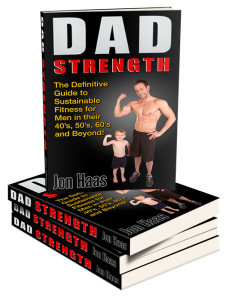
MEN – Pick up a free copy of my book, Dad Strength HERE 

Warriorship in the Modern World

These days it seems like everyone fancies themselves a warrior.  The word has become so overused in our society that the essence of it has become lost.  It seems that anyone engaged in any type of struggle, be it physical or not, has co-opted the word for their own personal bandwagon.

Originally, the word had just one interpretation – one who wages war.  This is a very strict and narrow definition, but probably the most accurate.  In this sense then, a warrior is a professional military or police man who carries a weapon and puts their life on the line day after day to protect our freedom and way of life.  In addition to putting their own lives on the line for us, professional warriors do one other thing that completely separates them from the rest of the population.  They are sometimes required in the course of their role as protectors and defenders to take a life.  This is a great responsibility that weighs on them heavily and one that only they are allowed to bear.  It is one critical distinction that many people who want to play warrior do not consider or perhaps even understand.

 Let’s Extrapolate A Bit…

If we extrapolate this idea of a warrior as professional soldier a little further, we can than begin to look at those who make a lifetime study and practice of the warrior arts.  These are the martial arts which are derived from the ancient warrior traditions of the world.  They come from India, China, Japan, Philippines, Indonesia, Russia, and others.  These traditions all have one thing in common – they were used hundreds, if not thousands, of years ago in real battle to save someone’s life.  Their wisdom, training methods, and skills were then passed on down the generations to those of us who practice them today.

As for me, I have never been in the military.  But I have spent over 30 years training in the warrior arts of Japan, China, and Russia.  I developed a system of physical training called, Warrior Fitness, based on my experience in the warrior arts.

However, in spite of this, I must state that I believe a true warrior is much, much more than a person striving for physical perfection in the gym – yes, no matter how hard or intense they are training.

More to This Warrior Thing

There is much more to being a warrior than merely struggling for something or training crazy hard in the gym.  A true warrior must have be a protector and defender of life.

This might be my own personal bias, but I believe a warrior has a greater responsibility, one of both self and others.  My perception has been colored, for the better, I think, by my teacher, Jack Hoban, author of The Ethical Warrior: Values, Morals and Ethics – For Life, Work and Service, and his mentor, Dr. Robert L. Humphrey.

spartan warrior

These 2 men are both true warriors whom I admire greatly.  Jack served as a U.S. Marine Corps officer and is a master level instructor in the Bujinkan martial arts.  Dr. Humphrey was a boxer and Marine Corps officer who survived the battle of Iwo Jima in World War II.  There is much, much more to both of their stories, but for now, we can sum up the essence of what it means to be a warrior like so:

“The Warrior Creed”

Wherever I go,
Everyone is a little bit safer because I am there.
Wherever I am,
Anyone in need has a friend.
When I return home,
Everyone is happy I am there.
It’s a better life! 

-Dr. Robert L. Humphrey

Everyone who calls themselves a warrior believes that they should possess greater strength, greater power, and greater skill; should they not also possess greater compassion for others and a greater sense of responsibility for helping others as well? 

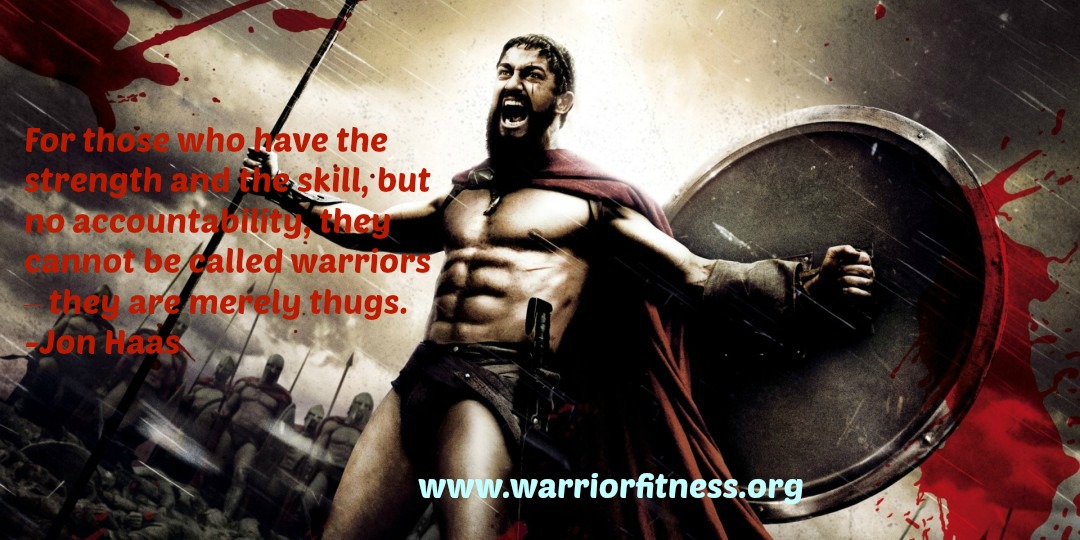
For those who have the strength and the skill, but no accountability, they cannot be called warriors – they are merely thugs.

The Day That Changed My Life

I still remember it like it was yesterday.  I was 16 years old, sitting in the back seat of my parent’s car thumbing through the latest issue of Black Belt magazine when I came to a full page advertisement for the 1989 Tai Kai with Ninjutsu Grandmaster Masaaki Hatsumi.  To my shock and utter astonishment this 3-day seminar with the master ninja and his top students from Japan was being held in the United States.  Not only was it being held in the US, but in my home state of NJ, not even an hour drive from my house!  Something clicked in my brain – I HAD to go to this thing!  Continue reading

This is Dangerous to YOUR Training

Alright.  Strap in, kids because this is gonna be a bumpy one.

There is a huge problem that affects many people training in martial arts today that needs to be addressed because it is severely inhibiting their progress and skill.  It applies to fitness training as well, so if you don’t train martial art read this with whatever type of training you do in mind. Continue reading

RGI Conflict Resolution Course Review

Last week I had the very special privilege of attending the RGI Conflict Resolution Certification Course.  Resolution Group International (RGI) is a conflict resolution company specializing in: Ethics presentations, Leadership training, Tactical Communication, Cross-Culture Conflict Resolution, and Defensive Tactics and Combatives.  It was hosted in Spring Lake, NJ and taught by a panel of experts in the field of conflict with decades of real world experience and credentials behind them. 

The RGI seminar format utilizes a unique teaching methodology which blends values-based lessons, conflict communication skills, and ethics with physical training and exercise to activate and clarify the principles being taught.  The interchange of movement with the classroom style lecture increases the absorption and retention of the intellectual and values-bases lessons.  This concept is backed up by latest research into combining education with physical exercise.  Check out the book, Spark: The Revolutionary New Science of Exercise and the Brain by John J. Ratey, MD for a more detailed discussion of the science behind it. 

RGI’s Conflict Resolution course starts with a premise: in order to resolve conflict one must be moral, knowing right from wrong; one must be ethical, putting that morality into action; and one must have the physical skills and confidence from which to proceed.  The Dual Life Value (DLV) theory is the linchpin holding the course together.  It permeates the philosophy, intellectual discussions, physical skills, and emotional stories.  The DLV states that we are all equal because my life and the lives of my loved ones are as important to me as your life and the lives of your loved ones are to you.  Further, the life value is a universal value by which all other values are judged.  If they support the life value, they are moral, if they don’t, then they are not.  This is a very high level summary of an extremely important concept.  To really gain a full understanding and appreciation of the DLV theory, you really need to attend the course and be immersed in the philosophy.  This review can do nothing more than offer a taste to whet your appetite.  I hope it makes you hungry!

PT with Joe Marine

Joseph C. Shusko AKA “Joe Marine” is a decorated veteran who served the United States Marine Corps for over 30 years.  He is now serving as the Deputy Director, Marine Corps Martial Arts Center of Excellence overseeing the Corps’ Martial Arts Program.  Joe Marine is also known as the “combat conditioning guru”.  He took the class through 2 morning PT sessions Thursday and Friday.  The Thursday morning PT session began with a discussion on health and fitness in which Joe Marine shared his outlook and really brought home the importance of taking care of oneself, especially as we get older.  We then proceeded to go through a simple, yet highly effective workout Joe calls “5-10-15-20”.  It’s basically a plug –n- play type workout template which uses a variety of bodyweight exercise for the prescribed number of repetitions, 5, 10, 15, and 20, respectively.  The set is repeated as many times as possible in 10 minutes.  This allows trainees to work at their own pace and to their own fitness level.  But as Joe says, you only get out of it what you put into it!  Friday morning’s PT was a real treat as we moved the location outdoors to the beach on Spring Lake.  This time the workout was done in teams of 2.  This really pulled the participants together as they struggled to overcome the shared adversity of the physical challenges together.

In addition to being the combat conditioning guru, Joe Marine is also known for his “tie-ins”.  These are values-based stories which serve to illustrate points and drive home the intellectual or physical lessons with an emotional impact.  Never miss an opportunity to ask for a tie-in!

Maneuver Martial Arts

Maneuver Martial Arts is the term RGI President, Jack Hoban uses to describe RGI’s approach to physical conflict.  Jack is a speaker, writer and Subject Matter Expert (SME) for the U.S. Marine Corps Martial Arts Program (MCMAP).  His business and military experiences, as well as an extensive 30-year background in martial arts, give him a unique and interesting perspective.  Jack, along with co-instructors Craig Gray and Artie Mark, skillfully introduced the participants to the concept of tactical movement, striking, escapes, takedowns, submissions, and protecting others.  Tactical movement and being able to control the tactical space around the opponent(s) was emphasized as primary, over and above the concept of technique.  This allowed the participants, some of whom had no prior martial arts experience, to gain an understanding and quickly absorb the principles of martial movement as the seminar progressed.  As a martial artist of almost 30 years of experience myself, it was hugely gratifying to watch this process unfold!

The crown jewel of RGI’s martial arts training though is really the protecting others piece.  As Jack mentioned in his introduction to this section, in a typical martial arts school setting, if 100 techniques are taught, 100% of those techniques are geared towards defending yourself.  How many look at how to defend others?  Usually none.  This segment of the training served to rectify that deficiency in current martial arts training, as well as to drive home the importance of the universal life value of self and others – all others.  Protecting others activates the life value and solidifies the concepts, principles, and ethics in a very real and effective way.

Conflict Communication

RGI’s approach to conflict communication is both an art and a science.  Gary Klugiewicz is employed by PoliceOne as a police and corrections subject matter expert. He is retired from the Milwaukee County Sheriff’s Department after 25 years of service where he was promoted to the rank of captain. Gary has been a Verbal Judo Instructor for the last fifteen years.  Gary expertly distilled the essence of Dr. George Thompson’s Verbal Judo, to give the participants a highly beneficial introduction to tactical communication.  Take a look at what Verbal Judo calls the 5 Universal Truths and see if they resonate with you.  They certainly did with me.  Also, try them out on your kids.  You’ll be amazed at the level of compliance!

5 Universal Truths

  1. All people want to be treated with dignity and respect.
  2. All people want to be asked rather than told to do something.
  3. All people want to be told why they are being asked to do something.
  4. All people want to be given options rather than threats.
  5. All people want a second chance.

Real world experience in conflict communication from both the ER and out on the street from a law enforcement perspective was also shared by Joseph Lau, RN, veteran police detective Arthur “Artie” Mark, and decorated veteran detective James Shanahan.  Additional presentations were given by heavy hitters such as Brian Pensak, Marine Corps Martial Arts Program Instructor Trainer and SME, and Bruce Gourlie, Special Agent of the FBI.  There is so much experience, expertise, and information to unpack from just one of these gentlemen’s presentations that it’s impossible to delve into in a short seminar review.  My advice?  If you deal with any type of conflict in your job, in your family, in your life, get to an RGI Conflict Resolution course ASAP – you’ll never look at conflict the same way again!

The RGI Conflict Resolution Course has a synergistic effect whereby the whole is much, much greater than the sum of its individual parts.  The combined impact of the instructors’ professional presentations, the interchange of physical skills with values, morals, and ethics, and the engaging course material create an outstanding professional development course. 5 out of 5 stars – highly recommended!!

For more information on RGI upcoming events and seminars, please click here.

Jack Hoban on Fitness

The interviews conducted here at Warrior Fitness will highlight people who have significantly influenced my thinking and training on fitness, who are leaders in their particular fields of expertise, and whom I admire.  Jack Hoban happens to fit all three.  Through his unwavering commitment to martial arts and fitness, Jack has inspired me to keep going over the past 20 years down the dual path of martial arts and fitness.

 Jack Hoban is a former active duty U.S. Marine Corps Captain and long time practitioner of martial arts.  He is Shidoshi Senior Instructor in the Bujinkan Budo Taijutsu and Togakure Ryu Ninjutsu systems under Grand Master Masaaki Hatsumi in Japan and has authored three books on warriorship.  Mr. Hoban also holds an MBA and is an executive in the healthcare industry.    Jack’s full biography, and further information, can be found on his website here


1.  Can you please describe your current philosophy on physical fitness?

I have been serious about physical fitness for most of my life, first as an athlete in grammar school, high school and college, and then as a Marine, and martial artist.  That hasn’t changed, just become more refined and age-appropriate as the years have gone by.  Humans are physical beings and have been so for millions of years; I think we should acknowledge and honor that fact by maintaining a high level of physicality in our lives.  That’s my philosophy.  Until fairly recently, being physically fit, for most of us, was just a part of being human—and staying alive through hunting and gathering, farming, work, or other physical endeavors.  That has changed, and there is a greater risk of falling into a sedentary lifestyle today.  But our basic nature as physical animals has not changed.  We have to be careful not to stray too far from our nature, or certainly unhappiness and ill health may result.

2.  How has your outlook changed over the years?

It really hasn’t changed.  It has just become more refined.  I have tried some of the new fitness technologies—for example I run barefoot now using the new Vibram footwear.  I also think I use cross-training more effectively than in the past.  But I pretty much do the kinds of things I have always done.  I do have to worry more about “overdoing it,” because injuries take longer to heal.

3.  Do you have a daily fitness regimen that you follow?

Yes and no.  I have a range of things that I do, but it changes according to my schedule, the season, the weather and how I am feeling.

4.  Can you briefly tell us what it consists of?

Again, it is not a daily thing in that I don’t do the same thing every day.   But over the course of a week I typically fit in a few runs (45 minutes to an hour), I lift weights, I do a lot of core training, and I do various calisthenics.  In the winter I use the gym for the rowing machine, treadmill and elliptical.  In the summer I swim in the ocean almost every day.  I practice martial arts daily by myself, and have a class between 2 and 5 times a week.

5.  How do you think fitness and budo (martial arts) are related?

Inseparably, although martial artists might take care to explore a regimen that is complimentary to martial arts—one that increases strength and endurance, but also promotes flexibility and relaxation.

6.  How has your being in excellent physical condition enhanced your martial arts training?

Simple, it helps me to “keep going” longer and more consistently without being tired or sick.  And by the way, real fights are very physical—tiring and punishing. 

7.  How does your being in excellent physical condition help your work with the Marine Corps Martial Arts Program (MCMAP)?

When I first meet a new class of students, the unspoken question is “Is he one of us?  Can he do what we do?  If he can’t, why should we do what he does?”  That’s just the nature of young, competitive men.  Because I can pretty much keep up with them “for an old guy,” I gain a certain measure of respect.  That way, they are open to the other physical and ethical lessons I am there to share.

8.  Has the Marines Combat Conditioning program influenced your personal exercise program, and if so, how?

Yes, in at least two ways.  It has made me more aware of the value of cross training, and two, it has made me more creative in using training aides of opportunity.  By that I mean, you can design your own training regimens and make your own training apparatuses just by using your brain and common items and structures.  You don’t need fancy equipment; an old tire works just fine as an exercise apparatus.

9.  The last, but most important question, how do you keep going?

I enjoy it!  Find a method of physical exercise that you enjoy and pursue that.  Find other people who like it as well, and do it together.  That will help too.

Thanks Jack!