 As martial artists most of us tend to cringe and shy away from words like “strength” and “power” in favor of seemingly more budo-friendly fitness words like “agility”, “coordination”, or “balance”. Yet, often we do not understand the actual definitions of the words and simply avoid them because of some misplaced fear that they will be detrimental to our taijutsu and make us “muscle” through our techniques. Nothing could be further from the truth! Let’s examine some of the components that make up strength in more detail to understand just how much they are applicable to creating a strong physical and mental base from which to launch the rest of our Budo Taijutsu skills.
General physical conditioning is essential for the warrior to develop a broad-based platform of strength, endurance, agility, coordination, and flexibility from which to launch and further refine skills. But, what exactly is strength? Strength is defined as “the ability of a given muscle or group of muscles to exert force against resistance.” It is a function of the appropriate muscles contracted by effective nervous stimulation. This alone, however, is insufficient. There are also at least five different sub-categories of strength which we will break down to give you a more complete understanding of the term.
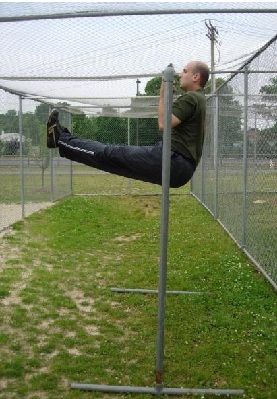
The first sub-category is Maximal Strength. This is the maximum amount of force that a person can voluntarily produce. Example exercises to cultivate Maximal Strength are: one arm pushups, one arm chin-ups, one legged squats, and heavy weight lifting. But what on earth does Maximal Strength have to do with Budo Taijutsu? Aren’t we training to only use as much force as necessary and appropriate to a specific movement or technique? Why would we need our maximal voluntary strength output when training for taijutsu fitness? These are all good questions. On the surface, it would seem like this sub-category of strength is a big “N/A” for us. What possible benefit could this particular strength quality have for budoka? To begin to appreciate the benefits of training maximal strength, we must first understand the different types of muscle fibers. Generally, when people speak about fast twitch and slow twitch muscle fibers, they tend to separate them out as two distinct types. This can be a little misleading due to the fact that muscle fibers are not either /or, but in actuality they appear to lie somewhere on a continuum between the two. Thus to emphatically state that one type or the other is predominate within certain groups of muscles can cause confusion. Because low intensity exercise, like jogging at a steady-state pace for example, does not activate the fast twitch (FT) muscle fibers, we must increase the intensity of the exercise to stimulate the motor units that contain the FT fibers. If the motor units are not stimulated, then no response occurs and no adaptation occurs. Fast twitch muscle fibers and slow twitch muscle fibers are both recruited in high percentages when performing maximal strength exercises. Maximal strength training creates potent neural adaptations which lead to increased intermuscular and intramuscular coordination. A side bonus for working on maximal strength with body weight exercises is that the majority of them that fall in this category also require balance, coordination, flexibility, and appropriate tension throughout the entire body. Examples include, but are by no means limited to, one arm push-ups, one-legged squats, one arm chin-ups/pull-ups, etc.
Does this mean that we should devote every training session to developing maximal strength? No – far from! As warriors, we must understand the different qualities that make up strength and learn how to apply them to optimize our fitness levels specific to our goals. Since our goals do not revolve around winning any Strongman competitions or Power lifting contests, we can relegate working on maximal strength to only once a week, at the most, or a every couple weeks at the very least, to reap the benefits. The rest of the time, consign maximal strength to its rightful place back in our strength and conditioning toolbox. Too much emphasis on maximal strength can lead to becoming muscle “bound”, as in bound, constrained, unable to move freely and without appropriate tension.
The second sub-category of Strength is Explosive Strength. This is the ability to produce maximal force (see above) in a minimal amount of time. Explosive strength? Jon, you’ve got to be kidding me! We don’t use explosive strength in Bujinkan Budo Taijutsu! Really? Are you sure? Every time you leap, sprint, dive out of the way of an errant sword strike, or (and this is a big one!) use stored elastic energy to create power in your movement, you are using explosive strength. Sure, the terminology sounds like something that will adversely affect our taijutsu and that any serious budoka should avoid like the plague, but rest assured, that the much maligned concept of strength does play an important role in budo taijutsu and utilizing the strength exercises prescribed in this manual will provide a solid physical basis on which to build real skill. Plyometrics is a specific training means for developing explosive strength designed by Russian sports scientist, Yuri Verkhoshansky in the early 1960’s. Closely linked to Explosive Strength are Speed Strength and Reactive Strength.
The third sub-category of strength is probably one of the most familiar to us. It is Strength-Endurance. OK; much better… now we are in familiar territory. Endurance is a concept that a ninja can relate to! This strength quality involves the production of muscular tension without a noticeable decrease in efficiency over long periods of time. Development of strength-endurance is a fundamental necessity for warriors, whether on the battlefield, in training, or just everyday life. A helpful analogy to keep in mind when applying the different aspects of strength training to budo is that they are like a recipe for success. All of the ingredients in any recipe are not utilized in the same amounts. A little bit of salt may be all that’s required to enhance the flavor, while a lot of flour may be necessary to provide the base. The same idea applies to strength training. Warriors will normally require a lot of strength endurance and cardio-respitory endurance, but maybe only a little bit of maximal strength development is necessary to round out their overall skill. “When effective methodology is used, exercises with resistance promote not only an increase in movement speed but also perfection of coordination, motor reaction, quickness and frequency of movements, the ability to relax muscles, development of local muscular endurance and an increase in maximal anaerobic capacity.” (Verkhoshansky, Special Strength Training – A Practical Manual for Coaches) The key here is in how these various strength qualities are trained. For martial arts, specifically Bujinkan Budo Taijutsu, we want to work exercises which emphasize intermuscular coordination of the whole body. Isolation exercises should be avoided as they are antithetical to what we are trying to accomplish in training. When performing all of the exercises listed here, try to use as little tension and muscular effort as possible; just enough to accomplish the task and no more. Try not to utilize general tension (tightening of the entire body) to carry you through the exercise. Since everything that we do acts as conditioning for our Central Nervous System (CNS), for good or for bad, we want to make sure our exercise philosophy is in harmony with our overall training strategy. Remember that in our day-to-day Bujinkan Budo training we are striving to perform techniques efficiently and effectively with minimal muscular recruitment, therefore our physical fitness training should not use a separate strategy.
Hopefully this short look at the various types of strength has been helpful!