Why Sitting All Day is Slowly Killing You

There’s more to leading an active lifestyle than just getting in a workout a few times a week.  Check out this Men’s Health article on Why Sitting All Day is Slowly Killing You.  Think your 45 minute exercise session 3-4 times a week is protecting you from heart disease?  Think again.
For some ideas on how to add beneficial movement to your sedentary office worker life, check out the Corporate Warriors section of Warrior Fitness.

Applying Six Sigma Principles to Your Fitness Plan

Six Sigma is a process improvement methodology that has its origins in the manufacturing business.  It has been adapted and expanded to cover a wide variety of business products, services, and help foster solutions in terms of reducing costs, removing defects, and continuously increasing efficiency.

Today, we are moving from the boardroom to the gym and looking at ways to apply a scaled-down version of Six Sigma methodology to improving your health and fitness.  Right now, you are the product and we are looking for ways to foster continuous improvement in you!

What is DMAIC?

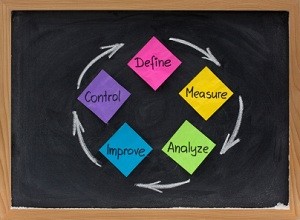
Let’s look at one of the basic methodologies for Six Sigma projects called DMAIC and see how it can be applied to improve your fitness program.

DEFINE the problem and project goals specifically.

  • What are your fitness goals, right now, today?  Whether it’s to lose a certain number of pounds in an allotted time-frame, or be able to do a one-arm push-up at 40, it doesn’t matter.  Here is where we define our objective.

MEASURE key aspects and collect data.

  • What is your current weight or dress size or waist size?
  • How many push-ups can you do in one session?
  • How many calories, carbohydrates, and grams of protein do you eat daily?
  • How many servings of fruits and vegetables do you eat daily?
  • What is your resting heart rate?  Blood pressure?  Cholesterol numbers?
  • How fast can you run a mile?
  • Or, any other measurements that pertain specifically to the goal you outlined in the Define section above.

ANALYZE the data to investigate and verify cause and effect relationships.  Determine the root cause of the problem.

  • Do you have 3 sausage, egg and cheese breakfast sandwiches from Dunkin Donuts daily and notice that your cholesterol has sky-rocketed, your blood pressure is too high, and your waist line has expanded?
  • Do you run out of breath climbing a flight of stairs?
  • Or, not have enough energy to play with you kids in the park?
  • Do you aspire to run a marathon this year, but can’t get motivated?
  • Look closely at the data you gathered above and figure out what is holding you back from achieving your goal.

IMPROVE or optimize the process based on the analysis.

Here is where all the real work gets done, but also where you may encounter a stumbling block.  You’ve defined your goal, measured key aspects as they relate to your goal, analyzed all the data and determined the root cause of the problem, but what do you do now?

This is where having a knowledgeable and highly experienced Coach comes into play

(Book a Strategy Session Call with me HERE).

You need someone who can review the findings above and determine the best possible solution for you.  This includes:

  1. Knowledge and understanding of exercise methodologies and how to apply them on a case-by-case basis.
  2. Ability to design an individualized fitness plan for you.
  3. Ability to effectively and efficiently get you the maximum results in the minimum amount of time.
  4. Ability to communicate, break things down, and respond accordingly to questions and concerns.
  5. Ability to motivate and keep you on the path.

CONTROL future state process to ensure any deviations from the target are corrected before they result in defects.

  • Here is where your progress is charted and tracked to make sure slippage does not occur.  If slippage does occur, it can be noticed and corrected for immediately to assure the project – a fit and healthy you – remains on track!

Many companies and organizations have applied these principles to better their businesses, increase production, reduce costs, and improve their overall business processes.  Why shouldn’t you be able to take the same ideas and apply them to your health and fitness?

Warrior Fitness Executive Coaching Program

Book a Free Strategy Session call with me HERE to see if you are a good fit.

Fitness at Work?

This proves to be quite difficult for many cube-dwelling corporate warriors. This article will provide the reader with concrete examples of ways to increase health, energy, mobility, and core strength all while seated (or standing) at your own desk. Fitness at Work will only require about 10 minutes a day which can even be broken up into shorter increments and done throughout the work day.  And, for those concerned with being stared at, most of these can be accomplished surreptitiously!

Before we get started, let’s take a look at some of the specific impediments to our health, vitality, and fitness that may be exacerbated by sitting at a desk, working on a computer 8+ hours a day, 5 days a week:

  • General fatigue
  • Short-range stiffness
  • Stiff neck, neck pain (pain in the neck?)
  • Low back trouble, ruptured/herniated/bulging discs, etc.
  • Carpal tunnel syndrome
  • Expanding waist line
  • Lack of good overall muscle tone

Try to perform the following exercises a few times a day to reduce tension from the daily grind!

Neck Mobility

  • Up/Down (Lift up from crown of head, slide down along plane of jaw)
  • Left/Right (Turn head as far left as possible without pain, turn as far right as possible)
  • Side/Side (Tilt head down to left, move from corner of jaw, repeat to right)
  • Full circle

Shoulder Mobility

  • Roll both shoulders backwards (Lift shoulders up towards ears, roll backward fully articulating the range of motion, drop them down as far as comfortable)
  • Roll both forward
  • Alternate shoulder rolls (Roll left shoulder back as described above while pushing right shoulder forward then switch)


Wrist Mobility 

  • Hold both hands in loose fists, make circles clockwise and counter clockwise with wrists
  • Begin with left wrist, hold in fist as above, lift wrist up, to the outside, down, to the inside, reverse direction and repeat with right wrist

Finger Mobility

  • Begin circling fingers with thumb (5 times) then continue with each additional finger
  • Circle fingers from pinky in the opposite direction

Core Strength

  • Tilt the pelvis up slightly while rolling the shoulders down, creating a “scooped out” concave with your torso. As you do this exhale and tighten all the core muscles and muscles around the core
  • Hold the tension for 5 – 8 seconds, then release allowing the breath to rush in as your abdomen naturally expands out again
  • Repeat 5 to 10 reps

Remember, just a short 10 minute break a few times a day will do wonders to increase your concentration, productivity, and mental health!

 Let me know how these exercises work for you.  Also, how do you relieve stress at work?

Want to know more?  Check out Warrior Fitness: Conditioning for Martial Arts!

5 Ways to Help Decrease the Stress

Today’s corporate warriors are often besieged with too many tasks, meetings, email, cell phone calls, pagers going off, Blackberrys buzzing, etc. Individually, these things are not significant, but when combined together in a constant barrage, all day long, they produce a cacophony of stimulation which, if not addressed through specific countermeasures, can cause a significant stress response in the brain. This stress response emanates from our primal, survival oriented center of the brain which, in times of crisis, can overload and over run the higher brain functions – i.e., those that allow us to plan, prioritize, manage time and people, and be creative.

Article in Harvard Business Review

 According to an article in Harvard Business Review, when busy executives begin to experience symptoms of this stress response in the brain, they often forget important details, lose the ability to prioritize tasks, and generally feel overwhelmed. Overall tension in the body increases, as well as other important markers such as heart rate and blood pressure.

The ability to reduce and manage stress is a key issue in the overcoming of these symptoms in busy workers. Stress can be reduced in various ways such as relaxation, meditation, vacation, diet, and exercise. It is the last two, diet and exercise, that I am focusing on in my recommendations today.

5 Ways to Help Decrease the Stress

  1. Begin to increase complex carbohydrates at every meal. (Complex carbohydrates are whole wheat, multi-grain, etc.)
  2. As you increase complex carbohydrates, begin to eliminate simple carbohydrates. (Simple carbohydrates are white flour, white sugar, and white rice)
  3. Eat protein and vegetables (or fruit) with every meal.
  4. Exercise at least 3 days a week for a 1/2 hour or more.
  5. Daily short exercise breaks – this can be done at your desk or standing up in the office. It is a quick “10 Minute Recharge” for stress reduction and to increase energy throughout the day. This consists of moving all the joints in the body in circles or waves to increase mobility, increase blood flow in muscles and prevent stagnation. These joint mobility exercises coupled with active exhalation breathing aid in the reduction of stress and help to lower blood pressure.

These exercises can be taught quickly and easily, but the benefits are enormous.

For all the aspiring Corporate Warriors out there, how do you deal with stress?