Muscle Building Secret of an Escaped Convict

Muscle Building Secret of an Escaped Convict

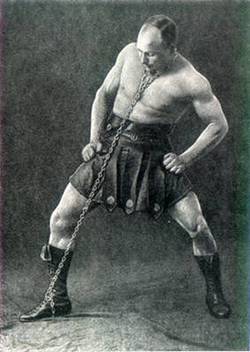
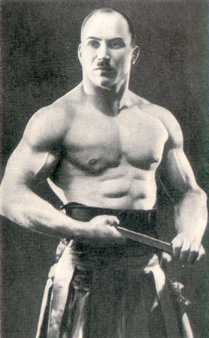
There’s an 8-second strength and muscle-building trick once used by a Russian spy to literally bend steel jail bars and rip open his heavy shackles to escape prison… not once, but 4 TIMES! Anyway…


Research shows this single trick will explode your muscle and strength gains from your very first workout. Check it out!

=> Muscle building secret of escaped convict (use THIS next workout)

World famous strongman competitors and legendary bodybuilders like Arnold Schwarzenegger have used this technique to make their most stubborn body parts more powerful, dense, and eye-popping…

Even some of the “baddest” cage-fighters like Connor McGregor and Georges St. Pierre…

And history’s best martial artists like Bruce Lee and Jean Claude Van Damme have used this method to build lethal force that can instantly put an end to any fight…

I’m talking about a specific kind of isometrics. Which…

According to a recent study published in the Journal of Applied Physiology this method boosts strength by 45% while increasing muscle growth by 5%…

WITHOUT having to perform endless amounts of sets and reps that bombard your joints with painful inflammation and injury…

Basically, adding this one max static muscle stimulation technique to your workouts will have you building muscle FASTER…

While keeping you “in the game” for decades to come. Check it out…

=> Max Muscle Stimulation (do these if you want more strength & muscle)


4 Tips for Bruce Lee Strength

Thanks to my friend, Jarell Lindsey, owner of Muscular Strength System, for this awesome guest blog post!

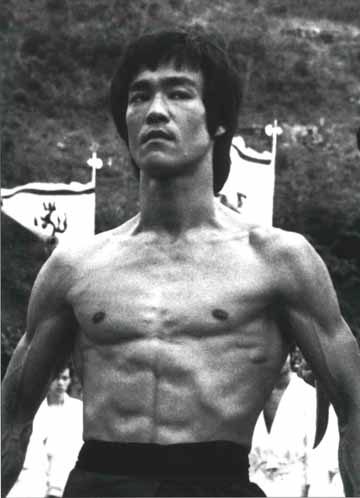
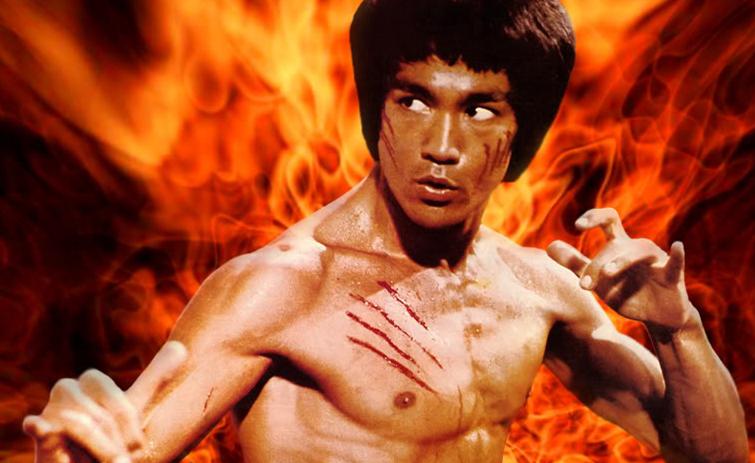
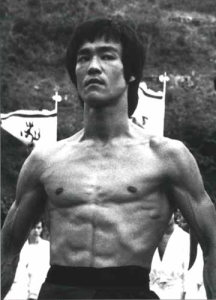
Bruce Lee is the face of fitness in America. Even 40 years after his death, he is an icon for one of the best physiques that the movie industry has ever seen, and every ounce of his flesh produced terrible strength.  At his bodyweight of around 140, Bruce Lee was known to completely demolish 300 lb heavy bags with his kicks, and punch with a force strong enough to completely splinter pieces of wood. More than power, he had dexterity, able to catch pieces of rice thrown into the air with a pair of chopsticks. He trained for function first and foremost, and the rest seemed to follow.
Bruce Lee

So how can one hope to even get near Bruce Lee’s strength? Just as it wasn’t for him, it will not be easy for you. In all honesty, Bruce Lee was one of those one-of-a-kind people, but that shouldn’t discourage you from training your utmost for Bruce Lee strength.  Here are four tips on how to get there:


Dedication. First, if you don’t have dedication, you can forget about the rest of these tips, because you’ll never get anywhere near the Dragon’s level of strength without using his greatest strength, which was his almost manic level of dedication to training. You better believe that if there was a single moment in the day that Bruce Lee wasn’t training, he was thinking about it. Moments like watching TV or standing in line were opportunities for extra training. A walk along the beach turned into sprints or multiple-mile jogs. Are you this dedicated to your strength? If not, that’s okay for now, because you can get there. But you’ve gotta start by doing at least one fitness related thing a day. If you can’t go to the gym everyday, walk a mile or two in the morning. If you feel up to it, make it a jog. Always think about how to improve your strength in the little things you do everyday, and it’ll become second nature.


Pyramids. Bruce Lee did a lot of pyramid training with his workouts; for a man who exercised only for function, pyramids were key. The biggest argument that martial artists had against lifting weights was that it’d make them slow and bulky. Bruce Lee proved that, by starting heavy and working your way down, you can improve strength and power without sacrificing speed. Say, for punch power, Bruce would start punching with 50 lbs for 10 reps, 40 lbs for 15 reps, 30 lbs for 20 reps and so on. So, are you ready for some intense functional strength? Incorporate these into your workouts.


Cardio. I know a lot of big, strong guys who don’t think cardio is necessary as long as they just “lift weights faster”. If Bruce Lee, who had one of the best physiques of the modern era, wasn’t too good for cardio, I’m not either. Truth of the matter is, cardio will give you the endurance to go much longer and harder in your workouts, and leaving out cardio keeps you from reaching your best fitness potential. If you’re a fighter, you know how important cardio is to keep you sane and stable for those last few rounds or that final period of the fight. It takes more that just heavy lifting to have athletic function. Bruce Lee really pushed the limit with his cardio, running 5 and 10 miles like an Energizer bunny, but the most important thing I’ve taken from his running is his interval training. Bruce wouldn’t just run aimlessly for years or sprint himself to heaven; he’d sprint, jog, shadowbox, jog and shadowbox, sprint, and repeat or switch up the pattern. This interval training is the king of cardio; it teaches the heart to be able to spike it’s activity rate from a resting heart rate more comfortably. Basically, interval cardio teaches your heart to go from 0 to 60 faster than other forms of cardio, or a lack of cardio altogether.


Isometrics. This was Bruce Lee’s secret weapon in his training, and it should be yours too. Think of isometrics as taking your body and filling it up with titanium. Isometric exercises train you from the inside out, strengthening your bones and tendons/ligaments in addition to your muscles. This is what helped Bruce Lee get that “sinewy strength” people often talk about. Isometrics are interesting because you don’t move at all during your exercise, but it gives you some incredible strength benefits. You can push or pull against an immovable object like a wall, or you can load the machine up with supra-maximal weight in your strongest range and contract against it like there’s no tomorrow. Trust me, your limbs will feel like they just got treated with adamantium, and your resulting strength will be proof of that. Happy training 🙂


About the Author  
JarellJarell Lindsey is an avid physical culturist, and owner of MuscularStrengthSystem.com. He is an advocate of isometric training, and enjoys catch wrestling, sparring, or exercising in his free time. His training advice can be found on fitness, martial arts, and health sites across the web. Coming from a family plagued with various health conditions, he has been in pursuit of the best methods of health management and strength training around since youth. He is currently studying for a Bachelors in Exercise Science, and he hopes to motivate more youth to pursue physical fitness as a lifestyle. He offers training and diet advice, interviews from leading fitness experts, and self improvement advice. Ultimately, he encourages a physical culture revolution to overcome the modern health crisis.
Little Dragon

dragon

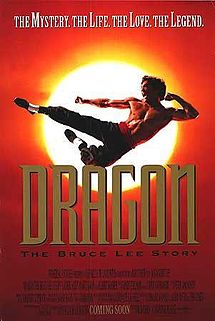
I just finished watching, Dragon: The Bruce Lee Story, for probably the 10th time since it came out in 1993.  It still amazes me that in such a short life, Bruce was only 32 when he died, he was able to have such a huge impact on the world.  Bruce was my childhood hero.  The man who inspired me, and so many others, to train in the martial arts.  It staggers my imagination thinking about how much he accomplished by the young, tender age of 32.  International movie star, world renowned martial artist, teacher, author, father, husband.  A man truly ahead of his time.  A revolutionary thinker forging a place for martial arts on the world stage.

How much more could he have accomplished had he lived?  What else would he have done?

In the movie, when Bruce was just starting out his teaching career, he placed a pebble in Linda’s (his girlfriend and future wife) hand and told her to drop it.  He then explained to her how dropping a simple pebble in a pond creates larger and larger ripples moving out from the center.  She drops it and he smiles, “It has begun.”  40 years after his death, the ripples of his life and his teaching still move us and affect us.

Dying Young

I remember back in my sophomore year in high school English class, we were studying poetry and we read a poem called, “To An Athlete Dying Young” by A.E. Housman.

To an Athlete Dying Young by A. E. Housman (1859-1936)

The time you won your town the race We chaired you through the market-place; Man and boy stood cheering by, And home we brought you shoulder-high.

To-day, the road all runners come, Shoulder-high we bring you home, And set you at your threshold down, Townsman of a stiller town.

Smart lad, to slip betimes away From fields were glory does not stay And early though the laurel grows It withers quicker than the rose.

Eyes the shady night has shut Cannot see the record cut, And silence sounds no worse than cheers After earth has stopped the ears:

Now you will not swell the rout Of lads that wore their honours out, Runners whom renown outran And the name died before the man.

So set, before its echoes fade, The fleet foot on the sill of shade, And hold to the low lintel up The still-defended challenge-cup.

And round that early-laurelled head Will flock to gaze the strengthless dead, And find unwithered on its curls The garland briefer than a girl’s.

Our assignment was to write a similar poem about a famous person we admired who had also died young.  I chose to write about Bruce Lee.  The day our poems were read in school, I was absent due to being sick.  One of my friends told me how much our teacher loved my poem and how she had read it to the class as an example.  I was shocked.  I didn’t try to write for a an “A”.  I wrote from my heart.  From my passion.  This was an important lesson for me – people recognize and respond to passion.  You don’t have to be the most educated or the most skilled, but if you do something – anything – with passion, people will feel it.

Live With Passion

The moral of the story, kids, is that you don’t know for sure how much time you have.  Don’t waste it.  Live your passion to the fullest.  Don’t wait for next year, next month, next week, or even for tomorrow, it may never come.  Do it now, TODAY!

Bruce-Lee

In the movie, Bruce Lee said, “The key to immortality is first living a life worth remembering.”

What are you still doing here reading this?

Go out there and create a life worth remembering!


Why Can’t You?

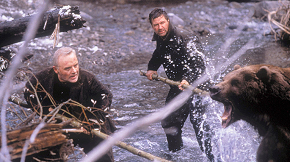
One of my favorite motivational quotes of all time comes from Antony Hopkins in the movie, “The Edge”.  They are stranded in the woods and he is tyring to  psyche up Alex Baldwin’s character to help him kill a bear.  Killing a bear seems like such an impossible task.  It’s fraught with danger.  It’s incredibly risky.  Unbelievable hard.  But they must do it.

Hopkins tells him – “What one man can do, another can do!”

Now, most of us will probably never be in a situation where we must kill a bear for survival.  But look at it as a metaphor.  The bear is any seemingly insurmountable task in your life.  Any goal that you long to achieve, yet seems unconquerable.  Doesn’t make a difference what it is – what one man can do (or woman, we’re equal opportunity here!), another can do!

It bugs to no end when students place highly skilled martial artists like Morihei Ueshiba, founder of Aikido, or Masaaki Hatsumi, head of the Bujinkan Dojo, or even Bruce Lee, founder of Jeet Kune Do on pedestals and hold them up as unreachable and impassible icons.  Are they great?  Yes, of course.  Are they worthy of our respect and admiration for their skill and achievement?  Hell yeah!  But are they an enigma?  Are they once in a generation geniuses that the rest of us mere mortals cannot hope to reach?  No.  Not at all.  They are men.  Human beings like you and me.  They put in ungodly amounts of hard work, study, and practice to reach the peak of their craft, but what one man can do, another can do.

Thomas Edison failed over ten thousand of times before he successfully created the first incandescent light bulb.  No, that’s not a typo.  Ten thousand.  What if he gave up after the first failure, or the hundredth, or even after the thousandth failure?  Where would we be?  In the freakin’ dark, people, that’s where!

Do you want the martial skill of a Hatsumi?

The Internal Power of Ueshiba?

The legacy of a Steve Jobs?

The money of a Bill Gates?

The body and fitness levels of an elite athlete?

The strength of a world champion strongman?

Go out and get it.  What one man can do, another can do.  Why can’t you?


Got Some Spare Time? Try Isometrics!

If you’re like me and can’t stand to waste any amount of time no matter how short, you’ll love how isometrics can fill in some strength gaps.  Nowadays, my days are jam-packed full with work, meetings, conference calls, networking, family time, training time, teaching time, writing time, and oh yeah – a little sleeping in my spare time.  Since there are never enough hours in the day to accomplish all the things I want to do (not to mention those pesky things I have to do!), I try to make the most of those few free minutes of downtime in between tasks so I can be just a little more productive.

The only way to constantly improve is to consistently work on improving your self.  One of my favorite quotes of all time is from Calvin Coolidge:

“Nothing in this world can take the place of persistence. Talent will not; nothing is more common than unsuccessful people with talent. Genius will not; unrewarded genius is almost a proverb. Education will not; the world is full of educated derelicts. Persistence and determination alone are omnipotent.”

And, since I don’t consider myself particularly talented, or even all that smart, it’s a good thing I am persistent!

So, let’s talk isometrics. 

Isometrics are a great way to work on increasing strength, or shoring up a strength deficiency in a certain movement or exercise, with virtually no equipment and very little time.  They are both effective and efficient – good news for us!

So what exactly are isometrics?  Basically, isometric exercise is exerting force against an immovable object.  The idea is that the length of the muscle does not change, but the tension remains constant during the exercise.  There are 2 general types of isometric exercise:

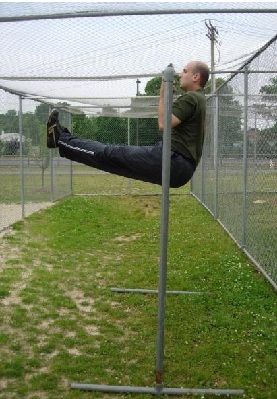
1.  Holding yourself (or a weight) in a static state.  For example holding the mid-point of a push-up position or the mid-point of a squat.  Or, holding yourself statically on a pull-up bar.

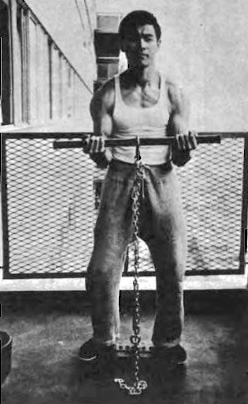
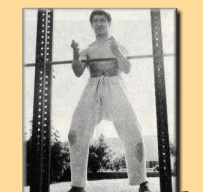
2.  The other type of isometric exercise consists of pushing or pulling against an immovable object.  This picture of Bruce Lee is a great example of just one of the ways he used to train isometrics.

For our purposes, when training the first type of isometric drill, try holding the mid-range or hardest point of the exercise for 30 to 60 seconds.  Make sure to keep breathing!  Then shake it out – see the vibration exercises here  – and go again.

We will use much shorter time frames for the second type of isometric exercise.  Here we will be pushing or pulling against an immovable object as hard as possible (maximal contraction) for 1 to 3 seconds each rep.  Exert force as quickly as possible to improve speed strength.  Studies have found that the intention to move fast was more important for speed development than the actual speed of the the movement.  Interesting, eh?  Train about 4 to 6 reps per set and use the vibration exercises referenced above to remove residual muscle tension between sets.  Since there are innumerable variations here – pushing with the arms (one or both), pushing with the legs (one of both), pulling with the arms (one or both), pulling with the legs (one or both), not to mention the number of different joint angles one can use with either push or pull, I will leave it up to your creativity to determine how to best apply it in your training.  Let me know what you find works best for you.

I hope you enjoyed this short primer on isometrics.  We will be exploring them in more depth, as well as showing how isometrics can be used to not only increase strength, but increase power for your strikes in my upcoming book… Stay tuned!