Everyone Needs a Coach!

The other day, I was working out with my good friend Eric Chasko at his studio, Redemption Kettlebell Gym in East Windsor, NJ.  After our training session, we were discussing the mechanics of a basic kettlebell swing and Eric had me demo a few swings.  As I began demonstrating the basic kettlebell swing that I had been taught almost 10 years ago, he noticed a hitch in my movement during the back swing.  Instead of keeping my back flat, I was raising it slightly as the bell moved into back position.  This was something I had never noticed previously.  Initially, it would not cause a problem, but over time, and with some serious volume, it would begin to stress my low back and contribute to pain in that area if not addressed. 

Eric picked up another kettlebell and showed me the difference between what I was doing on my back swing and how it should be done correctly.  We then worked on keeping my back flat while bringing the bell back and then driving with the hips to swing the bell upwards.  After a practicing for a couple repetitions, I got it.  As Eric is fond of saying, “Kettlebell swings are not bad for your back.  The way YOU are doing them is bad for your back!”   Unless you ask questions and talk to a knowledgeable professional, you never know what you don’t know!

So, although I have done kettlebell swings for years, I still had something to learn from a coach.  Never assume you already know how to do something, even something as basic as a kettlebell swing!

Kettlebell Swing #1 - Approach
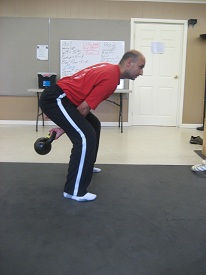


Kettlebell Swing #2 - Back Swing


Kettlebell Swing #3 – Hip Drive!


Basics Ain’t So Basic After All

As a teacher and student of Bujinkan Budo Taijutsu, I often hear the same question over and over again – how can I improve my skill?  What should I practice to get better?  Since I remember myself asking that question several times (probably several hundred times if you ask some people!) to my teacher and seniors in the art, I always take time to give a thoughtful and honest answer.  And, my answer to these sincere seekers is always the same  – practice the basics. 

Basic Does NOT Equal Simple 

I think maybe the term “basic” itself is a little misleading.  When someone says, basic, most of us immediately translate it in our minds to “simple”.  Nothing could be further from the truth for the basics of our martial art.  What I’d like us to do today for the purposes of our discussion is to suspend the judgement that basic = simple.  Instead, replace the word basic with foundational.  How do you continue to build upon a skill set indefinitely?  Well, the foundation must be strong.  It must be broad.  And, to keep going higher still, it must be deep.

Each January, every year, for the past 20 years I have been training in the Bujinakn, my teacher, Jack Hoban, spends the entire month with us reviewing nothing but the basics of our art.  This sets the tone for the year and helps to increase the capacity of the entire class to absorb the higher level lessons for that year.  Guess what?  Invariably, I learn something new each time Jack teaches.  Every year, just by practicing the basics… eh… excuse me… the foundational training of our system new ideas, new concepts are born as we go deeper into the details and application of the techniques.

Shu Ha Ri

In traditional Japanese arts, there’s a concept called Shu-Ha-Ri.  This is a method of progression, or more accurately, a cycle of progression, for learning any art.

Shu – “Protect” the form. 

Ha – “Break” the form

Ri – “Leave behind” the form

This process is a continuous cycle in our Bujinakn training.  In order to progress higher in the art, our base must be solid, so we protect the form.  In order to understand the art, we must begin to break the form.  In order to master the art, we must leave the form behind.  Yet, this is not a linear progression at all!  Working on the foundation is never a step backwards.  Think of it more as a ratcheting back to spring forward.  Want to surpass your current level?  Strengthen the foundation.

Think you know the basics?  Think again.

I will be sharing my interpretation and experience of the foundational skills of Bujinkan Budo Taijutsu here.  Please come and check it out!