Special thanks to guest author, Tony Notarianni for another excellent contribution!
Recently I read a book called, Makko-ho: Five Minutes Physical Fitness , by Mr. Haruka Nagai.
Summary:
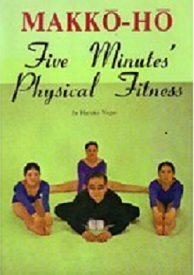 Makkō-Hō is a system which through regular practice can produce a huge range of benefits for just about anybody at any age. This book gives a good clear breakdown of the four main exercises and also some detail on the science behind the purpose and results of the exercises. Although not a complete guide to the system (which would be an impossible feat anyway) the material provides a great opportunity to begin study and try for yourself.
So first of all what is it? Makkō-Hō is a complete system of exercises for wellbeing created in Japan during the mid 1900’s by the father of the book’s author. The main benefits of this system are: increased flexibility, symmetrical skeletal alignment, nerve stimulation, improved circulation, overall good health, and even increased libido. The founder invented this system after having been paralyzed across half of his body and seriously ill after a stroke. He was told that he would probably never work again and would need constant care for the rest of his life even though he was only 42. Being a very independent character he was not ready to accept this future of boredom or to be a burden upon his family. He obtained the idea of certain postures from Buddhist prayer positions which he maintained regularly. Over time these prayer poses developed into four main exercises which are the core of Makkō-Hō today and at the same time he managed to heal himself dramatically. In other words the system is on first glance extremely simple and capable of remarkable regeneration. The exercises themselves are probably familiar to students of Yoga or Japanese martial arts. In fact I have personally seen and practiced these exercises several times in the past in different settings. However this book clearly demonstrates that in order to really get the full benefits the student needs to study very hard and if possible find a qualified teacher to help them have the correct form. This book is in fact not just a list of exercises.
What is in the book? Chapter Breakdown
Two Kinds of Love: Overprotection and Discipline
The introductory chapter highlights all that is wrong with many aspects of society, such as our lack of willingness to experience hardship for the sake of long term benefit. Essentially this early truth sets up the reader for the arduous nature of what will be required later.
Lack of Use Leads to Aging and Functional Failure
In this section Mr. Nagai describes much that most of us should now know. Perhaps the most remarkable thing is that this was written in 1972 describing trends of modern living and predictions that have since born out.
God Planned the Human Body as a Delicately Balanced Machine
For me this was quite an important section of the book. Looking at the body as a whole system with constantly regenerating living cells creates a perspective that helps the reader to get an understanding of how Makkō-Hō actually works.
Maintaining Good Circulation
At this point the book introduces some basic concepts about the major role of healthy circulation and nerve tissue in the body. Using common analogies these concepts are clearly presented to generate recognition of the importance of these systems.
The joints: Inspecting and correcting
In reading this area I had an epiphany of study. Quite bluntly Mr. Nagai points out that if you can’t demonstrate full hip flexibility then you are, in a sense, out of shape. I had to re-read this several times while I internally argued that only a small percentage of the population can do these stretches however I soon had to concede that going by averages in fitness is not going to get us all very far.
Structure of the pelvic zone and the hips
This section through diagrams gives some rudimentary understanding of the lower body. It seems that a key component of Makkō-Hō is the importance of maintaining a healthy, aligned and supple structure in this area.
Makkō-Hō Exercises
This section includes the 4 main exercises of Makkō-Hō. There are photographs and diagrams demonstrating both correct and incorrect form. The information is extremely clear and well written. It left me with little doubt as to the intended objective however I did find the exercises very hard to perform even with the constant encouragement that repetition would work eventually.
Some Rules for Practicing Makkō-Hō Exercises
Here the author again covers the strict nature of doing the Makkō-Hō correctly, but also provides some guidelines on how and when to practice. The basic rule of course being “Keep doing it right, and keep doing it daily”.
Effects of Makkō-Hō Exercises
The effects range from physical to psychological benefits. Obviously when dealing with exercises that improve stability, flexibility and circulation the noticeable changes will be small but accumulative. They will also benefit in a wide range of situations.
What is Missing?
For some of us even the beginning postures may be very difficult to get into. You may have bad form before you even begin to perform the movement in which case the exercise may seem impossible. Mr Nagai does give us some clues about using cushions in some of the exercises but unless you have some confidence and imagination you may get stuck. There are other books I have seen in Japanese that show progressions for all of the exercises and it is a shame that these are not included in this English book. Also, although essential, I think these exercises need to be supplemented with other activities. Five minutes a day may not make you ‘fit’ but they certainly can give you a solid base of fitness.
Real Makkō-Hō?
As with all systems it is easy to get fooled by those who do not have the required qualification to teach. This book is from the son of the founder of the system and quite legit. If you do pursue a study of Makkō-Hō then be sure of where you get your knowledge from. The Makkō-Hō headquarters website is here (Japanese only so use Google translator at your peril).
In the US there are two qualified instructors listed there.
| Overseas |
| New York |
多田 千恵子 Tada Tieko |
212-980-0088 |
|
| Chicago |
堀川 智子 Horikawa Tomoko |
312-545-8221 |
|
I have personally met and had a lot of great advice (plus encouragement) from Tomoko Horikawa. She has a website that canbe found here, and is extremely knowledgeable.
Hopefully this relatively unknown art will spread more globally in the coming years.
About the Author
Tony Notarianni has been training in martial arts since the age of 12. Up to this point, although quite active, he had very little interest in sports and fitness but that all changed over the coming years. He started studying Sport as a subject at school and finally graduated with a Bachelors Degree in Sport and Exercise Science in 1998. Although not a typical sportsman and not a great fan of any one sport, Tony was always keen to try new activities and considers the world to be literally full of physical experiences to explore. Before graduation he was working at a sports complex where he was a lifeguard and could join and observe many different forms of exercise. He also taught circuit classes and was a qualified personal fitness instructor. After graduation he chased the dollar and ended up working in Software Development. Although becoming more sedentary he still has a deep rooted interest in improving himself physically and developing his knowledge.