This is an article I wrote last year for my friend, Josh Sager’s kick-ass guitar blog, Fretterverse. I hope my Warrior Fitness readers enjoy it as well!
Every guitar player knows that consistent practice is the key to becoming great. But what happens when your daily practice is causing you daily aches and pains? Give up? No way. Scale back your practice? Not a chance. Live with it? Some do. You shouldn’t have to.
Every activity that we repeat consistently causes an adaptation in the body. The critical thing to note here is that it does not matter at all how we value this adaptation. It can be something that we want like how healthy exercise increases lean muscle mass and burns excess fat, or it can be something we do not want like how eating junk food to an extreme causes our body to adapt by putting on weight. Both of these are examples of activities that cause adaptations in the body. Sitting and playing guitar for extended periods of time also causes specific adaptations in the body. Some we value highly, like the enhanced neural connections in our nervous system that adapt to increase our skill level. Others, like hunching over a classical guitar for example, may cause our body to adopt this rounded back, slumped shoulders posture while standing and performing activities other than practicing guitar. In order to bring our bodies back to balance, while retaining the adaptations we value, ie the skill in playing that our practice is supposed to generate, we must compensate specifically for the typical posture used while shredding.
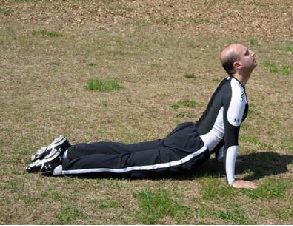
Yoga is designed to bring your body back to balance. Don’t worry, I’m not about to ask you to jump into a Power Yoga class. Not unless you want to, anyway. What I am going to have you do is take about 10 minutes after your practice and use just a few simple yoga postures (illustrated below) to help bring your body back to balance and prevent, or relieve, the back and neck pain that tend to be associated with long term sitting, whether due to working on a computer, sitting in an office, or sitting while practicing guitar. An added benefit is that we will also open up your chest and lungs to improve your breathing pattern and help reduce stress.

Note in the picture above how his back is rounded and his head looking down. Over time, this will contribute to low back pain, neck pain, and hunched, rounded shoulders. His posture is not optimal for breathing either. The effect of rounding the back concaves the chest and compresses the lungs making it difficult to achieve a full, deep breath.
Postures
1. Shoulder bridge
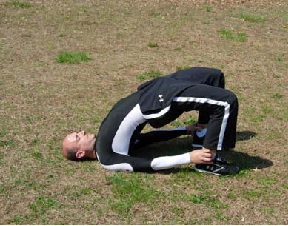
- Lay on your back and bend your knees
- Pull your heels in as close to your butt as possible
- Exhale and lift your hips up, driving with the middle part of your feet
- Squeeze your glutes and lift a little higher
- Exhale and pull your belly to your spine
- Hold for 20 to 30 seconds
- Relax for a few breaths and then do it again
- Bring your knees into your chest and squeeze them tight to release any excess tension
- Straighten out your legs and then move onto the next posture
2. Upward Facing Dog
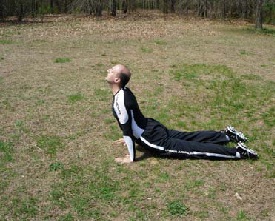
- From the end position of the last posture, laying on your back, roll over onto your stomach
- Lift from the crown of your head and drive with the palm heels
- Make sure your elbow pits are facing forward
- Drop your shoulder down, so they are not up by your ears
- Lift your hips and legs off the ground
- Inhale, expanding the chest, lifting it up at a 45 degree angle
- Hold for 20 to 30 seconds
- Lay down flat on your stomach and rest for a few breaths
- Repeat and then finish by moving into Sleeping Warrior
3. Sleeping Warrior

- From a kneeling position, exhale and pull your belly to your spine.
- Fold your torso forward over your knees and place your forehead on the ground.
- Extend your arms straight out in front of you.
- As you extend and reach with the hands, draw the shoulder blades down so they are not coming out of joint.
- Continue to extend and pull back to stretch and release the tension stored in your shoulders.
- As you inhale, you will find it difficult to expand the abdomen and the chest due to the compression. Try to find the free spaces on the sides and back where you can inhale into and expand slightly.
- As you exhale, again pull belly to spine and contract your core moving deeper into the posture.
What About My Hands?
Although the following are not particularly yoga exercises, they can be of benefit to guitar player’s hands. The repetitive motion of strumming and chord changing can cause problems similar to the repetitive keyboard typing of the desk jockey and thus special attention needs to be paid to the hands, wrists, and fingers.
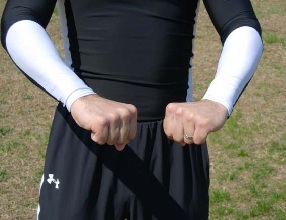
Releasing the Wrists
- Hold both hands in loose fists, make circles clockwise for 5 to 10 reps and counter-clockwise for 5 to 10 reps
- Next, starting with left wrist, hold in fist as above, lift wrist up, to the outside, down, to the inside, reverse direction and repeat with right wrist for 5 to 10 reps each direction
Releasing the Fingers
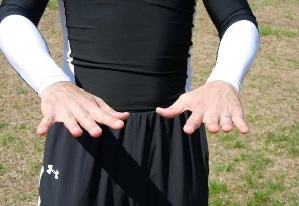
- Begin circling fingers with thumbs (5 times each) then continue with each additional finger
- Circle fingers from pinkies back to the thumbs in the opposite direction
Shaking the Hands
- Shake the hands vigorously keeping them very loose for about 10 to 20 seconds. This has the effect of releasing residual tonus and relaxing the muscles.
The above exercises, if performed consistently, will act as compensation for long periods of sitting and help you to abate any type of chronic muscle tension and pain that comes as a result of your practice. There are, of course, many other yoga postures that can be utilized with the same type of success to help compensate for any type of activity, including inactivity! Hopefully this brief introduction on yoga for guitar players will enable you to practice longer and pain free – shred on!
About the Author: Jon Haas is a NJ based fitness trainer, writer, and martial artist. He can be reached at www.warriorfitness.org